

Imagine walking through a city square and glancing up at a building that looks more like a sculpture than something meant for everyday use — swirling metal, unexpected curves, a façade that catches sunlight like a shimmering wave. You pause. You smile. Maybe you even feel a little joy, wonder, or disorientation. That’s the kind of reaction Gehry often sought. For decades, he didn’t just design buildings — he created emotional experiences.
Frank Gehry passed away on December 5, 2025 at the age of 96, leaving behind a legacy that forever changed how we think about architecture, art, and our built environment.
In this post, I want to take you on a friendly, human journey through Gehry’s world — what made him stand out, why his work keeps inspiring, and what aspiring designers (or just architecture lovers) can learn from him.
Who Was Frank Gehry — A Quick Portrait
- Early life and beginnings: Born in Toronto in 1929 as Frank Owen Goldberg, Gehry moved with his family to Los Angeles at age 17, where he first worked in modest jobs while studying architecture at the University of Southern California.
- From modest roots to bold dreams: His upbringing around hardware stores and building materials gave him a grounding in the everyday — and yet he ended up transforming city skylines with some of the boldest architectural statements of his time.
- Philosophy and style: Gehry refused to be boxed into labels, but his work is often associated with deconstructivism — a departure from clean, modernist lines toward expressive forms, playful shapes, and sculptural surfaces.
Why Frank Gehry’s Buildings Matter — Real-World Impact
Breaking the “Box” of Conventional Architecture
Gone were the days when buildings had to be rigid, rectangular, predictable. Gehry’s structures — from residences to concert halls to museums — often look like art installations.
The “Bilbao Effect” — Architecture as Urban Renewal
One of his most famous works, the Guggenheim Museum Bilbao (Spain), became more than a museum — it transformed a city. With its swirling titanium and stone façade, the building helped redraw Bilbao’s identity and economy, attracting visitors worldwide and revitalizing the region.
Blending Art, Function, and Emotion
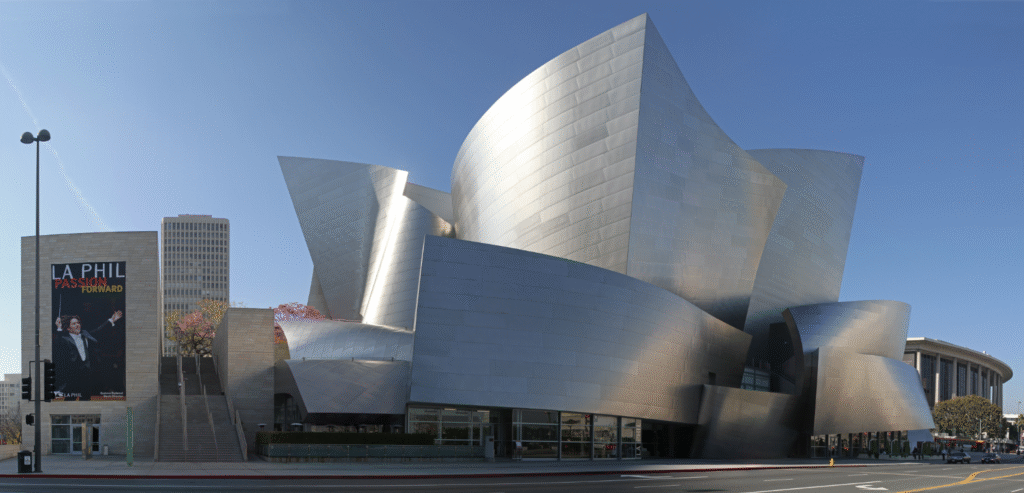
Take the Walt Disney Concert Hall in Los Angeles — a rippling, stainless-steel exterior that captures the light, paired with a warm, wood-lined interior designed for top-notch acoustics and audience comfort. Gehry showed that functional buildings — concert halls, museums, towers — could also stir the soul.
Influencing an Entire Generation
Gehry didn’t limit himself to buildings: he dabbled in furniture, jewelry, even bottle design — proving that his aesthetic vision could translate across scales.
ALSO READ: Remembering Steve Cropper: The Quiet Genius of Soul Guitar

What Aspiring Architects (or Curious Minds) Can Learn — A Simple Guide
1. Start with the Everyday, Then Dream Big
Gehry’s roots in humble materials and hardware shops didn’t stop him from dreaming sculpturally. If you’re designing, begin by understanding basic materials — plywood, metal, concrete — then imagine how you can push them beyond the ordinary.
Tools & Mindset: Basic knowledge of materials, openness to experimentation, and a readiness to question “normal” forms.
2. Embrace Technology — As a Means, Not a Crutch
When curved, whirlwind facades became impractical to model by hand, Gehry adopted advanced design software (notably CATIA, originally developed for aerospace) to translate his visions into buildable reality.
Tip: Use tools like 3D modeling software or CAD — but always with a clear artistic/functional vision. Let software serve your creativity, not limit it.
3. Think of Buildings as Living Experiences
A concert hall is not just space — it’s emotion. A museum is not just walls — it’s narrative. Design for how people feel, move, interact.
Guiding Principle: Ask not just what a building holds — but how it makes people feel.
4. Expect Pushback — And Learn from It
Some of Gehry’s early work (like his own residence in Santa Monica) was controversial — neighbors hated it, critics called it odd. But that’s often part of breaking new ground.
Common Mistakes to Avoid:
- Trying bold forms without understanding materials or structure — ends up unstable or impractical.
- Over-relying on software without a clear design vision — results may feel hollow or derivative.
- Forgetting human scale — a sculpture-like building that’s uncomfortable or unusable fails its purpose.
Examples of Iconic Gehry Works (Worth Googling or Visiting)
- Guggenheim Museum Bilbao, Spain — titanium curves that redefined what a museum could be.
- Walt Disney Concert Hall, Los Angeles — a harmony of steel, sound, and architectural drama.
- Vitra Design Museum, Germany — one of his earlier works that helped bring his sculptural ideas to life in a museum context.
- Personal residences and smaller projects — evidence that bold design doesn’t always require huge budgets.
Why Gehry’s Legacy Still Matters Today
In a world increasingly driven by sameness — cookie-cutter buildings, predictable skyscrapers — Gehry’s work stands as a reminder that architecture can be rebellious, emotional, and deeply human. He showed us that buildings can sing, bend, reflect light, surprise us — and even change a city’s destiny. His passing in 2025 at age 96 marks the end of an era — but his vision lives on.
FAQs — Quick Answers for Curious Readers
Q: Was Frank Gehry only interested in “pretty” buildings?
A: No — while his buildings are visually striking, Gehry was deeply concerned with function, space, light, and human experience. He bridged art and practicality.
Q: Do his radical designs work only for big cities and museums?
A: Not at all. He began with modest houses and small public buildings, proving that even “ordinary” architecture can carry bold vision.
Q: Is digital design essential to achieve Gehry-style architecture?
A: It helps — software like CATIA made possible shapes that were once unbuildable. But the software is a tool. The real magic comes from creative vision, clear purpose, and understanding materials.
Q: If I’m not an architect, can I still learn from Gehry’s approach?
A: Absolutely. His spirit — challenge convention, mix art with function, seek emotional resonance — can influence design thinking in art, interiors, storytelling, and even daily life.
Final Words — Why We Should Remember Gehry
Frank Gehry taught us that architecture isn’t just about walls and roofs. It’s about possibility. It’s about daring to make the ordinary extraordinary. It’s about inviting wonder in places we thought we knew.
Next time you see a building that twists, curves, or gleams — ask yourself: what if this place wasn’t just built, but dreamed?
If you want — I’d love to walk you through 5–10 of Gehry’s most inspiring buildings (with pictures) so you get a vivid sense of his legacy. Just say the word.

Hannah Price is a digital journalist who covers breaking news, global events, and trending stories with accuracy and speed. She has previously contributed to several online magazines and has built a reputation for verifying facts before publishing. Hannah believes in responsible reporting and aims to present stories in a way that readers can trust.