
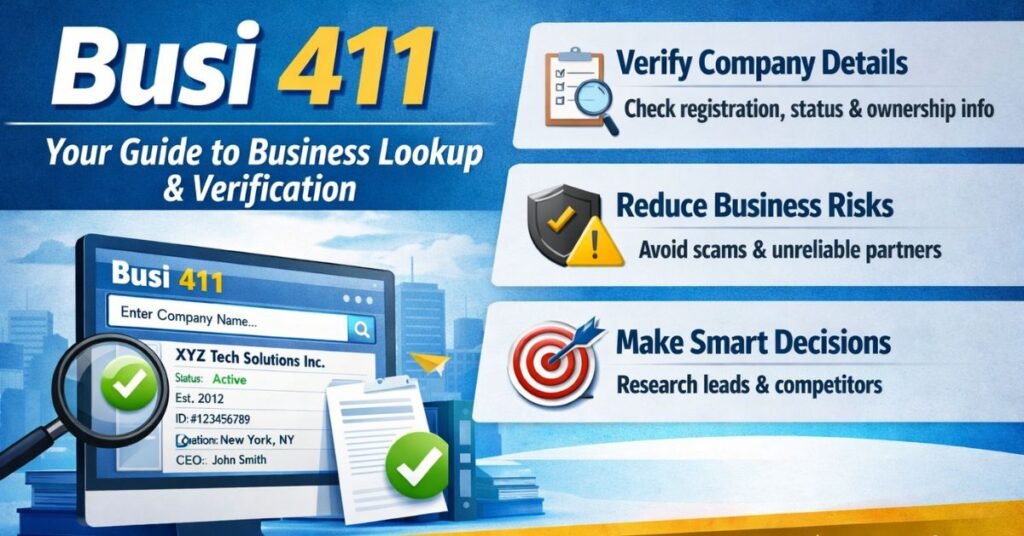
If you’ve recently come across the term busi 411, you’re probably wondering: Is this a business directory? A support line? A research tool? Or something bigger?
You’re not alone.
In today’s fast-moving digital economy, finding accurate business information quickly is a competitive advantage. Whether you’re an entrepreneur validating a lead, a marketer researching prospects, a customer looking for verified contact details, or a startup founder analyzing competitors, access to structured business intelligence can save hours — and sometimes thousands of dollars.
That’s where busi 411 enters the conversation.
In this in-depth guide, I’ll walk you through exactly what busi 411 is, how it works, who it’s best for, how to use it effectively, common mistakes people make, tools to pair it with, and how to turn it into a real business asset instead of just another search attempt.
If you’re serious about smarter business research and more informed decision-making, this guide is for you.
What Is Busi 411? A Clear, Beginner-Friendly Explanation
At its core, busi 411 refers to a business information lookup system or platform that helps users access verified company details quickly. Think of it as a modern evolution of the old 411 directory service — but focused on businesses instead of phone numbers.
Years ago, you’d dial 411 to get a contact number. Today, business research has moved online, and platforms like busi 411 aim to centralize:
- Company names
- Contact details
- Industry classification
- Registration data
- Ownership information
- Public records
- Business status (active, dissolved, etc.)
Imagine you’re trying to verify a supplier. You don’t want to rely solely on their website. You want to confirm:
- Is this company legally registered?
- How long has it been operating?
- Does it exist in public databases?
- Are there red flags?
That’s the problem busi 411 is built to solve.
In practical terms, busi 411 functions as a searchable business intelligence directory. Depending on the specific platform or region, it may pull data from:
- Government business registries
- Commercial data aggregators
- Industry databases
- Public filings
- Corporate records
It’s not just about contact numbers. It’s about credibility and clarity.
Why Busi 411 Matters in Today’s Business Landscape
We live in a world where anyone can launch a website in an hour. That’s powerful — but it also creates risk.
Scams, shell companies, fake vendors, and misrepresented credentials are more common than most people realize. I’ve personally worked with business owners who wired deposits to suppliers without verification — only to discover the company never legally existed.
This is where busi 411 becomes more than a lookup tool. It becomes a risk management asset.
Here’s why it matters:
1. Due Diligence Is No Longer Optional
Before signing contracts, transferring funds, or forming partnerships, verifying business legitimacy is critical. Investors, procurement teams, and financial institutions rely on structured data — not guesswork.
2. Faster Lead Qualification
Sales teams waste countless hours pursuing unqualified leads. A quick busi 411 lookup can confirm whether a business is active, where it’s registered, and what industry it operates in.
3. Competitive Intelligence
Understanding competitors’ registration history, corporate structure, and industry classification can reveal valuable strategic insights.
4. Fraud Prevention
Verifying official records reduces the risk of dealing with impersonators or non-existent entities.
In short, busi 411 is about informed decision-making. And in business, information is leverage.
Who Should Use Busi 411?
Not everyone needs deep corporate intelligence every day — but many professionals benefit from it regularly.
Here are the most common user profiles:
Entrepreneurs & Startup Founders
Before partnering with vendors, investors, or service providers, founders can verify business legitimacy and operational history.
Sales & Marketing Professionals
Need to confirm a company’s legal name for invoicing? Want to check industry classification before pitching? Busi 411 simplifies prospect research.
Investors & Financial Analysts
Verifying incorporation status, historical data, and corporate structure helps reduce financial risk.
Legal & Compliance Teams
For contract verification, litigation checks, and due diligence processes.
Freelancers & Consultants
Even independent professionals can use busi 411 to verify clients before starting large projects.
Consumers
When hiring contractors or service providers, verifying registration details can prevent costly mistakes.
If your work involves business-to-business interactions, busi 411 becomes a strategic tool — not just a directory.
Core Benefits of Using Busi 411
Let’s move beyond theory and talk about tangible benefits.
1. Time Efficiency
Instead of searching multiple databases manually, busi 411 centralizes business information. What used to take 45 minutes can often be done in under 5.
2. Increased Accuracy
When information comes directly from public registries or verified databases, you reduce the risk of relying on outdated or false data.
3. Better Negotiation Power
Knowledge changes dynamics. If you understand a company’s operational timeline, structure, or status, you negotiate from a position of awareness.
4. Risk Reduction
The biggest hidden benefit? Avoiding bad deals.
One avoided fraudulent transaction can justify years of access to business lookup tools.
5. Improved Documentation
Accurate legal names, registration numbers, and corporate details ensure correct contracts and invoices — reducing administrative friction.
How Busi 411 Typically Works
While features vary across platforms, the workflow is usually straightforward.
Here’s what a typical process looks like:
Step 1: Enter Business Name or Identifier
You input:
- Company name
- Registration number
- EIN (where applicable)
- Director or owner name
Step 2: Filter Results
You may filter by:
- Location
- Industry
- Active/inactive status
- Incorporation date
Step 3: Review Business Profile
A typical profile may include:
- Legal entity name
- Registration number
- Formation date
- Registered address
- Business status
- Industry classification
- Directors or officers
- Filing history
Step 4: Export or Save Data
Many platforms allow:
- PDF downloads
- CSV exports
- Reporting tools
- API integration
The interface is often simple — but the implications are powerful.
Step-by-Step Guide: How to Use Busi 411 for Maximum Value
Let’s go deeper into execution.
Step 1: Define Your Objective Clearly
Before you search, ask yourself:
- Am I verifying legitimacy?
- Researching competitors?
- Collecting lead data?
- Checking legal status?
Clarity prevents unnecessary searches.
Step 2: Use Exact Legal Names
Avoid abbreviations when possible. For example:
- Instead of “Tech Solutions,” search “Tech Solutions LLC” if known.
- Include regional identifiers if applicable.
Precision improves results.
Step 3: Cross-Reference When Necessary
For high-stakes decisions, verify information across:
- Government registries
- Tax identification systems
- Corporate filings
Busi 411 should be part of a layered verification strategy.
Step 4: Review Formation Dates
A company formed two weeks ago may present different risk than one operating for 12 years.
Context matters.
Step 5: Analyze Filing Patterns
Frequent status changes or long gaps in filings may indicate instability.
Step 6: Save and Document Findings
For contracts or investment reviews, always document findings with:
- Date of lookup
- Source
- Registration numbers
Documentation protects you later.
Tools, Comparisons & Alternatives to Busi 411
No single tool solves every research problem. Here’s how busi 411 compares to alternatives.
Free Public Registries
Examples include state-level corporate databases.
Pros:
- Free access
- Official government source
Cons:
- Limited search functionality
- No advanced filtering
- Manual data gathering required
Best for occasional lookups.
Paid Business Intelligence Platforms
Examples include commercial data providers and corporate research platforms.
Pros:
- Advanced analytics
- Bulk search capabilities
- API integration
- Export features
Cons:
- Subscription cost
- May require onboarding
Best for sales teams, investors, compliance departments.
Hybrid Approach (Recommended)
Use busi 411 for quick searches.
Cross-check with official registries for high-value transactions.
Leverage advanced platforms for bulk data needs.
This layered strategy balances cost, efficiency, and accuracy.
Common Mistakes When Using Busi 411
Even powerful tools can be misused.
Mistake 1: Relying on One Source Only
Never make major financial decisions based on a single lookup. Always cross-verify.
Mistake 2: Ignoring Status Indicators
“Inactive,” “Dissolved,” or “Suspended” statuses are red flags. Don’t overlook them.
Mistake 3: Confusing Similar Names
Many companies share similar names. Always confirm registration numbers and addresses.
Mistake 4: Not Checking Jurisdiction
A business registered in one state may operate elsewhere. Verify the correct jurisdiction.
Mistake 5: Failing to Document Findings
Without records, verification becomes difficult to prove later.
Avoiding these mistakes turns busi 411 into a precision instrument rather than a superficial search tool.
Advanced Strategies: Turning Busi 411 Into a Competitive Advantage
Now let’s elevate this from basic research to strategic use.
Prospect Scoring
Sales teams can score leads based on:
- Years in operation
- Corporate structure
- Industry category
Older, stable companies may represent higher-value contracts.
Competitor Mapping
Identify:
- Sister companies
- Directors with multiple entities
- Regional expansion patterns
This reveals market positioning strategies.
Partnership Vetting Framework
Before signing partnerships:
- Verify registration
- Confirm filing consistency
- Analyze ownership
- Cross-check litigation records
This reduces legal exposure.
When Should You Not Rely Solely on Busi 411?
Transparency matters.
Busi 411 is not:
- A full credit report
- A legal audit
- A guarantee of financial stability
- A substitute for formal due diligence
For high-value mergers, acquisitions, or investments, professional audits remain essential.
Think of busi 411 as your first filter — not the final verdict.
Real-World Example: A Practical Scenario
Let’s say you’re a digital marketing consultant approached by a new e-commerce brand offering a large retainer.
Before signing:
- You search their company name in busi 411.
- You discover it was registered two weeks ago.
- Filing history is minimal.
- Registered address is residential.
This doesn’t automatically mean it’s fraudulent — but it changes your contract terms.
Maybe you require:
- Upfront payment
- Shorter billing cycles
- Limited initial scope
Information changes risk management.
That’s the power of structured business lookup.
The Future of Business Lookup Systems
As data becomes more interconnected, tools like busi 411 are evolving toward:
- Real-time updates
- API integrations
- AI-driven risk scoring
- Global cross-border search capabilities
In the future, business verification may become automated within CRMs and accounting software.
But the principle remains the same:
Verified information equals smarter decisions.
Conclusion: Why Busi 411 Is More Than a Directory
At first glance, busi 411 might seem like just another business lookup tool.
In reality, it’s a decision-support system.
It helps you:
- Verify legitimacy
- Reduce risk
- Save time
- Improve negotiations
- Strengthen due diligence
- Protect your business
In an economy built on digital interactions, transparency is power.
Whether you’re an entrepreneur, investor, marketer, or consultant, integrating busi 411 into your workflow can transform how confidently you operate.
If you haven’t used structured business verification before, start small. Try it on your next vendor or prospect.
You’ll quickly realize that informed decisions feel different — and perform better.
FAQs
What is busi 411 used for?
Busi 411 is primarily used to look up and verify business registration details, contact information, and company status.
Is busi 411 free?
Availability depends on the specific platform. Some directories are free, while advanced business intelligence tools require paid subscriptions.
Can busi 411 detect scams?
It can help identify red flags such as dissolved status or mismatched registration details, but it is not a fraud detection guarantee.
Is busi 411 accurate?
Accuracy depends on data sources. Many platforms pull from official registries, but cross-verification is recommended.
Can I use busi 411 for international searches?
Some platforms offer cross-border lookup, but coverage varies by region.

Michael Grant is a business writer with professional experience in small-business consulting and online entrepreneurship. Over the past decade, he has helped brands improve their digital strategy, customer engagement, and revenue planning. Michael simplifies business concepts and gives readers practical insights they can use immediately.