Introduction
Have you ever attended an online event that looked great on paper but felt flat the moment it started? Slides droned on, cameras stayed off, engagement dropped after ten minutes, and by the end, nobody remembered what they were supposed to learn. This is exactly the problem that online event pblgamevent was designed to solve.
In a world where virtual workshops, hackathons, bootcamps, and training sessions are now the norm, attention is the rarest resource. Traditional webinar formats simply don’t work anymore. People want interaction, challenge, and relevance. They want to do, not just listen.
That’s where online event pblgamevent comes in. It blends problem-based learning (PBL) with structured online events to create immersive, game-like experiences that keep participants engaged from start to finish. Instead of passively consuming information, attendees collaborate, solve real-world problems, compete (or cooperate), and leave with skills they can actually apply.
In this guide, you’ll learn exactly what an online event pblgamevent is, why it works so well, how to design one step by step, which tools to use, common mistakes to avoid, and how to make your event memorable instead of forgettable. Whether you’re an educator, trainer, community manager, or event organizer, this guide will give you practical, real-world insights you can use immediately.
What Is an Online Event PBLGamevent? A Clear, Beginner-Friendly Explanation
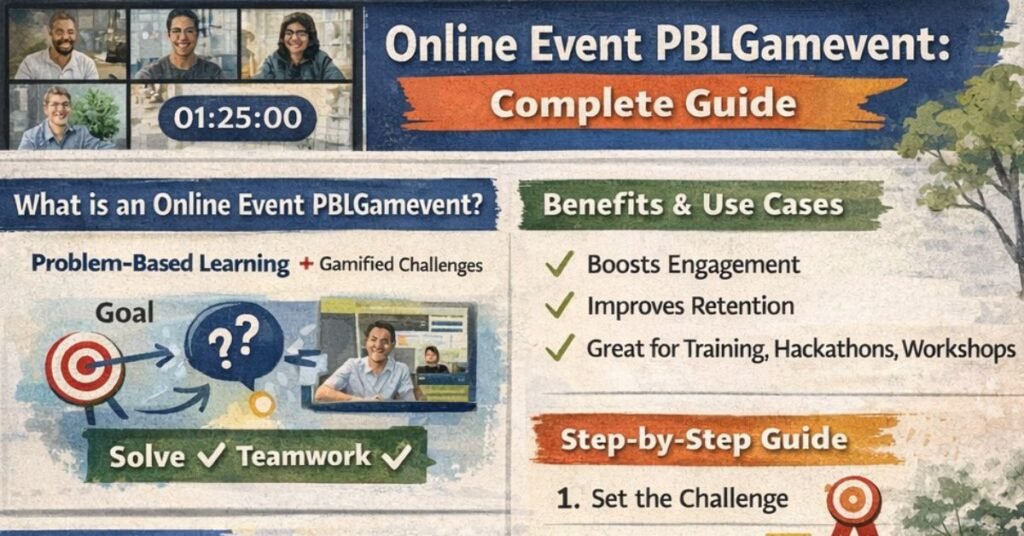
At its core, an online event pblgamevent is a virtual event built around problem-based learning, structured like a game or challenge rather than a lecture. Think of it as the difference between reading about swimming and actually jumping into the pool with an instructor guiding you.
Problem-based learning focuses on presenting participants with a realistic problem and letting them learn by trying to solve it. Instead of starting with theory, you start with a challenge. The learning happens naturally as people ask questions, test ideas, fail, adjust, and try again.
Now add the “gamevent” layer. This includes:
- Clear objectives and rules
- Time-bound challenges or rounds
- Teams or individual roles
- Points, levels, or milestones
- Feedback loops and debriefs
Put together, an online event pblgamevent feels less like a webinar and more like a collaborative mission. For example, instead of teaching cybersecurity concepts via slides, you might run an online event where teams must identify and fix vulnerabilities in a simulated system. Learning becomes a byproduct of participation.
The beauty of this format is its flexibility. Online event pblgamevent can be used for corporate training, university courses, onboarding programs, community events, or even marketing activations. Anywhere you want people to learn deeply and remember what they learned, this approach shines.
Benefits and Use Cases of Online Event PBLGamevent
One of the biggest reasons online event pblgamevent has gained traction is because it solves multiple problems at once. Engagement, retention, collaboration, and practical skill-building all improve dramatically when learning is active.
First, engagement skyrockets. When participants are given a problem to solve and a role to play, they have a reason to stay focused. Cameras turn on, chat becomes lively, and silence disappears. People don’t multitask as much because the event requires their input.
Second, learning retention improves. Research consistently shows that people remember far more from doing than from listening. In an online event pblgamevent, participants apply concepts immediately, which cements understanding and builds confidence.
Third, collaboration becomes natural. Teams must communicate, negotiate, and divide tasks. This mirrors real workplace dynamics, making the experience highly transferable to real-world settings.
Common use cases include:
- Corporate training programs that need measurable skill outcomes
- University courses that struggle with online engagement
- Hackathons and innovation challenges
- Leadership and soft-skills workshops
- Community-building events for tech or creative groups
For example, a startup might host an online event pblgamevent where new hires solve a mock customer problem using the company’s tools. By the end, they understand the product, the workflow, and each other far better than they would through orientation slides.
How to Design an Online Event PBLGamevent Step by Step
Designing a successful online event pblgamevent requires intention. You can’t just gamify a webinar and hope for the best. The structure matters.
Start with a clear learning outcome. Ask yourself what participants should be able to do by the end. This outcome becomes the backbone of your problem scenario. If the goal is to teach project management, the problem might involve rescuing a failing project under time pressure.
Next, design the core problem. It should be realistic, challenging, and slightly uncomfortable but not overwhelming. A good rule of thumb is that participants should feel unsure at first but confident by the end.
Then define the game mechanics:
- How long does the event last?
- Will participants work in teams or solo?
- How is progress measured?
- Are there checkpoints or rounds?
After that, choose the right tools. You’ll typically need:
- A video platform for facilitation
- Collaboration tools for team work
- A shared space for instructions and resources
Finally, plan your facilitation. In an online event pblgamevent, the facilitator acts more like a guide than a lecturer. You observe, ask probing questions, provide hints when needed, and run structured debriefs after each phase.
Best Practices and Tips for High-Impact Execution
Execution is where many online event pblgamevents fail or succeed. One best practice is to over-communicate instructions. In a virtual environment, confusion spreads fast. Clear written instructions, short verbal explanations, and visual cues all help.
Another key tip is pacing. Online attention spans are fragile. Break the event into short, focused segments with clear transitions. Even a 90-minute event should feel like a series of mini-missions rather than one long session.
Debriefing is also critical. Learning crystallizes when participants reflect on what they did, what worked, and what didn’t. Always reserve time for discussion, even if it means shortening the challenge itself.
Finally, test everything. Run a dry session with a small group to catch technical issues, unclear rules, or timing problems. This step alone can dramatically improve participant experience.
Tools, Comparisons, and Recommendations for Online Event PBLGamevent
Choosing the right tools can make or break your online event pblgamevent. The goal is not to use the most tools, but the right combination.
For video and facilitation, platforms like Zoom and Microsoft Teams are reliable. Zoom’s breakout rooms are especially useful for team-based challenges. Teams integrates well with corporate environments but can feel heavier.
For collaboration, tools like Miro, Mural, or FigJam shine. They allow teams to brainstorm, map ideas, and track progress visually. Free versions often work for small events, while paid plans unlock facilitation features.
For task management and resources, Notion and Google Docs are popular. Notion works well for structured event hubs, while Google Docs is fast and familiar.
Free tools are great for pilots and small groups, but paid tools offer stability, analytics, and advanced facilitation options. If you run online event pblgamevents regularly, investing in paid plans usually pays off in smoother delivery and better outcomes.
Common Mistakes in Online Event PBLGamevent and How to Fix Them
One common mistake is overcomplicating the game. Too many rules, points, or tools can overwhelm participants. The fix is to simplify. Focus on one core problem and one main objective.
Another mistake is underestimating facilitation. Leaving participants alone without guidance often leads to frustration. A good facilitator balances freedom with support, stepping in when teams are stuck but not solving the problem for them.
Technical issues are another frequent problem. Poor audio, broken links, or unclear access instructions can derail momentum. Always provide a clear tech checklist and backup options.
Finally, skipping the debrief is a costly error. Without reflection, the event feels fun but shallow. Build in time for discussion, insights, and connection to real-world application.
Conclusion: Why Online Event PBLGamevent Is Worth the Effort
Online learning and events aren’t going away. The question is whether they’ll continue to be forgettable or become transformative. Online event pblgamevent offers a proven path toward deeper engagement, stronger learning outcomes, and more meaningful connections.
By centering your event around real problems, structured challenges, and thoughtful facilitation, you create experiences people remember long after the session ends. It takes more effort than a traditional webinar, but the payoff is enormous.
If you’re ready to elevate your next virtual event, experiment with an online event pblgamevent. Start small, learn from each run, and refine your approach. And if you’ve already tried this format, share your experience or insights in the comments to help others learn from your journey.
FAQs
What is the main goal of an online event pblgamevent?
The main goal is to enable deep, practical learning through active problem-solving rather than passive listening.
How long should an online event pblgamevent last?
Most effective events run between 60 and 180 minutes, depending on complexity and audience.
Do participants need prior experience?
Not necessarily. Well-designed problems scale to different skill levels with proper facilitation.
Is online event pblgamevent suitable for large groups?
Yes, but it requires strong facilitation, clear structure, and reliable breakout tools.
Can online event pblgamevent be used for marketing events?
Absolutely. Many brands use it to demonstrate value and build trust through experience.

Michael Grant is a business writer with professional experience in small-business consulting and online entrepreneurship. Over the past decade, he has helped brands improve their digital strategy, customer engagement, and revenue planning. Michael simplifies business concepts and gives readers practical insights they can use immediately.