
Introduction
A few months ago, I opened a blog post that had everything it should have had. Clean structure. Perfect grammar. Keywords placed like clockwork. And yet, halfway through, I realized something unsettling: I felt nothing. No curiosity. No resistance. No sense that a real human was on the other side of the screen. It was technically “good,” but it was hollow.
That moment captures exactly why we shoudlnt let ai write for us.
This isn’t an anti-technology rant, and it’s not a fear-based argument about machines taking over creative work. It’s a grounded, experience-driven conversation about authorship, thinking, trust, and long-term value—especially in a world flooded with instant content.
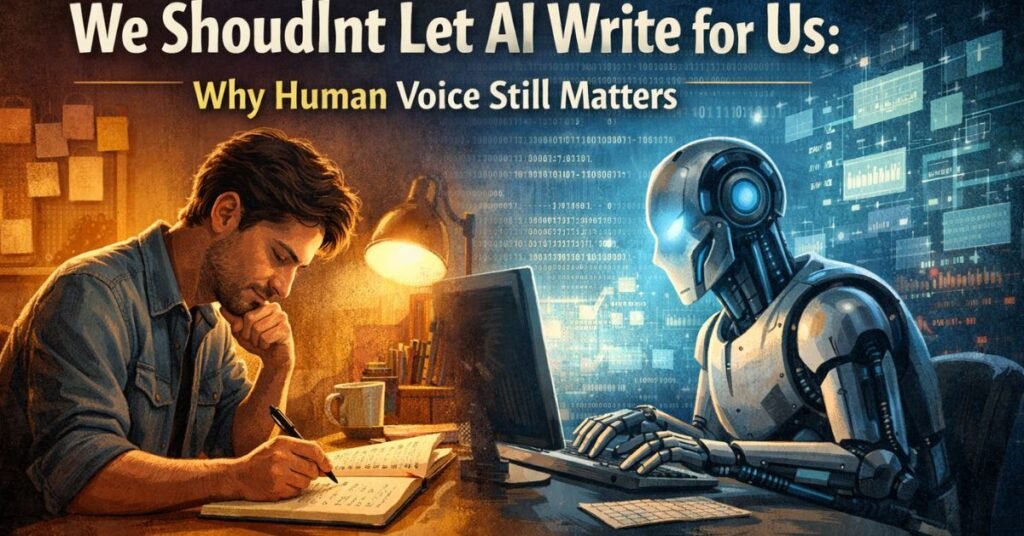
Writing is not just about producing words. It’s how we think in public. It’s how we test ideas, clarify beliefs, and build credibility over time. When we hand that process entirely to AI, we don’t just outsource labor—we outsource thinking.
In this guide, we’ll unpack what this keyword really means, why it matters more now than ever, and how writers, marketers, founders, students, and creators can use AI without letting it replace their voice. You’ll get real examples, practical frameworks, step-by-step guidance, and honest tool comparisons—no hype, no scare tactics.
If you care about originality, authority, and being taken seriously in the long run, this is a conversation worth having.
Topic Explanation: What “We Shoudlnt Let AI Write for Us” Really Means

When people hear the phrase we shoudlnt let ai write for us, they often imagine an extreme position: banning AI tools, rejecting automation, or clinging to outdated workflows. That’s not what this idea is about.
At its core, this keyword is about agency.
Think of writing like cooking. A food processor can chop vegetables faster than your hands ever could. A recipe generator can suggest flavor combinations. But if you let a machine choose the ingredients, cook the meal, and plate it without your involvement, you’re no longer a cook—you’re just reheating something.
AI writing tools work the same way. They predict text based on patterns in existing data. They don’t understand what they’re saying. They don’t have lived experience, personal stakes, or original insight. When we let AI fully write for us, we’re publishing probability, not perspective.
This matters because readers can feel the difference, even if they can’t articulate it. Human writing has:
- Friction: moments of uncertainty, nuance, and exploration
- Memory: references to lived experiences and specific contexts
- Judgment: choosing what not to say as much as what to include
AI-generated writing, by contrast, tends to flatten ideas. It averages opinions. It sounds confident without being accountable. Over time, this leads to content that is technically correct but strategically weak.
So when we say we shoudlnt let ai write for us, what we really mean is:
- AI should assist thinking, not replace it
- Humans should remain the final decision-makers
- Writing should reflect responsibility, not automation
This distinction becomes critical when trust, expertise, and authority are on the line.
Why This Topic Matters More Than Ever Right Now
Ten years ago, the biggest challenge for writers was getting published. Five years ago, it was getting traffic. Today, the challenge is being believed.
Search engines are saturated. Social feeds are flooded. Thousands of articles are published every minute, many of them generated or heavily assisted by AI. In that environment, sameness is the enemy.
Audiences are getting better at detecting when content lacks depth. Editors are raising standards. Platforms are quietly adjusting algorithms to reward originality, firsthand experience, and genuine insight. This is where the principle behind we shoudlnt let ai write for us becomes practical, not philosophical.
From a credibility standpoint, over-reliance on AI creates several risks:
- Your content sounds like everyone else’s
- Your brand voice becomes generic and interchangeable
- You struggle to defend or explain what you’ve published
From a cognitive standpoint, it’s even more concerning. Writing is one of the most powerful tools for thinking clearly. When AI does the drafting, humans often skip the hardest part—the part where ideas are formed, challenged, and refined.
This matters for:
- Founders explaining their vision
- Professionals building authority in their field
- Students developing critical thinking
- Marketers trying to differentiate brands
In all of these cases, letting AI write for you might save time today but cost you trust tomorrow.
Benefits & Use Cases: Who This Approach Is Best For (And Why)
Understanding why we shoudlnt let ai write for us doesn’t mean rejecting AI entirely. In fact, this mindset often leads to better use of AI—more strategic, more ethical, and more effective.
Writers and Bloggers
For writers, the biggest benefit is preserving voice. Your voice is your moat. It’s the reason readers come back. When you use AI as a brainstorming partner instead of a ghostwriter, you maintain:
- Consistency in tone
- Emotional resonance
- A recognizable style
AI can help outline ideas or challenge assumptions, but the final narrative should come from you.
Businesses and Brands
Brands live or die by trust. Letting AI fully write your content risks publishing statements that don’t align with your values or experience. When humans stay in control, AI becomes a productivity multiplier rather than a liability.
Use cases include:
- Drafting internal notes faster
- Generating rough outlines for campaigns
- Rewriting for clarity after human intent is defined
Educators and Students
Learning happens in the struggle. When students let AI write essays end-to-end, they miss the mental reps that build understanding. Used correctly, AI can:
- Explain complex concepts
- Suggest alternative viewpoints
- Help refine arguments
But the thinking must remain human.
Thought Leaders and Experts
If you’re positioning yourself as an authority, your credibility depends on originality and accountability. AI can’t replace firsthand experience. It can’t stand behind claims. Keeping authorship human protects your reputation.
Step-by-Step Guide: How to Use AI Without Letting It Write for You
This is where theory becomes practice. The goal isn’t to avoid AI—it’s to reframe how you use it.
Step 1: Start With a Human-Only Draft (Even If It’s Messy)
Before opening any AI tool, write your raw thoughts. Bullet points are fine. Rambling is fine. What matters is that the core ideas come from you.
Ask yourself:
- What do I actually believe about this topic?
- What experiences shape my opinion?
- What do I disagree with in common narratives?
This creates an anchor that AI can’t overwrite.
Step 2: Use AI as a Question Generator, Not an Answer Machine
Instead of asking AI to “write an article,” ask it to challenge you:
- What am I missing here?
- What counterarguments exist?
- Where might readers get confused?
This keeps you in control while expanding your thinking.
Step 3: Let AI Help With Structure, Not Substance
AI is excellent at organizing information. Use it to:
- Suggest outlines
- Improve flow between sections
- Identify redundancies
But keep the examples, opinions, and conclusions yours.
Step 4: Rewrite in Your Own Voice (Out Loud Helps)
One practical trick: read your draft out loud. If it doesn’t sound like something you’d say to a colleague, rewrite it. This is often where AI-written text reveals itself.
Step 5: Take Responsibility for Every Word Published
If you wouldn’t defend a sentence in public, don’t publish it. This mindset alone ensures that AI remains a tool, not an author.
Tools, Comparisons & Recommendations (Used the Right Way)
AI tools are not the enemy. Misuse is.
Free Tools
Free AI writing tools are useful for:
- Brainstorming headlines
- Generating lists of questions
- Simplifying complex explanations
Pros:
- No cost barrier
- Fast ideation
Cons:
- Generic outputs
- Limited customization
- High risk of sameness
Paid Tools
Paid tools offer more control, better context handling, and longer memory. They’re best used when:
- You already have a strong draft
- You want stylistic suggestions
- You need editing help, not authorship
Pros:
- Better quality suggestions
- Custom prompts and tone control
Cons:
- Can encourage over-reliance
- Still require human judgment
The Golden Rule
If a tool makes decisions for you, be cautious. If it helps you make better decisions yourself, it’s likely being used correctly.
Common Mistakes & Fixes
Even well-intentioned users fall into traps. Here are the most common ones—and how to fix them.
Mistake 1: Publishing First Draft AI Output
Why it happens: Speed pressure.
Fix: Treat AI output as a rough note, not a finished product. Always revise manually.
Mistake 2: Letting AI Define the Angle
Why it happens: Convenience.
Fix: Decide your thesis before opening the tool. Never outsource the “why.”
Mistake 3: Ignoring Lived Experience
Why it happens: AI sounds confident.
Fix: Add specific examples only you could know—projects, failures, lessons learned.
Mistake 4: Assuming Readers Don’t Notice
Why it happens: Overestimating automation.
Fix: Remember that trust is intuitive. Readers may not say “this is AI,” but they will disengage.
The Long-Term Consequences of Letting AI Write for Us
Short-term gains can hide long-term losses.
If we normalize AI as the primary author:
- Writing skills atrophy
- Original thinking declines
- Authority becomes performative
Over time, the internet fills with content that references itself, creating an echo chamber of recycled ideas. The writers who stand out will be the ones who kept their hands on the keyboard and their minds engaged.
This is why the statement we shoudlnt let ai write for us is ultimately about preserving thinking, not resisting technology.
Conclusion: Keep the Pen, Use the Tool
AI is here to stay. That’s not the question. The question is who remains responsible for ideas, opinions, and meaning.
When you write, you’re not just filling space on a page. You’re making a claim about how the world works. That deserves intention.
Use AI to explore, to question, to refine—but don’t let it replace your voice. The writers, creators, and professionals who thrive in the next decade will be those who embrace tools without surrendering authorship.
If this perspective resonated with you, share your thoughts, challenge the idea, or experiment with the framework above. Writing, after all, is a conversation.
FAQs
Why do people say we shoudlnt let ai write for us?
Because writing is a thinking process, not just a production task. Letting AI fully write removes human judgment and accountability.
Is it bad to use AI for writing at all?
No. It’s about how you use it. AI should assist, not replace, human authorship.
Can AI-written content rank in search engines?
Sometimes, yes. But long-term authority, trust, and differentiation come from human insight.
How can I tell if I’m overusing AI?
If you can’t explain or defend what you’ve published without rereading it, you’re likely over-relying on AI.
What’s the safest way to use AI as a writer?
Use it for brainstorming, editing, and structure—never for core ideas or conclusions.

Michael Grant is a business writer with professional experience in small-business consulting and online entrepreneurship. Over the past decade, he has helped brands improve their digital strategy, customer engagement, and revenue planning. Michael simplifies business concepts and gives readers practical insights they can use immediately.