
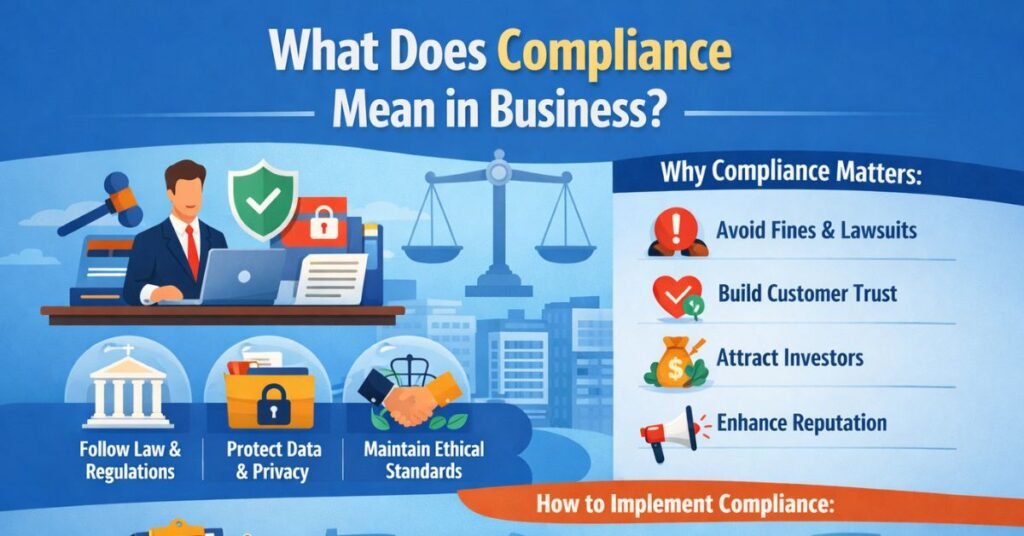
If you’ve ever signed a contract, hired an employee, handled customer data, or filed taxes, you’ve already brushed up against a powerful concept — even if you didn’t realize it at the time. So, what does compliance mean in business?
At its core, compliance means following the laws, regulations, standards, and ethical practices that apply to your organization. But in the real world, it’s much bigger than “following rules.” It’s about protecting your company, earning trust, preventing disasters, and building something sustainable.
I’ve worked with startups scrambling after a regulatory warning, mid-sized companies rebuilding after data breaches, and large organizations navigating complex international laws. One thing is always true: compliance isn’t optional. It’s infrastructure.
In this in-depth guide, we’ll break down:
- What compliance really means in business (in plain English)
- The different types of compliance every company should understand
- Why compliance is a competitive advantage — not just a cost
- A step-by-step guide to building a compliance framework
- Tools and systems that make compliance manageable
- The most common mistakes businesses make (and how to fix them)
- FAQs that clarify the confusion around compliance
Let’s start at the beginning.
What Does Compliance Mean in Business? A Clear, Beginner-Friendly Explanation
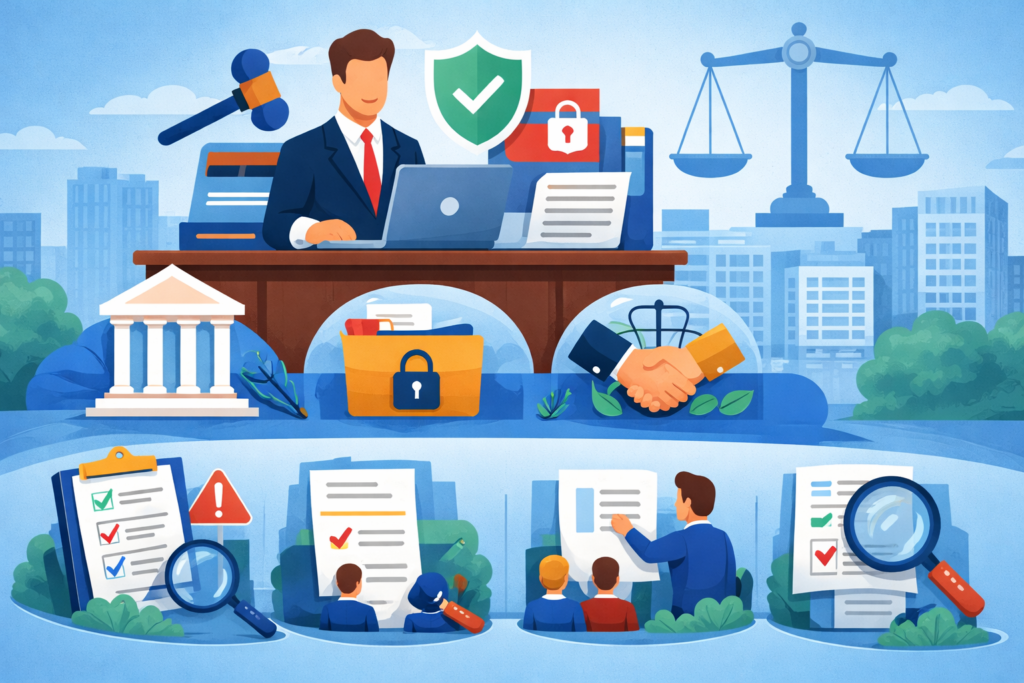
If you’re looking for a quick, featured-snippet-ready definition:
Business compliance means ensuring that a company follows all applicable laws, regulations, industry standards, and internal policies relevant to its operations.
That sounds simple. But let’s unpack it.
Imagine running a restaurant. You need to:
- Follow food safety regulations
- Pay employees according to labor laws
- Report income correctly for tax purposes
- Maintain fire safety standards
- Handle customer data responsibly
If you fail in any of these areas, you risk:
- Fines
- Lawsuits
- License revocation
- Reputation damage
- Even criminal charges in severe cases
Compliance is the system that prevents those risks.
Now scale that to:
- A fintech startup handling financial data
- An eCommerce store processing global payments
- A SaaS company collecting user analytics
- A manufacturing business dealing with environmental laws
Compliance becomes layered and complex.
At its heart, compliance in business is about three things:
- Legal alignment – Following laws and government regulations
- Ethical standards – Acting responsibly beyond minimum legal requirements
- Risk management – Preventing financial, operational, and reputational damage
It’s not just about avoiding punishment. It’s about building a resilient organization.
The Different Types of Business Compliance You Need to Know
When people ask what compliance means in business, they often assume it’s one thing. It’s not. It’s a collection of responsibilities across multiple domains.
Let’s explore the most important categories.
Regulatory Compliance
This refers to complying with government laws and regulations at local, national, and international levels.
Examples include:
- Tax laws
- Labor laws
- Environmental regulations
- Industry-specific financial rules
- Consumer protection laws
For example, a company operating in the European Union must follow the General Data Protection Regulation (GDPR) when handling customer data. Failing to comply can result in massive fines.
Regulatory compliance is non-negotiable. These rules are enforced by authorities.
Corporate Compliance
Corporate compliance focuses on internal governance — how a company structures itself and operates ethically.
This includes:
- Board governance rules
- Conflict-of-interest policies
- Anti-bribery policies
- Whistleblower protections
- Code of conduct guidelines
It’s about maintaining integrity within leadership and management.
Large public companies often formalize this through dedicated compliance officers and ethics committees.
Data and Privacy Compliance
In today’s digital economy, this category is exploding in importance.
Businesses must protect:
- Customer data
- Employee data
- Payment information
- Sensitive internal data
For example, companies in the United States handling health data must comply with Health Insurance Portability and Accountability Act (HIPAA).
Failure here doesn’t just mean fines. It means broken trust — and that can be fatal for a brand.
Financial Compliance
This involves adhering to financial reporting standards, anti-money laundering (AML) laws, and auditing requirements.
Public companies must comply with the Sarbanes–Oxley Act (SOX), which was created after major corporate scandals.
Financial compliance ensures:
- Accurate reporting
- Fraud prevention
- Transparent investor communication
Industry-Specific Compliance
Certain industries have unique compliance frameworks:
- Banking
- Healthcare
- Education
- Energy
- Aviation
- Cryptocurrency
For example, companies listed on the New York Stock Exchange must meet strict governance and reporting standards.
Compliance isn’t one-size-fits-all. It depends heavily on your industry and location.
Why Compliance Matters More Than You Think
Many founders treat compliance as a checkbox. Something to “deal with later.”
That’s a mistake.
Here’s why compliance in business matters deeply:
1. It Protects You From Financial Disaster
Fines can be enormous. GDPR violations can cost millions. Regulatory penalties can wipe out startup capital.
A single compliance failure can cost more than years of preventative investment.
2. It Builds Customer Trust
Consumers are increasingly aware of data protection, ethical sourcing, and corporate responsibility.
When customers know you:
- Protect their data
- Follow fair labor practices
- Operate transparently
They trust you more.
Trust converts.
3. It Attracts Investors
Investors conduct due diligence. If your compliance is weak:
- Funding rounds stall
- Valuations drop
- Legal exposure scares capital away
Strong compliance signals maturity and stability.
4. It Prevents Operational Chaos
Without compliance processes:
- Documentation becomes inconsistent
- Policies are unclear
- Employees make risky decisions unknowingly
Compliance frameworks create structure.
5. It Strengthens Your Brand Reputation
Reputation damage spreads faster than ever in the digital era. Compliance failures become headlines overnight.
A compliant company is a credible company.
Real-World Use Cases: How Compliance Plays Out in Business
Let’s make this practical.
Startup Scenario: SaaS Company Collecting User Data
A SaaS startup collects email addresses, IP logs, and behavioral data.
Compliance actions needed:
- Clear privacy policy
- Cookie consent banner
- Data retention policies
- Secure encryption
- Data breach response plan
Without these, regulatory risk skyrockets.
eCommerce Business Expanding Internationally
Selling to Europe? GDPR applies.
Selling to California? Consumer privacy laws apply.
Expanding internationally multiplies compliance complexity.
Manufacturing Business
Needs:
- Environmental compliance
- Worker safety compliance
- Supply chain audits
- Hazardous material regulations
Non-compliance could shut down operations.
Compliance isn’t theoretical. It affects daily decisions.
Step-by-Step Guide: How to Build a Compliance Framework in Your Business
If you’re wondering how to implement compliance practically, here’s a structured approach.
Step 1: Identify Applicable Laws and Regulations
Start by asking:
- What industry am I in?
- Where do I operate?
- Where are my customers located?
- What type of data do I collect?
- Do I handle payments or financial transactions?
Consult:
- Government websites
- Legal advisors
- Industry associations
Create a compliance checklist specific to your business.
Step 2: Conduct a Risk Assessment
Identify where your biggest compliance risks exist:
- Data handling
- Financial reporting
- Employment contracts
- Vendor agreements
- Cybersecurity
Rate risks by:
- Likelihood
- Financial impact
- Legal exposure
- Reputational damage
Focus first on high-risk areas.
Step 3: Develop Written Policies
Policies are your internal compliance blueprint.
Examples include:
- Code of conduct
- Data protection policy
- Anti-harassment policy
- Financial reporting standards
- Vendor compliance guidelines
Policies must be:
- Clear
- Accessible
- Regularly updated
- Acknowledged by employees
Step 4: Train Employees
Most compliance failures happen because employees don’t understand rules.
Training should include:
- Data privacy awareness
- Anti-bribery rules
- Cybersecurity hygiene
- Reporting mechanisms
Training isn’t a one-time event. It’s ongoing.
Step 5: Implement Monitoring and Auditing
You can’t manage what you don’t measure.
Create systems for:
- Internal audits
- Policy reviews
- Access controls
- Documentation tracking
- Incident reporting
Regular audits reduce surprises.
Step 6: Create a Response Plan
Despite best efforts, incidents happen.
You need:
- A data breach response plan
- A regulatory notification process
- Legal counsel contact procedures
- PR crisis management protocol
Preparation reduces panic.
Step 7: Review and Update Continuously
Regulations change.
Technology evolves.
Markets expand.
Compliance must evolve with them.
Schedule annual or biannual reviews of your compliance program.
Tools, Comparisons & Recommendations for Managing Compliance
Managing compliance manually becomes overwhelming as businesses grow.
Here are practical tools and categories.
Governance, Risk & Compliance (GRC) Software
GRC platforms help centralize compliance efforts.
Popular options include:
- LogicGate
- MetricStream
- NAVEX
- Compliance 360
Pros:
- Centralized documentation
- Automated risk tracking
- Audit-ready reporting
Cons:
- Expensive
- May require training
- Overkill for small startups
Best for: Mid-size to enterprise organizations.
Compliance Management for Small Businesses
Smaller companies often rely on:
- Legal counsel (on retainer)
- HR software with compliance modules
- Accounting platforms with tax automation
- Cybersecurity services
Affordable options:
- Outsourced compliance consultants
- Fractional compliance officers
- Industry association templates
Free vs Paid Approach:
Free:
- Government resources
- DIY policy templates
- Basic training
Paid:
- Legal advice
- GRC software
- Audit services
- Compliance certifications
Expert insight: Start lean but professionalize early. Compliance debt compounds.
Common Compliance Mistakes (And How to Fix Them)
After years of observing businesses struggle with compliance, certain patterns repeat.
Mistake 1: Treating Compliance as a One-Time Task
Fix:
Schedule recurring audits and reviews.
Mistake 2: Copy-Pasting Generic Policies
Fix:
Customize policies to your actual operations.
Mistake 3: Ignoring Data Security
Fix:
Invest in encryption, access controls, and cybersecurity training.
Mistake 4: Poor Documentation
Fix:
Keep organized, timestamped records of policies, training, and audits.
Mistake 5: No Reporting Mechanism
Fix:
Implement anonymous whistleblower systems and clear reporting channels.
Mistake 6: Leadership Indifference
Compliance culture starts at the top. If leadership cuts corners, employees will too.
Fix:
Embed compliance into company values.
Compliance vs. Ethics: Are They the Same?
Not exactly.
Compliance = following laws and rules.
Ethics = doing what’s right, even beyond legal requirements.
A company can be legally compliant but ethically questionable.
The strongest organizations integrate both.
Think of compliance as the floor. Ethics is the ceiling.
The Future of Compliance in Business
Compliance is becoming more:
- Technology-driven
- Automated
- Data-centric
- Global
AI tools now monitor transactions, detect fraud, and flag risk patterns.
Cross-border operations mean multi-jurisdictional compliance.
Data privacy regulations are expanding globally.
Businesses that build compliance into their foundation — not as an afterthought — will thrive.
Conclusion: Compliance Is a Growth Strategy, Not Just a Legal Obligation
So, what does compliance mean in business?
It means protecting your company, earning trust, reducing risk, and building a foundation for long-term growth.
It’s not just about avoiding fines.
It’s about:
- Trust
- Stability
- Credibility
- Sustainability
Whether you’re running a startup from your living room or scaling internationally, compliance is part of professional business infrastructure.
Invest in it early.
Maintain it consistently.
Treat it as a strategic asset.
And if you found this guide helpful, consider reviewing your current compliance processes today. You might discover opportunities to strengthen your foundation.
FAQs
What does compliance mean in business in simple terms?
It means following the laws, regulations, and internal policies that apply to your company’s operations.
What is regulatory compliance?
Regulatory compliance refers to following laws set by government authorities relevant to your industry and location.
What is the difference between compliance and risk management?
Compliance ensures adherence to laws and policies. Risk management identifies and mitigates potential threats. They overlap but are not identical.
Who is responsible for compliance in a company?
Ultimately, leadership is responsible. Larger organizations appoint compliance officers or compliance departments.

Michael Grant is a business writer with professional experience in small-business consulting and online entrepreneurship. Over the past decade, he has helped brands improve their digital strategy, customer engagement, and revenue planning. Michael simplifies business concepts and gives readers practical insights they can use immediately.