
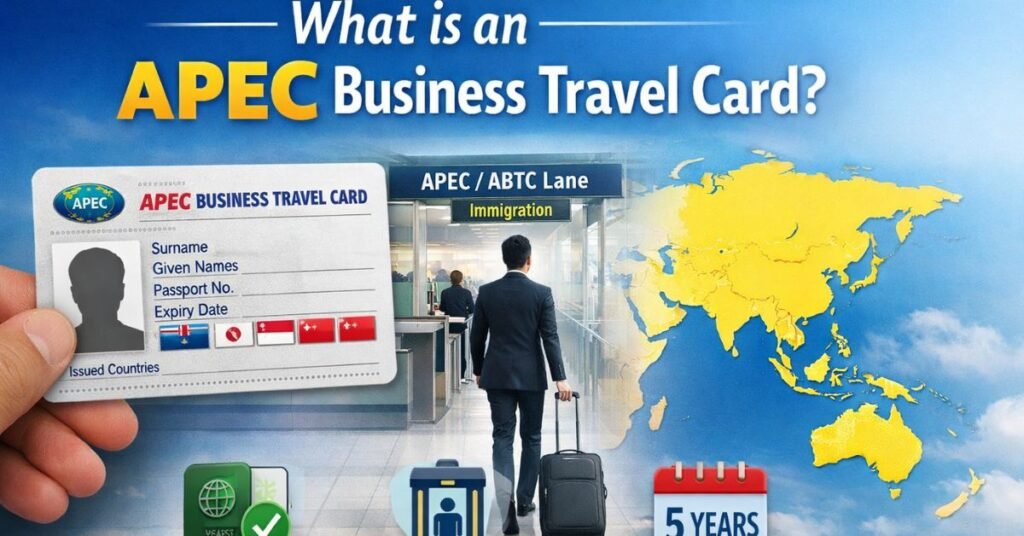
International business travel can feel like a marathon of visa forms, immigration lines, and bureaucratic red tape. If you’ve ever rushed through an airport hoping your visa paperwork checks out—or spent hours filling out applications just to attend a two-day meeting—you know how exhausting the process can be.
That’s exactly where the APEC Business Travel Card (ABTC) comes in.
If you’re wondering what is a APEC business travel card, the short answer is this: it’s a special travel document designed to help business professionals move faster and more easily between participating Asia-Pacific economies without applying for separate visas every time they travel.
But the real story goes much deeper.
The ABTC isn’t just a convenience—it’s a strategic tool used by executives, entrepreneurs, and trade professionals who regularly conduct business across the Asia-Pacific region. For many travelers, it eliminates visa hassles entirely, speeds up airport processing, and unlocks dedicated immigration lanes that can turn a two-hour wait into a five-minute formality.
In this comprehensive guide, we’ll unpack everything you need to know about the program, including:
- What the APEC Business Travel Card actually is
- How it works in practice
- Which countries participate
- Who qualifies and how to apply
- The real benefits for business travelers
- Step-by-step application guidance
- Common mistakes applicants make
- Tools, tips, and practical travel insights
Whether you’re a startup founder expanding into Asia, a corporate executive attending regional conferences, or a consultant frequently flying between Pacific economies, understanding the APEC Business Travel Card system could significantly simplify your travel routine.
Let’s dive in.
What Is a APEC Business Travel Card?

At its core, the APEC Business Travel Card (ABTC) is a travel document that provides streamlined entry into participating economies within the Asia-Pacific Economic Cooperation (APEC) region.
Think of it as a pre-approved visa system for frequent business travelers.
Instead of applying for individual visas for each country every time you travel, ABTC holders can enter multiple participating economies using a single card.
The card is issued by a traveler’s home economy and recognized by other participating economies that grant pre-clearance.
Key Definition
The APEC Business Travel Card is a government-issued credential that allows approved business travelers to:
- Enter participating APEC economies without applying for separate visas
- Use fast-track immigration lanes
- Make multiple short business visits over several years
Most ABTCs are valid for five years.
The Problem the Card Solves

Before the ABTC program existed, business travelers faced several challenges:
- Multiple visa applications
- Embassy appointments
- Processing delays
- Expensive visa fees
- Last-minute travel disruptions
Imagine a supply chain manager needing to visit Japan, Singapore, South Korea, and Australia in the same quarter. Traditionally, that might require four separate visas.
The ABTC simplifies this process dramatically.
Who Created the Program?
The program was launched by the Asia-Pacific Economic Cooperation (APEC) forum, an international organization focused on promoting economic cooperation and trade across the Asia-Pacific region.
The goal was simple:
Make cross-border business travel easier so trade and investment can grow faster.
Today, the program is widely used by:
- Executives
- Exporters
- Investors
- Entrepreneurs
- Trade professionals
- Government officials involved in commerce
And for frequent travelers in the region, the card can be a genuine game-changer.
Understanding the APEC Region and Participating Economies
To fully understand what is a APEC business travel card, it helps to know the geographic and economic network behind it.
APEC includes 21 member economies spanning Asia, Oceania, and the Americas.
These economies represent some of the most powerful trade markets in the world.
APEC Member Economies
Participating economies include:
- Australia
- Brunei
- Canada
- Chile
- China
- Hong Kong
- Indonesia
- Japan
- South Korea
- Malaysia
- Mexico
- New Zealand
- Papua New Guinea
- Peru
- Philippines
- Russia
- Singapore
- Taiwan (Chinese Taipei)
- Thailand
- United States
- Vietnam
Together, these economies account for roughly half of global trade.
Important Distinction: Full vs Transitional Members
Not all economies participate in the ABTC program the same way.
Some economies offer full visa-free entry through the card, while others only provide fast-track immigration lanes.
For example:
Transitional members typically include:
- United States
- Canada
In these cases, travelers may still need visas but gain access to expedited airport processing.
Why This Network Matters
The Asia-Pacific region is one of the fastest-growing economic areas in the world.
Businesses frequently operate across multiple countries in the region, especially in sectors such as:
- Manufacturing
- Technology
- Logistics
- Finance
- International trade
The ABTC program supports this ecosystem by reducing administrative barriers to travel.
How the APEC Business Travel Card Works
Now that we’ve defined what is a APEC business travel card, let’s look at how it actually functions in real travel scenarios.
The ABTC operates through a pre-clearance system between governments.
Here’s the basic idea:
When you apply for the card, your home economy shares your application with other participating economies.
Each economy reviews the request and decides whether to approve you for entry.
What Happens After Approval
Once approved:
- Your card lists the economies you are cleared to enter
- You can travel for short business visits
- You typically don’t need to apply for additional visas
Most business visits allowed under the card are up to 60 or 90 days, depending on the destination economy.
What the Card Looks Like
The ABTC resembles a government ID card.
It typically includes:
- Your name
- Passport number
- Photo
- Expiry date
- Approved economies printed on the back
Some economies now issue virtual ABTC cards through mobile apps, making the process even more convenient.
Using the Card at the Airport
Here’s a typical airport scenario:
- You arrive in a participating APEC economy.
- Instead of joining the standard immigration line, you enter the APEC lane.
- You present:
- Your passport
- Your ABTC
The immigration officer verifies the card and grants entry quickly.
For frequent business travelers, this can save hours every year.
Benefits of the APEC Business Travel Card
For professionals doing business across the Asia-Pacific region, the APEC Business Travel Card offers an impressive range of advantages.
It’s not just about skipping visa applications—it’s about transforming the entire travel experience.
Let’s explore the biggest benefits.
1. Visa-Free Business Travel
The most obvious benefit is visa exemption.
Instead of applying for visas every time you travel, the ABTC allows multiple entries into approved economies.
This is particularly valuable for people who travel frequently for:
- Trade negotiations
- Conferences
- Corporate meetings
- Supply chain management
- Investment visits
You can often arrange trips at the last minute without worrying about visa delays.
2. Fast-Track Immigration Processing
Many airports offer APEC priority lanes.
These lanes significantly reduce wait times.
During busy travel periods, standard immigration queues can take 45–90 minutes.
With an ABTC, travelers often pass through in just a few minutes.
3. Multi-Year Validity
Most cards are valid for five years, allowing frequent travelers to move across the region with minimal paperwork.
That long validity period makes it a cost-effective solution for businesses with regional operations.
4. Lower Travel Administration Costs
Companies save money by avoiding:
- Repeated visa fees
- Courier services
- Embassy appointments
- Administrative labor
For companies with global travel teams, the savings can be substantial.
5. Greater Flexibility for Business Trips
Unexpected meetings or opportunities happen all the time.
The ABTC allows travelers to respond quickly.
For example:
A supplier invites you to visit a manufacturing facility in Vietnam next week.
Without the ABTC, you might miss the opportunity due to visa delays.
With the card, you can simply book a flight.
Who Should Apply for an APEC Business Travel Card?
The ABTC is specifically designed for business travelers, not tourists.
So who actually qualifies?
Generally, the program targets professionals who regularly engage in cross-border commercial activity.
Typical Applicants Include
- Corporate executives
- Entrepreneurs
- Exporters
- Importers
- Investors
- Trade delegates
- Senior managers
- Startup founders expanding internationally
Many applicants are involved in industries like:
- Manufacturing
- Technology
- Finance
- International logistics
- Consulting
- Government trade departments
Basic Eligibility Requirements
Requirements vary by economy, but most applicants must:
- Hold a valid passport from a participating economy
- Demonstrate a legitimate need for frequent business travel
- Have no serious criminal history
- Provide documentation from their employer or business
Some economies require additional verification through chambers of commerce or trade organizations.
Who Cannot Use the Card
The ABTC is not designed for tourism or casual travel.
It generally cannot be used for:
- Working abroad
- Long-term stays
- Immigration purposes
It’s strictly intended for short business visits.
Step-by-Step Guide: How to Apply for an APEC Business Travel Card
Applying for an ABTC involves several steps, but the process is generally straightforward.
Here’s a practical breakdown of how it typically works.
Step 1: Confirm Eligibility
Before starting the application, confirm that:
- Your country participates in the ABTC program
- You qualify as a business traveler
- Your passport is valid for several years
Many government immigration websites provide eligibility checklists.
Step 2: Gather Required Documents
Typical documents include:
- Passport copy
- Passport photo
- Employer letter confirming business travel
- Business registration documents (for entrepreneurs)
- Completed application form
Some economies also require:
- Police background checks
- Business references
Step 3: Submit the Application
Applications are usually submitted through:
- Immigration departments
- Government trade agencies
- Official online portals
Application fees vary widely by economy.
Step 4: Government Review and Pre-Clearance
Your home economy reviews your application first.
If approved, it is then circulated to other participating economies for pre-clearance.
This stage can take several months.
Step 5: Receive the Card
Once enough economies approve your application, your ABTC is issued.
You can then begin using it for travel.
Pro Tip
Apply several months before you expect to travel, since pre-clearance approvals can take time.
Tools, Comparisons, and Travel Alternatives
While the ABTC is extremely valuable, it’s not the only travel facilitation program available.
Understanding how it compares to other travel tools can help professionals choose the best option.
APEC Business Travel Card vs Traditional Visas
Traditional visas:
Pros
- Available to anyone eligible
- Often valid for long stays
Cons
- Repeated applications
- Processing delays
- Higher costs over time
ABTC:
Pros
- Multi-country access
- Faster immigration
- Multi-year validity
Cons
- Limited to business travel
- Eligibility restrictions
ABTC vs Global Entry or Trusted Traveler Programs
Programs like Global Entry focus on customs and immigration efficiency in a single country.
The ABTC focuses on regional mobility across multiple economies.
For frequent Asia-Pacific business travelers, the ABTC offers broader benefits.
Helpful Travel Tools for ABTC Holders
Experienced business travelers often combine the ABTC with:
- Airline alliance status programs
- Priority airport security memberships
- Corporate travel management platforms
- Mobile passport apps
These tools create a seamless travel experience from booking to arrival.
Common Mistakes Applicants Make (and How to Avoid Them)
Even experienced professionals sometimes make mistakes during the ABTC application process.
Understanding these pitfalls can save months of delays.
Mistake 1: Incomplete Documentation
One of the most common issues is missing paperwork.
Applications may be rejected if required documents are incomplete.
Fix:
Double-check the official checklist before submitting.
Mistake 2: Weak Business Justification
Governments want proof that applicants genuinely need the card.
Fix:
Provide detailed documentation showing regular cross-border business activity.
Mistake 3: Applying Too Late
Because approvals involve multiple economies, the process takes time.
Fix:
Apply 6–12 months before anticipated travel needs.
Mistake 4: Confusing Business Travel With Work Authorization
The ABTC does not grant permission to work abroad.
Fix:
Understand the card allows short business visits only.
Mistake 5: Passport Expiry Issues
If your passport expires early, your card validity may be shortened.
Fix:
Renew your passport before applying if necessary.
Practical Tips for Using the APEC Business Travel Card
Once you receive the card, a few smart practices can maximize its value.
Always Carry Your Passport
The ABTC does not replace your passport.
Both documents must be presented at immigration.
Check Entry Conditions
Even with the card, some economies still have specific rules about:
- Maximum stay duration
- Purpose of visit
Always verify before traveling.
Track Card Expiry Dates
Renewal applications should be submitted well before the card expires.
Use APEC Lanes When Available
At major airports, look for signs marked APEC Business Travel Card holders.
These lanes can dramatically shorten wait times.
Conclusion
So, what is a APEC business travel card?
It’s one of the most powerful travel tools available for professionals operating across the Asia-Pacific region.
By combining visa-free travel, fast-track immigration lanes, and multi-country access, the ABTC removes many of the barriers that once slowed down international business mobility.
For executives, entrepreneurs, and trade professionals who frequently cross borders in the Asia-Pacific region, the card isn’t just a convenience—it’s a strategic advantage.
It allows you to:
- Move faster between key markets
- Reduce administrative overhead
- Respond quickly to new opportunities
In today’s global economy, where timing and agility can make or break a deal, those advantages matter.
If your work regularly takes you across Asia-Pacific economies, applying for the APEC Business Travel Card could be one of the smartest travel decisions you make.
FAQs
What is a APEC business travel card used for?
The APEC Business Travel Card allows approved business travelers to enter participating Asia-Pacific economies without applying for separate visas and use fast-track immigration lanes.
How long is an APEC Business Travel Card valid?
Most ABTCs are valid for five years, depending on the issuing economy and passport validity.
Can tourists use an APEC Business Travel Card?
No. The card is intended only for short-term business travel such as meetings, negotiations, and conferences.
Which countries accept the APEC Business Travel Card?
Most economies in the Asia-Pacific Economic Cooperation region participate, including Australia, Japan, Singapore, South Korea, China, and others.
Does the United States accept the ABTC?
The United States participates as a transitional member, offering expedited immigration lanes but still requiring visas.

Michael Grant is a business writer with professional experience in small-business consulting and online entrepreneurship. Over the past decade, he has helped brands improve their digital strategy, customer engagement, and revenue planning. Michael simplifies business concepts and gives readers practical insights they can use immediately.