
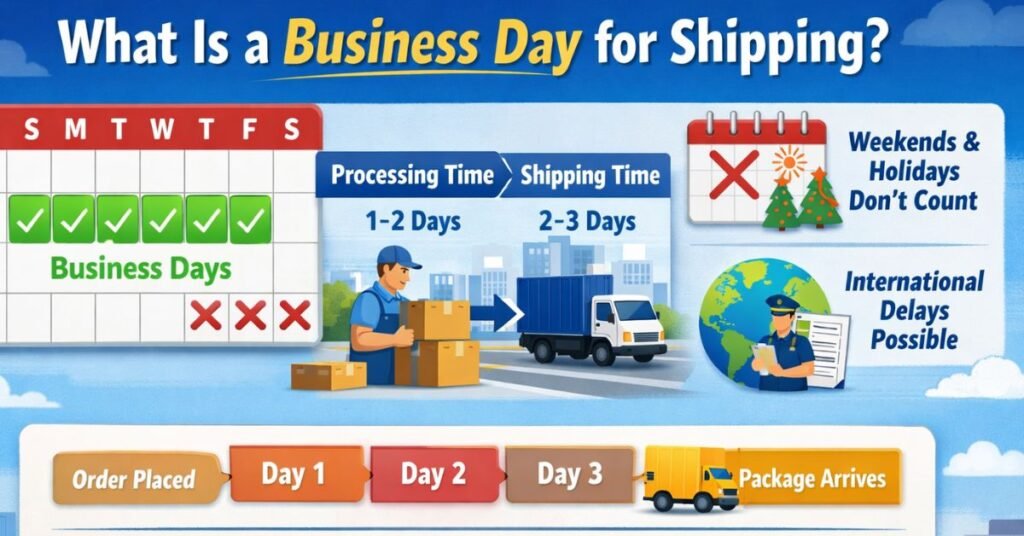
If you’ve ever placed an online order and seen the message “Ships in 3–5 business days,” you’ve probably wondered: what exactly is a business day for shipping? Does Saturday count? What about holidays? And why do some deliveries take longer than expected even when the seller promises a specific timeframe?
These questions come up constantly — whether you’re ordering a laptop for work, shipping a gift across the country, or running an e-commerce business yourself.
The confusion is understandable. Shipping timelines are full of industry jargon, and “business days” is one of the most misunderstood terms in logistics.
For shoppers, misunderstanding business days can lead to missed expectations. For businesses, it can mean frustrated customers and negative reviews.
In this complete guide, we’ll break down what a business day for shipping actually means, how different carriers define it, and how to calculate realistic delivery times.
By the end of this article, you’ll understand:
- Exactly what counts as a business day
- Why weekends and holidays affect delivery timelines
- How major shipping carriers define business days
- How to calculate delivery estimates accurately
- Tips to avoid common shipping mistakes
Whether you’re a shopper, small business owner, or logistics professional, this guide will help you understand shipping timelines like an expert.
Understanding What a Business Day for Shipping Means
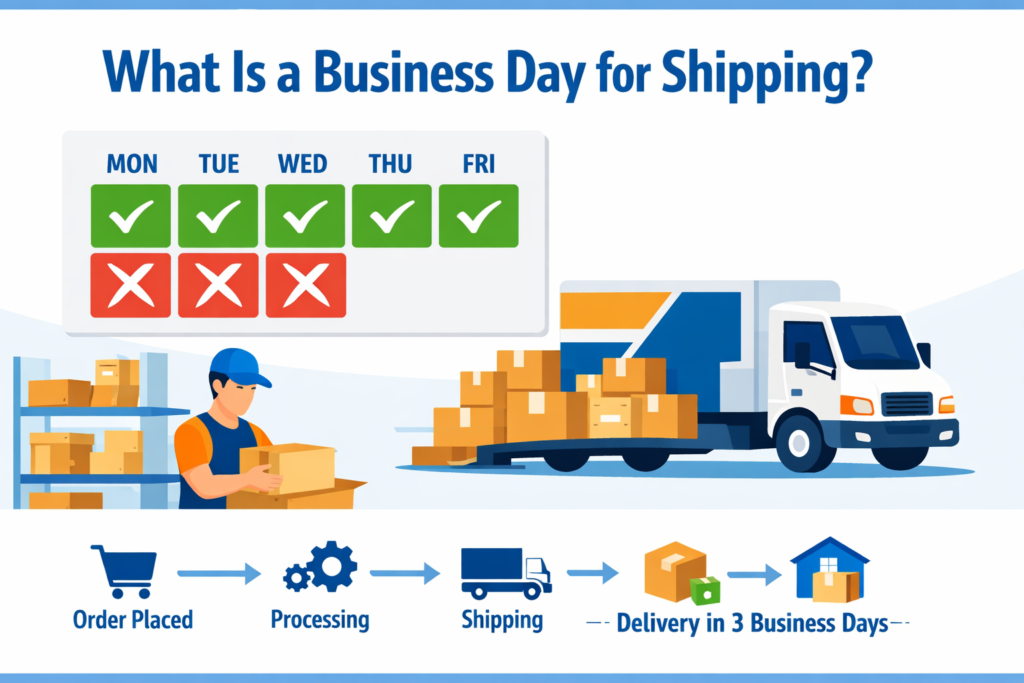
At its core, a business day for shipping refers to the standard working days when shipping carriers and businesses operate.
In most countries, this typically means:
- Monday
- Tuesday
- Wednesday
- Thursday
- Friday
Weekends — Saturday and Sunday — are usually not counted as business days.
Most major shipping companies process orders, move packages through distribution centers, and deliver shipments during these weekdays.
Simple Definition (Featured Snippet Ready)
A business day for shipping is any weekday (Monday–Friday) when shipping carriers and businesses are open and processing deliveries, excluding weekends and public holidays.
Example
Let’s say you order a product on Friday afternoon, and the store says shipping takes 3 business days.
Your timeline might look like this:
- Friday — Order placed (may or may not process same day)
- Saturday — Not a business day
- Sunday — Not a business day
- Monday — Business Day 1
- Tuesday — Business Day 2
- Wednesday — Business Day 3
Your package would likely ship or arrive on Wednesday, depending on the company’s processing policy.
Why Businesses Use Business Days
Shipping companies use business days because:
- Warehouses operate on weekday schedules
- Delivery networks follow standard work calendars
- Logistics hubs have fixed processing hours
- National holidays shut down operations
Using business days helps companies standardize timelines across different regions and operations.
Think of it like banking hours — transactions only move when the system is open.
Shipping works much the same way.
Why Understanding Business Days Matters for Shipping

For many consumers, shipping timelines feel unpredictable. You place an order expecting it to arrive within a few days, only to realize the estimated delivery date is nearly a week away.
The missing piece is often how business days work in logistics.
Understanding this concept matters because it directly affects when your package actually arrives.
1. Avoiding Unrealistic Delivery Expectations
Imagine ordering a birthday gift on Thursday with a 2-business-day shipping estimate.
Many people assume the item will arrive by Saturday.
But in reality:
- Thursday: Order placed
- Friday: Business Day 1
- Saturday: Weekend (not counted)
- Sunday: Weekend
- Monday: Business Day 2
Your delivery might not arrive until Monday.
Understanding this avoids last-minute surprises.
2. Planning Time-Sensitive Orders
Business days are especially important when ordering items for:
- Holidays
- Weddings
- Business events
- Product launches
- Client deliveries
If you know weekends don’t count, you can plan orders earlier and more strategically.
3. Reducing Customer Service Issues
For online stores, one of the most common support tickets is:
“Why hasn’t my order shipped yet?”
Often the answer is simple: the order was placed over the weekend or during a holiday.
Clear understanding of business days helps customers and businesses stay aligned.
4. Understanding Carrier Processing Times
Shipping isn’t just about transportation.
A package goes through several steps:
- Order processing
- Packaging
- Pickup by carrier
- Sorting facility processing
- Transit between hubs
- Local delivery
Each step usually operates only on business days.
This is why even fast shipping methods sometimes take longer than expected.
How Shipping Carriers Define Business Days
While the general rule for business days is Monday through Friday, different shipping companies have slightly different policies.
Understanding these differences can help you estimate delivery timelines more accurately.
Major Shipping Carrier Definitions
Here’s how common carriers typically define business days.
UPS
UPS considers business days to be:
- Monday through Friday
- Excluding major holidays
However, UPS does offer Saturday delivery in some locations, but Saturday usually does not count toward the standard business day calculation.
Example:
- 2-business-day UPS shipping ordered Friday → Delivery Tuesday.
FedEx
FedEx defines business days as:
- Monday through Friday
- Not including holidays
FedEx also offers:
- Saturday delivery in many areas
- Sunday residential delivery in some regions
But these are premium services, not standard business day operations.
USPS
The United States Postal Service is slightly different.
USPS operates:
- Monday through Saturday
In many cases, Saturday deliveries are included in USPS shipping estimates.
However, most businesses still calculate shipping timelines using Monday–Friday business days.
DHL
DHL international shipping typically uses:
- Monday through Friday business days
Global logistics networks often pause processing during weekends.
Quick Comparison
| Carrier | Standard Business Days | Weekend Delivery |
|---|---|---|
| UPS | Monday–Friday | Optional Saturday |
| FedEx | Monday–Friday | Optional weekend |
| USPS | Monday–Saturday | Regular Saturday |
| DHL | Monday–Friday | Limited |
The key takeaway is that most shipping timelines are calculated based on weekday operations.
The Difference Between Processing Time and Shipping Time
One of the biggest sources of confusion around business days is the difference between order processing and shipping transit time.
Many customers assume these are the same thing.
They are not.
Processing Time
Processing time refers to how long it takes the seller to prepare the order before it ships.
This includes:
- Payment verification
- Picking the product from inventory
- Packaging
- Printing shipping labels
- Scheduling carrier pickup
Example:
A store might say:
Processing time: 2–3 business days
This means your order might not even leave the warehouse for several days.
Shipping Transit Time
Shipping time refers to how long the carrier takes to deliver the package after it ships.
Example shipping options:
- Standard shipping: 3–5 business days
- Expedited shipping: 2 business days
- Overnight shipping: 1 business day
Example Timeline
Let’s break it down.
Order placed: Monday
Processing time: 2 business days
Shipping time: 3 business days
Timeline:
- Monday: Order placed
- Tuesday: Processing
- Wednesday: Processing
- Thursday: Shipping Day 1
- Friday: Shipping Day 2
- Monday: Shipping Day 3
Delivery: Monday
Even though shipping is “3 days,” the total timeline is one full week.
Understanding this distinction helps avoid frustration.
Step-by-Step Guide to Calculating Shipping Business Days
If you want to estimate when your package will arrive, you can calculate business days yourself.
Here’s a simple step-by-step process.
Step 1: Identify the Order Date
Start with the exact date the order was placed.
Example:
Order date: Friday
Step 2: Check Processing Time
Look at the store’s order processing estimate.
Example:
Processing: 2 business days
Timeline:
- Friday: Order placed
- Monday: Processing Day 1
- Tuesday: Processing Day 2
Shipment leaves Tuesday.
Step 3: Identify Shipping Speed
Next, check the shipping method.
Example:
Shipping: 3 business days
Timeline:
- Wednesday: Day 1
- Thursday: Day 2
- Friday: Day 3
Estimated arrival: Friday
Step 4: Account for Holidays
Public holidays pause shipping operations.
Common holidays include:
- Christmas
- New Year’s Day
- Independence Day
- Thanksgiving
- Labor Day
If a holiday occurs during transit, add an extra business day.
Step 5: Track the Package
Once shipped, you’ll receive a tracking number.
Use carrier tracking tools to monitor:
- Package scans
- Transit hubs
- Out-for-delivery status
Tracking gives the most accurate estimate.
Tools, Comparisons, and Shipping Time Estimators
Today’s shipping industry offers a variety of tools that help individuals and businesses estimate delivery times more accurately.
These tools remove the guesswork and help you predict how business days translate into real-world delivery dates.
1. Carrier Delivery Calculators
Most major shipping companies provide delivery time calculators.
Examples include:
- UPS Delivery Time Calculator
- FedEx Shipping Rate & Time Tool
- USPS Delivery Map
- DHL Transit Time Calculator
These tools let you enter:
- Origin ZIP code
- Destination ZIP code
- Shipping method
- Shipment date
The system then calculates estimated delivery based on business days and carrier schedules.
Pros
- Highly accurate
- Free to use
- Based on real logistics data
Cons
- Requires shipping details
- Estimates may change during peak seasons
2. E-commerce Shipping Platforms
Businesses often rely on platforms like:
- ShipStation
- Shippo
- Easyship
- Pirate Ship
These tools integrate with online stores and automatically estimate shipping times for customers.
Benefits include:
- Real-time rate comparisons
- Automated label printing
- Shipping analytics
- Delivery estimate displays
These platforms are especially helpful for small e-commerce stores managing multiple carriers.
3. Order Tracking Apps
Consumers can track packages through apps such as:
- AfterShip
- ParcelTrack
- Shop App
These tools consolidate tracking information across multiple carriers.
Advantages include:
- Real-time notifications
- Delivery predictions
- Shipment history
For frequent online shoppers, these apps provide peace of mind and visibility.
Common Mistakes People Make About Business Days
Despite being a simple concept, business days are misunderstood surprisingly often.
These mistakes frequently lead to missed deadlines and customer frustration.
Mistake 1: Assuming Saturday Counts as a Business Day
Many people assume Saturday counts toward delivery timelines.
In most cases, it does not.
Even if a carrier offers Saturday delivery, the shipping estimate still counts only Monday through Friday.
Mistake 2: Ignoring Processing Time
Another common misunderstanding is thinking the shipping countdown begins immediately after ordering.
In reality:
Orders often spend 1–3 business days in processing before they even leave the warehouse.
Mistake 3: Overlooking Holidays
Shipping operations slow down or pause during major holidays.
During peak periods like Christmas, delivery delays can extend beyond normal business-day estimates.
Mistake 4: Misreading “Ships in X Business Days”
There is a big difference between:
- “Ships in 3 business days”
- “Arrives in 3 business days”
The first refers to when the package leaves the warehouse, not when it arrives.
Mistake 5: Assuming All Carriers Operate the Same
Different carriers have different schedules.
For example:
- USPS may deliver Saturday
- DHL may not
Always check the specific carrier policy.
Business Days in International Shipping
International shipping adds another layer of complexity to business day calculations.
When packages cross borders, delivery timelines depend on multiple logistics systems and customs processes.
Why International Business Days Differ
International shipping timelines depend on several factors:
- Customs inspections
- International flight schedules
- Import regulations
- Local courier networks
- Destination country holidays
Each country may have different working calendars and public holidays.
Example Scenario
A package ships from the United States to Germany.
Timeline might include:
- US processing center
- International air transit
- German customs inspection
- Local courier delivery
Each step operates on business days within its region.
Customs Delays
Customs processing can add several business days depending on:
- Documentation
- Import taxes
- Security inspections
For international orders, businesses often estimate 7–14 business days for standard delivery.
Tips for Faster International Shipping
- Use express international shipping
- Ensure customs forms are accurate
- Choose carriers with global networks
- Track shipments regularly
These steps can significantly reduce delays.
Business Days for E-commerce Sellers
If you run an online store, clearly communicating business day timelines is essential.
Shipping confusion is one of the top reasons customers contact support.
Best Practices for Online Stores
Successful e-commerce brands set clear expectations.
Here are a few proven strategies.
1. Display Processing Times Clearly
Example:
“Orders ship within 1–2 business days.”
Place this message:
- On product pages
- In checkout
- In order confirmation emails
2. Show Estimated Delivery Dates
Instead of vague timelines, many stores display:
Estimated Delivery: March 10–12
This approach reduces confusion.
3. Offer Multiple Shipping Options
Customers appreciate flexibility.
Common options include:
- Standard shipping
- Expedited shipping
- Overnight delivery
4. Communicate Holiday Cutoff Dates
During peak seasons, announce deadlines for holiday delivery.
Example:
“Order by December 18 for Christmas delivery.”
5. Provide Real-Time Tracking
Tracking numbers dramatically reduce support tickets.
Customers prefer checking shipment status themselves.
Conclusion
Understanding what a business day for shipping means can make a huge difference in how you plan purchases, shipments, and deliveries.
At its simplest, a business day typically refers to Monday through Friday, excluding weekends and public holidays. These are the days when warehouses operate, packages move through distribution centers, and carriers process deliveries.
However, shipping timelines involve more than just transit time. Processing time, carrier schedules, holidays, and international logistics can all affect when a package arrives.
For shoppers, knowing how business days work helps set realistic expectations and avoid last-minute delivery surprises.
For businesses, clear communication around business days improves customer satisfaction, reduces support requests, and builds trust.
The next time you see a shipping estimate like “3–5 business days,” you’ll know exactly how to interpret it — and how to calculate when your package will arrive.
If you frequently order online or run an e-commerce store, mastering this concept can save time, money, and frustration.
FAQs
What is considered a business day for shipping?
A business day for shipping usually refers to Monday through Friday, excluding weekends and public holidays when shipping carriers and warehouses are closed.
Does Saturday count as a business day for shipping?
In most cases, no. Saturday is typically not counted as a business day, even if some carriers offer optional Saturday delivery services.
How long is 3 business days for shipping?
Three business days typically means three weekdays, excluding weekends and holidays. For example, an order shipped on Thursday would arrive around Tuesday.
Do holidays count as business days?
No. Major public holidays are excluded from business day calculations because shipping companies and warehouses often close during those dates.
What is the difference between business days and calendar days?
Business days include only working weekdays, while calendar days include every day of the week, including weekends and holidays.

Michael Grant is a business writer with professional experience in small-business consulting and online entrepreneurship. Over the past decade, he has helped brands improve their digital strategy, customer engagement, and revenue planning. Michael simplifies business concepts and gives readers practical insights they can use immediately.