
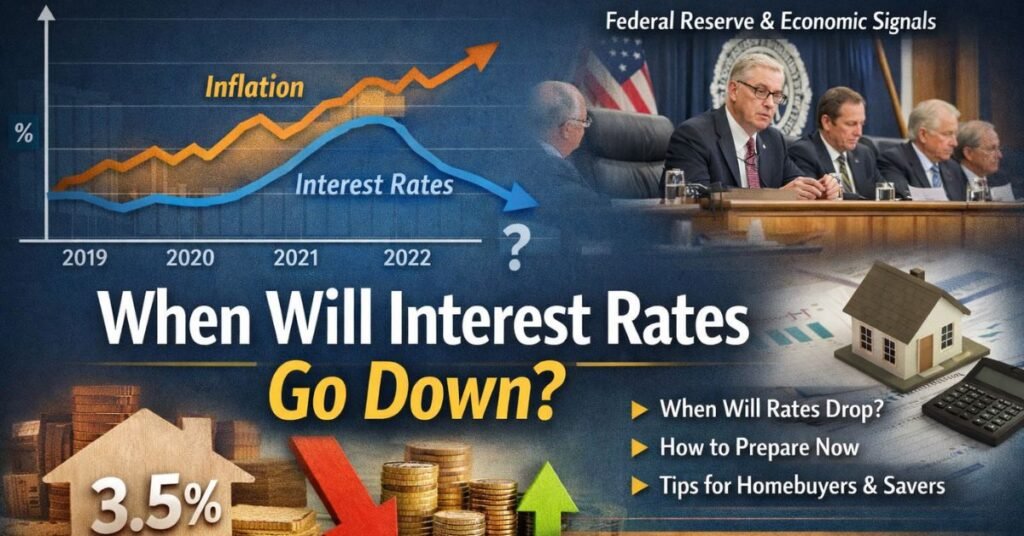
If you’ve found yourself asking “when will interest rates go down?” you’re not alone. I hear this question everywhere—at family dinners, from first-time homebuyers staring at mortgage calculators, from small business owners delaying expansion, and from savers wondering whether today’s high-yield accounts are temporary or here to stay.
Interest rates touch nearly every corner of daily life. They shape how much we pay for homes, cars, and credit cards. They influence whether businesses hire or pause. They even affect how confident people feel about spending or saving. So when rates rise sharply—as they have over the past few years—the natural instinct is to look ahead and ask: when does the pressure ease?
In this guide, we’ll walk through the question step by step, without hype or fear-mongering. You’ll learn how interest rates actually work, what signals economists and central banks watch, realistic timelines for rate cuts, and—most importantly—what you can do right now to prepare, no matter which direction rates move next. Think of this as a calm conversation with someone who’s lived through multiple rate cycles and learned that timing matters—but preparation matters more.
Understanding Interest Rates (Without the Economics Degree)
To understand when interest rates might go down, you first need a clear picture of what they are and why they move. At their core, interest rates are simply the price of borrowing money. When you take out a loan, the interest rate is what you pay for the privilege of using someone else’s cash. When you save money, it’s what the bank pays you for letting them use yours.
Here’s where it gets interesting. While banks set the rates you see on mortgages, credit cards, and savings accounts, those rates are heavily influenced by central banks—especially the Federal Reserve in the United States. Central banks adjust benchmark rates to manage inflation and economic growth. When inflation runs hot, they raise rates to cool spending. When the economy slows too much, they lower rates to encourage borrowing and investment.
A simple analogy helps. Think of the economy as a car. Interest rates are the gas pedal and the brake. When the economy is overheating, central banks tap the brakes by raising rates. When it’s slowing down, they ease off and add gas by lowering them. The challenge is timing. Brake too late or too hard, and you risk stalling. Ease off too early, and inflation can roar back.
That’s why the answer to “when will interest rates go down?” is never just a date on the calendar. It depends on how fast inflation cools, how resilient jobs remain, and whether growth stays steady or falters.
Why Everyone Is Asking: The Real-World Impact of High Rates
High interest rates aren’t just abstract numbers discussed on financial news. They show up in very real, very personal ways. For homeowners, higher mortgage rates can mean thousands more in interest over the life of a loan—or being priced out entirely. For renters, it can mean landlords passing on higher financing costs through rent increases.
Credit cards are another pain point. Many variable-rate cards move almost instantly when benchmark rates rise. That means balances get more expensive month after month, even if spending habits don’t change. Auto loans, student loans, and business credit lines all feel the squeeze too.
On the flip side, savers often benefit. High-yield savings accounts and money market funds tend to pay more when rates are elevated. For retirees or conservative investors, that can feel like a long-awaited reward after years of near-zero returns.
This split reality is why predicting when interest rates will go down matters so much. Borrowers want relief. Savers want clarity. Businesses want stability. And policymakers are trying to balance all of it at once, without tipping the economy into recession or letting inflation rebound.
What Actually Triggers Rate Cuts?
Central banks don’t wake up one morning and decide to cut rates on a whim. Rate cuts are usually the result of several economic signals lining up at the same time. Inflation is the biggest one. If prices are rising too fast, rate cuts are unlikely. But once inflation shows sustained cooling—month after month—cuts come back onto the table.
Employment data is another major factor. Strong job growth gives central banks confidence that the economy can handle higher rates for longer. Rising unemployment, on the other hand, often accelerates discussions around easing policy.
Then there’s economic growth itself. Slowing consumer spending, weaker manufacturing data, or declining business investment can all push policymakers toward rate cuts. Financial stability also plays a role. If stress shows up in banking or credit markets, central banks may act faster to prevent wider damage.
It’s also important to understand expectations. Central banks, including the Federal Reserve under leaders like Jerome Powell, pay close attention to how households and businesses expect inflation to behave. If people believe prices will keep rising, they tend to spend faster, which fuels inflation further. Keeping expectations anchored is half the battle.
So… When Will Interest Rates Go Down?
This is the heart of the question, and the honest answer is: gradually, and only when conditions allow. Rate cuts usually happen in cycles, not all at once. Central banks test the waters with small cuts, watch the data, and adjust as needed.
Historically, once inflation is clearly under control and economic momentum slows, rate cuts can begin within several months. But that doesn’t mean rates return quickly to pre-crisis lows. More often, they settle at a “new normal” that reflects long-term trends like productivity, demographics, and global demand for capital.
Another key point: markets often move before central banks do. Mortgage rates, bond yields, and investment returns can start falling in anticipation of future cuts. That’s why you sometimes see borrowing costs ease even before an official announcement.
Globally, different regions move at different speeds. The European Central Bank and the Bank of England face their own inflation and growth challenges, which means rate-cut timelines can diverge. For globally connected investors and businesses, this matters more than many people realize.
Benefits of Lower Interest Rates (and Who Gains the Most)
When interest rates finally start to come down, the effects ripple quickly. Borrowers usually feel relief first. Mortgage refinancing becomes attractive again, monthly payments shrink, and housing activity often picks up. Businesses find it cheaper to finance new projects, which can lead to hiring and expansion.
Consumers tend to regain confidence as well. Lower rates reduce the cost of carrying debt, which frees up cash flow for spending or saving. That boost in demand can help stabilize or reaccelerate economic growth.
However, lower rates aren’t universally positive. Savers may see yields on savings accounts and fixed-income investments decline. Retirees who rely on interest income often need to adjust strategies when rates fall.
Understanding who benefits most helps you plan. If you’re heavily leveraged, lower rates can be a lifeline. If you’re asset-rich and income-focused, they may require more creative investing. Either way, knowing when interest rates might go down allows you to position yourself instead of reacting late.
A Step-by-Step Guide to Preparing for Rate Cuts
Rather than trying to perfectly time when interest rates will go down, focus on preparation. Here’s a practical, step-by-step approach that works in any rate environment.
Start by reviewing your current debt. Identify which loans have variable rates and which are fixed. Variable-rate debt will benefit faster from cuts, while fixed-rate loans may require refinancing to capture lower rates.
Next, strengthen your credit profile. Better credit scores unlock better rates, regardless of timing. Pay down balances, make on-time payments, and avoid unnecessary credit inquiries.
Then, build flexibility into your finances. An emergency fund gives you options if rates stay higher longer than expected. Liquidity is underrated during uncertain cycles.
For homeowners, it can be wise to track refinancing break-even points. That way, when rates drop, you already know whether refinancing makes sense. For investors, review asset allocation. Rate cuts often favor equities and longer-duration bonds, but risk tolerance matters more than predictions.
Finally, stay informed—but not obsessed. Follow reliable economic updates, not sensational headlines. One strong jobs report or inflation print doesn’t change the long-term trend by itself.
Tools, Comparisons, and Smart Recommendations
A few tools can make navigating interest rate changes much easier. Mortgage calculators help you model different rate scenarios and monthly payments. Many are free and surprisingly accurate. For refinancing, break-even calculators show how long it takes to recoup closing costs.
On the investing side, portfolio trackers and bond ladder tools can help you visualize how rate changes affect income and value. Some premium platforms offer scenario analysis and alerts when yields cross certain thresholds, but free tools are often enough for most individuals.
The key is not overpaying for complexity you don’t need. Paid tools make sense if you manage large portfolios or run a business with significant debt exposure. For households, simplicity usually wins.
Common Mistakes People Make (and How to Avoid Them)
One of the biggest mistakes is waiting too long. People often assume they’ll refinance or invest after rates fall significantly. By then, much of the benefit may already be priced in.
Another mistake is overreacting to short-term news. Markets are noisy. A single data release can move expectations temporarily, but long-term trends matter more.
Some borrowers also underestimate fees and terms. A lower rate isn’t always better if it comes with high costs or unfavorable conditions. Always look at the full picture.
Finally, many people forget opportunity cost. Sitting entirely in cash waiting for the “perfect” moment can mean missing gains elsewhere. Balance patience with participation.
The Bottom Line on When Interest Rates Will Go Down
Predicting the exact moment interest rates will go down is nearly impossible—and often unnecessary. What matters more is understanding why rates move, recognizing the signals that precede changes, and positioning yourself thoughtfully ahead of time.
History shows that rate cycles always turn eventually. Inflation cools, growth shifts, and policy adapts. Those who plan early tend to benefit the most, not because they guessed right, but because they were ready.
If there’s one takeaway, it’s this: don’t let uncertainty freeze you. Use it as motivation to strengthen your financial foundation so that whenever rates do fall, you’re prepared to move with confidence.
FAQs
Will interest rates go down this year?
It depends on inflation and economic data. If inflation continues to cool and growth slows, cuts become more likely, but timing varies.
Do mortgage rates fall immediately when central banks cut rates?
Not always. Mortgage rates often move based on expectations, so they can fall before or after official cuts.
Should I wait to buy a house until rates go down?
Waiting can help, but home prices and competition may rise when rates fall. It’s often better to buy when you’re financially ready.
Are savings accounts affected when rates go down?
Yes. Savings yields usually decline after rate cuts, which can reduce interest income for savers.
How fast do rate cuts usually happen?
Cuts typically occur gradually over months or even years, not all at once.

Michael Grant is a business writer with professional experience in small-business consulting and online entrepreneurship. Over the past decade, he has helped brands improve their digital strategy, customer engagement, and revenue planning. Michael simplifies business concepts and gives readers practical insights they can use immediately.