A few years ago, a friend of mine—an accountant who swore she “wasn’t a tech person”—told me she’d started learning Python. I laughed, assuming she meant the snake. But a month later, she showed me a tiny script she wrote that automatically sorted hundreds of messy spreadsheet files. Something that once took her hours took Python less than a second.
That moment made me realize something important: Python programming isn’t just for engineers. It’s for anyone who wants to get things done more easily.
If you’re wondering what exactly Python is, why it’s so popular, and whether you should learn it, you’re in the right place.
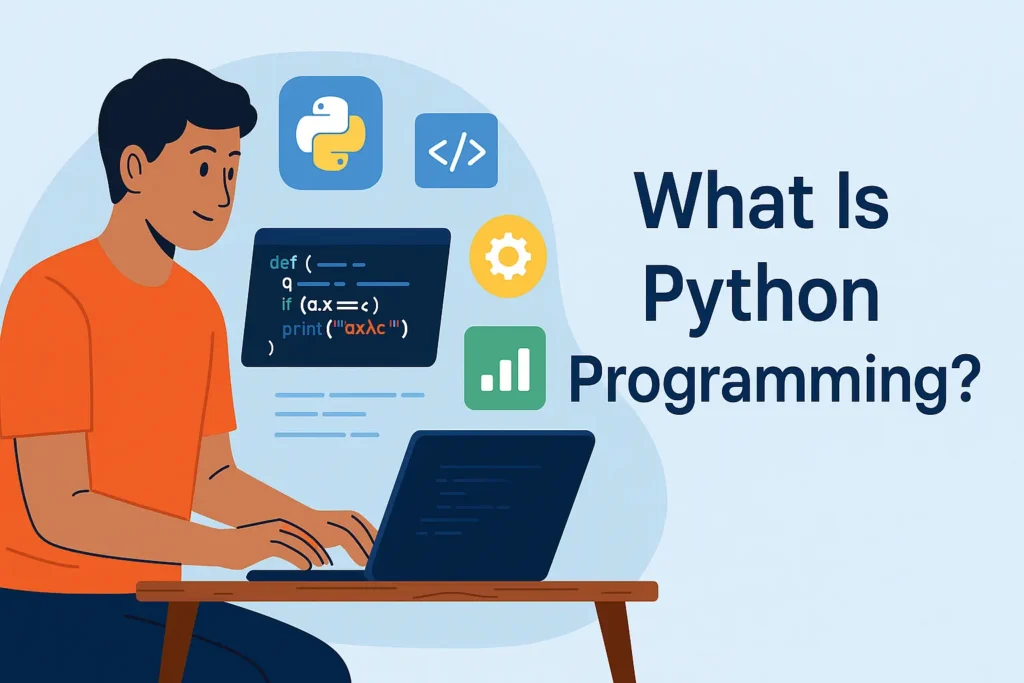
What Is Python Programming? (Simple Definition)
Python is a high-level, beginner-friendly programming language that helps you build software, automate tasks, analyze data, create websites, work with AI, and so much more.
It’s known for:
- Readable syntax — it looks almost like English.
- Flexibility — you can use it for simple scripts or large applications.
- A huge community — meaning lots of tutorials, tools, and ready-made libraries.
If programming languages were tools, Python would be the Swiss Army knife.
Why Is Python So Popular?
1. It’s Easy to Learn (Even if You’re Not Technical)
Python keeps things simple. For example, here’s how you print text:
print("Hello, world!")
That’s it. No confusing brackets or cryptic symbols.
2. Massive Library Support
Want to analyze data? Use Pandas.
Build a website? Try Django or Flask.
Dive into AI? TensorFlow and PyTorch have your back.
There’s a library for nearly everything.
3. Python Works Everywhere
Python runs on Windows, macOS, Linux, and even Raspberry Pi. You can create:
- Web apps
- Mobile prototypes
- Bots
- Automations
- AI and machine learning systems
- Data visualizations
- Games
4. High Demand in the Job Market
Careers that rely heavily on Python include:
- Data science
- Machine learning
- Cybersecurity
- Web development
- Automation engineering
- Fintech
- Scientific computing
Real-World Use Cases of Python
Here’s where you’ll see Python quietly powering the world:
- Netflix uses it to recommend shows.
- NASA uses it for scientific calculations.
- Instagram and Pinterest rely on Python for backend operations.
- Banks and financial institutions use Python for fraud detection and algorithmic trading.
- Small businesses use Python scripts to automate emails, reports, and data entry.
It’s everywhere—whether you notice it or not.
How Python Compares to Other Programming Languages
| Language | Difficulty | Best For | Why Choose It |
|---|---|---|---|
| Python | Easy | Data science, automation, web apps | Very readable + huge libraries |
| JavaScript | Medium | Web front-end | Runs in browsers |
| Java | Medium | Enterprise applications | Fast, reliable, scalable |
| C++ | Hard | Game engines, performance-critical tasks | Extremely powerful |
Python wins when you want speed of development, readability, and versatility.
How to Start Learning Python (Step-by-Step)
Step 1: Install Python
Download it from the official site: python.org.
During installation, check “Add Python to PATH.”
Step 2: Choose a Code Editor
Beginner-friendly options:
- VS Code (recommended)
- PyCharm Community Edition
- Jupyter Notebook (for data analysis)
Step 3: Learn the Basics
Start with:
- Variables
- Data types
- Functions
- Loops
- Conditionals
- Lists and dictionaries
Write tiny programs like:
- A calculator
- A to-do list
- A file organizer
Step 4: Pick a Project Based on Your Interests
- Like numbers? Try data analysis.
- Like building things? Try web development.
- Like problem-solving? Try automation scripts.
Step 5: Explore Popular Libraries
- Automation →
os,shutil,selenium - Web dev → Django, Flask
- Data science → Pandas, NumPy, Matplotlib
- AI/ML → TensorFlow, PyTorch
Step 6: Practice Consistently
Even 20 minutes a day is enough to build momentum.
Common Mistakes Beginners Should Avoid
Trying to learn everything at once
Focus on one path (automation, data, or web) instead of bouncing around.
Copying code without understanding it
Always pause and ask, “What is this line doing?”
Skipping fundamentals
Libraries are great, but core concepts matter long-term.
Ignoring errors
Error messages are your teachers—read them.
Not building projects
Projects are where the real learning happens.
Helpful Tools for Python Programming
1. Code Editors
- VS Code
- PyCharm
- Sublime Text
2. Package Manager
pip(comes with Python): lets you install third-party libraries.
3. Virtual Environments
venvconda
These keep your projects clean and dependency conflicts away.
4. Online Learning Platforms
- FreeCodeCamp
- Coursera
- Codecademy
- Real Python
5. Version Control
- Git + GitHub (for backing up and collaborating)
Practical Tips for Learning Python Faster
- Start with small wins—automate a repetitive task in your daily life.
- Read other people’s code on GitHub.
- Do coding challenges on LeetCode, HackerRank, or Codewars.
- Join Python communities on Reddit or Discord.
- Keep a “bug journal” to track mistakes you’ve solved.
Final Takeaway
Python programming is one of the most accessible and powerful skills you can learn today.
Whether you want to automate your job, break into tech, build websites, explore AI, or simply think more logically, Python gives you the tools to do it.
You don’t need to be a genius. You just need curiosity and consistency.
If you’ve been waiting for a sign to start learning Python… this is it.
fAQs
Is Python good for beginners?
Absolutely. Its simple syntax and strong community support make it ideal for newcomers.
How long does it take to learn Python?
You can learn the basics in a few weeks. Becoming advanced depends on how much you practice and what you want to build.
Do I need math to learn Python?
Not for general programming or automation. You only need math for specialized fields like machine learning or scientific computing.
Can Python get me a job?
Yes—Python skills are in high demand across tech, finance, data science, AI, and more.
Is Python free?
Yes, Python is completely open-source and free to use.

Adrian Cole is a technology researcher and AI content specialist with more than seven years of experience studying automation, machine learning models, and digital innovation. He has worked with multiple tech startups as a consultant, helping them adopt smarter tools and build data-driven systems. Adrian writes simple, clear, and practical explanations of complex tech topics so readers can easily understand the future of AI.