
Introduction: Why AI Governance Suddenly Feels So Urgent
A few years ago, most medium-sized companies were simply asking, “Should we use AI?”
Today, the question has shifted to something more serious:
“Are we using AI responsibly—and could it come back to bite us?”
I’ve spoken with CTOs who rolled out AI tools faster than their policies could keep up. Marketing teams quietly testing generative AI. HR experimenting with AI screening tools. Product managers plugging APIs into core systems with little oversight.
Nothing malicious—just fast growth and pressure to innovate.
And then the problems start showing up:
- A biased model that sparks employee complaints
- Customer data fed into tools with unclear retention policies
- Leadership suddenly worried about regulations they don’t fully understand
This is where an AI governance maturity model becomes invaluable—especially for medium-sized organizations that don’t have enterprise-scale legal teams or unlimited budgets.
In this guide, we’ll break down what an AI governance maturity model is, why it matters specifically for medium-sized businesses, and how you can build one step by step—without overengineering or slowing innovation.
What Is an AI Governance Maturity Model? (Plain-English Explanation)
At its core, an AI governance maturity model is a framework that helps organizations:
- Understand where they are today in managing AI
- Define where they want to be
- Progress systematically toward safer, more accountable AI use
Think of it like a fitness plan for AI governance.
You don’t start training for a marathon on day one. You build habits, track progress, and level up gradually. AI governance works the same way.
For Medium-Sized Organizations, This Matters More Than You Think
Large enterprises often have:
- Dedicated compliance teams
- Formal ethics boards
- Deep legal resources
Medium-sized companies usually don’t.
That means:
- Decisions happen faster
- Risk accumulates quietly
- One bad AI incident can do outsized damage
An AI governance maturity model helps you scale safely without becoming bureaucratic.
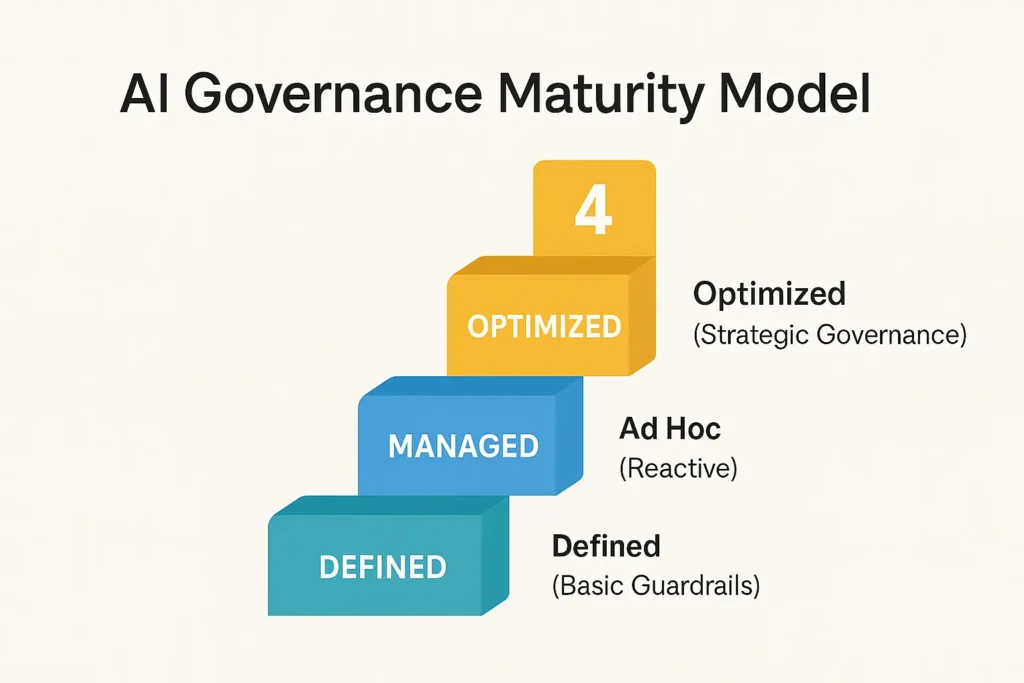
The Typical AI Governance Maturity Levels (Simplified)
Most AI governance maturity models follow a similar progression. The language varies, but the logic is consistent.
Level 1: Ad Hoc (Reactive)
AI tools are used informally across teams
No documented policies
Governance only comes up when something goes wrong
Common signs:
- “We didn’t know that team was using AI”
- No inventory of AI systems
- Policies copied from blogs (if any exist at all)
Level 2: Defined (Basic Guardrails)
Initial policies exist
Some awareness of legal and ethical risks
Ownership is assigned—usually part-time
Common signs:
- AI usage guidelines
- Basic data protection rules
- Informal review of new AI tools
Level 3: Managed (Operational Governance)
AI governance is part of normal operations
Clear approval processes
Risk assessments before deployment
Common signs:
- Central AI inventory
- Responsible AI principles
- Regular reviews and documentation
Level 4: Optimized (Strategic Governance)
AI governance supports business strategy
Metrics track risk, performance, and compliance
Continuous improvement built in
Common signs:
- Board-level visibility
- Automated monitoring
- Proactive regulatory readiness
Most medium-sized organizations realistically aim for Level 2 or 3—and that’s perfectly okay.
Why Medium-Sized Companies Need a Different Approach
Here’s the honest truth:
Most AI governance advice online is written for either startups or global enterprises.
Medium-sized companies live in the uncomfortable middle.
Unique Challenges You Face
- Limited compliance budgets
- Growing regulatory exposure
- Fast AI adoption across departments
- Pressure to move fast without breaking trust
An AI governance maturity model tailored to medium organizations balances:
- Speed
- Risk
- Cost
- Practicality
Benefits of Using an AI Governance Maturity Model
1. Reduced Legal and Reputational Risk
You identify issues before regulators, customers, or employees do.
2. Faster, Safer AI Adoption
Clear rules mean teams don’t hesitate—or hide experimentation.
3. Improved Trust (Internally and Externally)
Employees understand boundaries. Customers feel protected.
4. Regulatory Readiness
Whether it’s GDPR, the EU AI Act, or industry standards—you’re not scrambling.
5. Better Decision-Making
Leadership sees where AI creates value and risk.
Real-World Use Cases
HR & Recruitment
- Prevent bias in resume screening tools
- Document how models are evaluated
- Ensure explainability for hiring decisions
Marketing & Content
- Control generative AI brand risk
- Set rules for customer data usage
- Maintain IP ownership clarity
Product & Engineering
- Review third-party AI APIs
- Monitor model drift and accuracy
- Define escalation paths for failures
Customer Support
- Ensure chatbot transparency
- Prevent hallucinations
- Protect sensitive customer data
Step-by-Step Guide: Building an AI Governance Maturity Model (Medium-Sized Friendly)
Step 1: Inventory Your AI (Yes, All of It)
You can’t govern what you don’t know exists.
Create a simple AI inventory:
- Tools (ChatGPT, Copilot, custom models)
- Purpose
- Data used
- Owner
- Risk level (low/medium/high)
Tip: Start with a spreadsheet. Fancy tools can come later.
Step 2: Assign Clear Ownership
AI governance fails without accountability.
At minimum, define:
- Executive sponsor
- AI governance lead
- Cross-functional reviewers (IT, legal, HR)
This doesn’t require a new team—just clear responsibility.
Step 3: Define Practical AI Principles
Avoid abstract ethics statements.
Good principles are:
- Short
- Actionable
- Business-aligned
Examples:
- “AI decisions affecting people require human oversight”
- “Customer data must never be used to train external models”
Step 4: Introduce a Simple Risk Assessment
Before deploying AI, ask:
- What data is used?
- Who could be impacted?
- What happens if the AI fails?
For medium-sized companies, one-page checklists work better than 50-page policies.
Step 5: Implement Review & Approval Processes
Not every AI use case needs the same scrutiny.
Use tiers:
- Low risk: automatic approval
- Medium risk: manager review
- High risk: governance review
This keeps innovation moving.
Step 6: Train Teams (Without Overwhelming Them)
Focus on:
- What’s allowed
- What’s not
- Who to ask when unsure
Short workshops beat massive compliance courses every time.
Step 7: Review, Improve, Repeat
Maturity is not static.
Quarterly or biannual reviews help you:
- Adjust policies
- Learn from incidents
- Stay aligned with regulations
Tools, Frameworks & Resources Worth Considering
Governance & Risk Tools
Pros: Automation, tracking
Cons: Cost, complexity
Examples:
- Holistic AI
- Credo AI
- Fiddler AI
Lightweight Alternatives
- Google Sheets + Confluence
- Notion-based governance hubs
- Jira workflows for AI approvals
✅ Often better for medium organizations early on.
Free & Open Resources
- NIST AI Risk Management Framework
- OECD AI Principles
- ISO/IEC AI governance standards (reference-level)
Common Mistakes Medium-Sized Companies Make
1. Copying Enterprise Governance Models
Too complex → ignored by teams
2. Treating AI Governance as a One-Time Project
It must evolve with tools and regulations.
3. Over-Focusing on Tools
Governance is mostly people and processes.
4. Ignoring Shadow AI Usage
Employees will use AI regardless—better to guide than ban.
5. Waiting for Regulation Before Acting
By the time rules arrive, it’s often too late.
How to Measure AI Governance Maturity (Without Overengineering)
Ask these questions regularly:
- Do we know where AI is used?
- Are risks identified before deployment?
- Can we explain AI decisions?
- Are incidents documented and reviewed?
If the answer improves over time—you’re maturing.
Conclusion: AI Governance Is a Business Enabler, Not a Brake
An AI governance maturity model for medium-sized organizations isn’t about slowing down innovation—it’s about making innovation sustainable.
When governance is done right:
- Teams move faster
- Leaders sleep better
- Customers trust more deeply
You don’t need perfection.
You need progress, visibility, and accountability.
Start where you are. Build intentionally. Improve continuously.
And remember: the companies that win with AI aren’t just the ones who adopt fastest—but the ones who govern wisely.
FAQs
What is an AI governance maturity model in simple terms?
It’s a framework that helps organizations gradually improve how they manage AI risk, responsibility, and compliance.
Is an AI governance maturity model only for large enterprises?
No. Medium-sized organizations benefit the most because they often lack formal oversight but face real risk.
How long does it take to reach maturity level 3?
For most medium organizations, 6–18 months with steady effort.
Do we need special software to implement AI governance?
No. Many start with documents, spreadsheets, and workflows before investing in tools.
How does AI governance affect innovation?
Good governance accelerates innovation by removing uncertainty and hidden risk.

Adrian Cole is a technology researcher and AI content specialist with more than seven years of experience studying automation, machine learning models, and digital innovation. He has worked with multiple tech startups as a consultant, helping them adopt smarter tools and build data-driven systems. Adrian writes simple, clear, and practical explanations of complex tech topics so readers can easily understand the future of AI.