
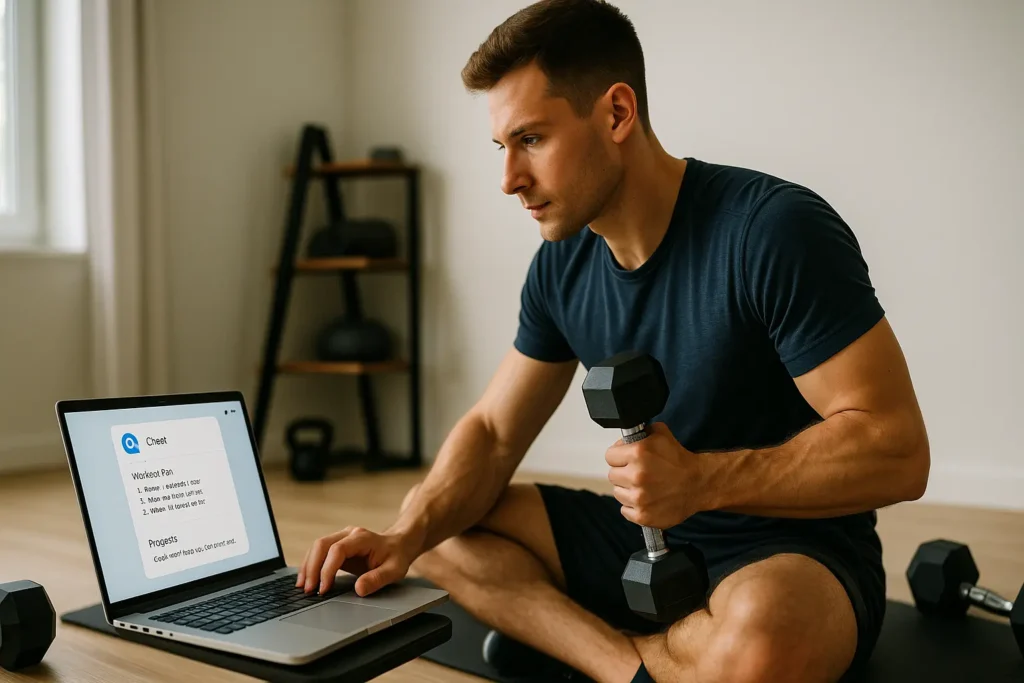
Can chatgpt be a personal trainer? It’s a question that’s popping up everywhere lately — in gym locker rooms, Reddit threads, and late-night Google searches after yet another skipped workout. Maybe you’ve wondered it yourself. You’re motivated, but not motivated enough to pay $80–$120 per session for a personal trainer. You want structure, accountability, and clarity — but on your own terms.
Here’s the truth: fitness has always been less about knowing what to do and more about having someone (or something) guide you consistently. That’s where AI tools like ChatGPT enter the conversation.
This article doesn’t hype or dismiss the idea. Instead, it gives you a grounded, experience-based answer. We’ll explore what ChatGPT can realistically do as a personal trainer, where it shines, where it falls short, and how people are actually using it right now to build muscle, lose fat, and stay consistent.
By the end, you’ll know whether ChatGPT can replace a human trainer, supplement one, or act as a smart fitness companion — and how to use it safely and effectively if you decide to try.
Topic Explanation: What Does It Really Mean for ChatGPT to Be a Personal Trainer?
When people ask if ChatGPT can be a personal trainer, they’re usually imagining one of two things.
The first is a full replacement for a human trainer — someone who watches your form, adjusts your workouts mid-session, pushes you harder when you want to quit, and keeps you accountable. The second is more like a fitness brain-in-your-pocket — a tool that helps plan workouts, answer questions, and keep you moving forward.
ChatGPT firmly fits into the second category.
Think of it less like a trainer standing beside you in the gym and more like an experienced fitness coach you can text anytime. It doesn’t have eyes, hands, or emotions, but it does have access to an enormous amount of fitness knowledge and the ability to personalize that knowledge based on what you tell it.
In practical terms, ChatGPT can:
- Design workout programs based on goals, time, and equipment
- Explain exercises in beginner-friendly language
- Adjust plans when your schedule changes
- Help with habit-building and motivation
- Answer nutrition and recovery questions
What it can’t do is assess your movement patterns in real time, physically spot you, or detect pain signals you might ignore.
A useful analogy: ChatGPT is like a highly informed fitness manual that talks back, asks clarifying questions, and adapts. A human personal trainer is more like a mechanic working directly on the engine while it’s running.
Understanding that distinction is key to using AI intelligently — and safely.
Benefits & Use Cases: Who ChatGPT Works Best For (and Why)
ChatGPT isn’t for everyone — but for the right person, it can be surprisingly powerful.
One of the biggest benefits is accessibility. Traditional personal training is expensive and time-bound. ChatGPT is available 24/7, costs little to nothing, and doesn’t care if you ask the same question five times in a row.
Here are the most common and effective use cases.
Beginners who feel overwhelmed
Walking into a gym for the first time can feel like stepping into a foreign country with no translator. ChatGPT can break things down simply — explaining what a “push-pull split” means or how many reps a beginner should actually do without overthinking it.
Busy professionals with inconsistent schedules
If your workout time changes week to week, ChatGPT can quickly rebuild a plan around 20-minute home workouts, hotel gyms, or last-minute schedule shifts.
People who need structure more than hype
Not everyone needs a drill sergeant. Many people just want clarity: “What do I do today?” ChatGPT excels at creating that daily structure.
Self-motivated learners
If you like understanding the “why” behind training, ChatGPT can explain muscle growth, recovery, and progression in plain language — something many trainers don’t always have time to do.
However, it’s less ideal for:
- Complete beginners with injuries or chronic pain
- Competitive athletes needing advanced programming
- People who rely heavily on external accountability
In short, ChatGPT works best as a guide, planner, and explainer — not a physical supervisor.
Step-by-Step Guide: How to Use ChatGPT as a Personal Trainer (The Right Way)
If you want results, how you use ChatGPT matters more than the fact that you’re using it at all.
Step 1: Define your starting point honestly
The biggest mistake people make is being vague. Instead of “I want to get fit,” give specifics:
- Age, height, weight
- Training experience
- Injuries or limitations
- Available equipment
- Time per session
The clearer you are, the better the plan.
Step 2: Ask for a structured program, not random workouts
Request a weekly or monthly plan. For example:
“Create a 4-day strength training program for fat loss using dumbbells and bodyweight, with workouts under 45 minutes.”
This gives you progression instead of chaos.
Step 3: Request explanations, not just exercises
Ask ChatGPT to explain why exercises are chosen and how progression works. This builds confidence and long-term adherence.
Step 4: Use it as a check-in tool
You can report back:
“I missed two workouts this week. Can you adjust next week’s plan?”
This adaptive element is where ChatGPT shines.
Step 5: Combine it with real-world feedback
If something hurts or feels off, stop and reassess. Use ChatGPT to troubleshoot, but trust your body first.
Best practices to keep in mind:
- Start conservatively
- Prioritize form over intensity
- Don’t blindly follow plans without listening to your body
Used this way, ChatGPT becomes a surprisingly capable fitness assistant rather than a risky replacement.
Tools, Comparisons & Recommendations: ChatGPT vs Fitness Apps vs Human Trainers
To really answer can chatgpt be a personal trainer, it helps to compare it honestly with alternatives.
ChatGPT (Free or Paid)
Pros:
- Highly customizable
- Explains concepts clearly
- Adapts quickly
- Low cost
Cons:
- No form correction
- No real accountability
- Relies on user input accuracy
Fitness Apps (Nike Training Club, Fitbod, Freeletics)
Pros:
- Visual demos
- Built-in tracking
- Some progression logic
Cons:
- Limited personalization
- Rigid programming
- Subscription fatigue
Human Personal Trainers
Pros:
- Real-time feedback
- Injury prevention
- Emotional accountability
Cons:
- Expensive
- Scheduling constraints
- Quality varies
The sweet spot for many people is a hybrid approach:
- ChatGPT for planning, education, and adjustments
- Apps for tracking and visuals
- Occasional sessions with a human trainer for form checks
This layered system gives you flexibility without sacrificing safety or progress.
Common Mistakes & Fixes When Using ChatGPT for Fitness
Mistake 1: Treating AI advice as medical guidance
Fix: Never use ChatGPT to diagnose injuries or ignore pain. When in doubt, consult a professional.
Mistake 2: Asking overly broad questions
Fix: Be specific. Better prompts lead to better outcomes.
Mistake 3: Program hopping
Fix: Stick to a plan for at least 4–6 weeks before making changes.
Mistake 4: Ignoring recovery and nutrition
Fix: Ask ChatGPT to build recovery days and basic nutrition guidance into your plan.
Mistake 5: Expecting motivation instead of building habits
Fix: Use ChatGPT to design systems (reminders, routines), not just pep talks.
Avoiding these pitfalls turns ChatGPT from a novelty into a reliable training partner.
Conclusion: So, Can ChatGPT Be a Personal Trainer?
Can chatgpt be a personal trainer? Not in the traditional, hands-on sense — and it shouldn’t pretend to be.
But can it be a knowledgeable, adaptable, always-available fitness guide that helps you train smarter, stay consistent, and understand what you’re doing? Absolutely.
For beginners, busy professionals, and self-directed learners, ChatGPT can lower the barrier to entry and remove much of the confusion that stops people from starting. When used thoughtfully — and combined with common sense — it’s one of the most practical fitness tools available today.
If you’re curious, try it for a week. Ask better questions. Track how you feel. You might be surprised how far a conversation can take you.
FAQs
Can ChatGPT create a personalized workout plan?
Yes, if you provide clear details about your goals, experience, and equipment, ChatGPT can design structured plans tailored to you.
Is ChatGPT safe to use for fitness advice?
It’s generally safe for general fitness guidance, but it should not replace medical or injury-specific advice.
Can ChatGPT help with weight loss?
Yes, it can assist with workout planning, habit-building, and basic nutrition education.
Does ChatGPT replace a certified personal trainer?
No. It complements trainers but cannot replace real-time coaching and form correction.
Can beginners use ChatGPT as a personal trainer?
Beginners can benefit greatly, as long as they start conservatively and prioritize learning proper form.

Adrian Cole is a technology researcher and AI content specialist with more than seven years of experience studying automation, machine learning models, and digital innovation. He has worked with multiple tech startups as a consultant, helping them adopt smarter tools and build data-driven systems. Adrian writes simple, clear, and practical explanations of complex tech topics so readers can easily understand the future of AI.