
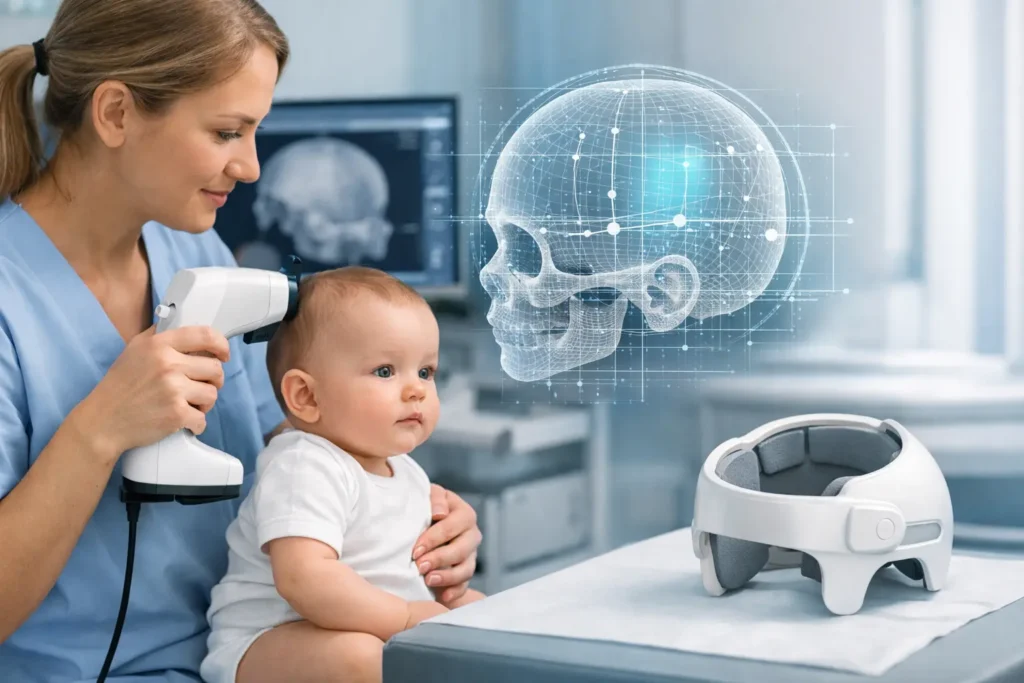
Cranial technology is one of those fields most people never think about—until they suddenly have to. A parent hears a pediatrician mention “plagiocephaly.” A clinician looks for more precise, less invasive solutions. A healthcare administrator evaluates whether advanced cranial systems are worth the investment. And almost overnight, this niche becomes very real.
This article exists for that exact moment.
If you’re here, you’re probably not looking for surface-level definitions or recycled explanations. You want to understand what cranial technology really is today, how it works in real-world settings, what problems it solves, where it shines, and where people get it wrong.
Cranial technology now sits at the intersection of biomechanics, digital imaging, pediatric care, orthotics, and data-driven personalization. It has evolved far beyond “helmets” or “head shaping” into a sophisticated ecosystem of diagnostics, custom fabrication, monitoring, and outcomes-based care.
Whether you’re a parent navigating treatment options, a clinician deepening your expertise, or a healthcare professional evaluating modern cranial solutions, this guide is designed to give you clarity, confidence, and practical insight—not theory.
Understanding Cranial Technology From the Ground Up
At its core, cranial technology refers to the medical and clinical systems used to assess, guide, and influence the growth and shape of the human skull—most commonly during infancy, when cranial bones are still malleable.
A useful analogy is orthodontics for the skull. Just as braces don’t force teeth to grow but gently guide natural movement over time, cranial technology works with biological growth patterns rather than against them. The skull expands rapidly during the first year of life, and that growth can be redirected when asymmetries or deformities are present.
Historically, clinicians relied on visual assessments, calipers, and manual molds. Outcomes varied widely depending on practitioner experience. Modern cranial technology replaced guesswork with data.
Today’s systems typically involve:
- High-resolution 3D cranial imaging
- Digital modeling and growth simulation
- Custom-fabricated orthotic devices
- Ongoing measurement and adjustment protocols
This shift matters because skull shape is not cosmetic alone. In moderate to severe cases, cranial asymmetry can affect jaw alignment, visual tracking, auditory canal positioning, and even psychosocial development later in life.
The biggest misconception is that cranial technology is experimental or optional. In reality, it is a mature, evidence-based field with standardized protocols, peer-reviewed outcomes, and decades of clinical refinement.
Why Cranial Technology Matters More Than Ever Today
The rise in cranial deformities over the past three decades is not accidental. Pediatricians began recommending back-sleeping to reduce the risk of SIDS, which unquestionably saved lives. But it also led to increased cases of positional plagiocephaly and brachycephaly.
Here’s the critical nuance many people miss: prevention guidance solved one problem and unintentionally created another. Cranial technology exists to bridge that gap safely.
Modern lifestyles also play a role. Infants spend more time in carriers, car seats, and swings. Less tummy time, less variation in head positioning, and less natural movement increase asymmetry risk.
From a clinical perspective, cranial technology allows early intervention during the narrow window when skull growth is fastest. From a family perspective, it offers reassurance that intervention can be non-invasive, temporary, and highly effective when done correctly.
Timing is everything. Most effective interventions occur between 3 and 12 months of age. Miss that window, and options become more limited, more expensive, and less predictable.
This urgency is why advanced cranial systems are no longer “nice to have” in pediatric care—they are essential.
The Evolution of Cranial Technology: From Manual to Digital Precision
Early cranial treatment relied heavily on practitioner intuition. Plaster molds were uncomfortable, imprecise, and difficult to reproduce. Adjustments were often reactive instead of proactive.
Digital cranial technology changed the entire paradigm.
Non-contact 3D scanners now capture thousands of data points in seconds. These scans create a digital twin of the infant’s head, allowing clinicians to simulate growth trajectories, predict pressure distribution, and design devices that guide expansion exactly where it’s needed.
This evolution brought several breakthroughs:
- Objective measurement replaces subjective judgment
- Consistency across clinics and practitioners
- Predictable treatment timelines
- Quantifiable outcomes for parents and insurers
Companies like Cranial Technologies pioneered standardized protocols that scaled expertise without losing personalization. That combination—standardized process with individualized design—is the hallmark of modern cranial technology.
Real-World Benefits and Use Cases of Cranial Technology
Cranial technology delivers value differently depending on who’s using it. Understanding these perspectives helps clarify why it has become so widely adopted.
For Infants and Families
The most immediate benefit is non-surgical correction during a natural growth phase. Properly designed cranial devices don’t cause pain or restrict development. Instead, they redirect growth gently, often achieving visible improvement within weeks.
Parents often report unexpected benefits: improved symmetry in facial features, better helmet tolerance than anticipated, and peace of mind from measurable progress.
For Clinicians
Cranial technology reduces diagnostic uncertainty. Instead of debating severity thresholds, clinicians can rely on objective indices and growth projections. This improves communication with families and aligns expectations from day one.
For Healthcare Systems
Standardized cranial care reduces long-term costs. Early intervention can prevent future orthodontic issues, surgical consultations, and psychosocial interventions tied to untreated deformities.
Before cranial technology, outcomes varied wildly. After its adoption, predictability became the norm.
A Step-by-Step Look at How Cranial Technology Is Applied
Understanding the process demystifies the experience and highlights why expertise matters at every stage.
The journey typically begins with assessment. A 3D scan captures cranial shape without radiation or discomfort. This scan establishes a baseline and identifies asymmetry patterns invisible to the naked eye.
Next comes clinical evaluation. Not all asymmetry requires intervention. Skilled clinicians differentiate between cosmetic variation and clinically significant deformity. This decision point prevents overtreatment—a crucial ethical consideration.
If treatment is indicated, digital modeling guides custom device fabrication. Each cranial orthosis is designed to allow growth in flattened areas while limiting expansion where shape is already optimal.
Follow-up is continuous, not passive. Regular scans track progress, and adjustments are made proactively. This is where modern cranial technology truly shines: it adapts as the child grows.
The final step is graduation—ending treatment once symmetry reaches clinically acceptable ranges. Most children complete therapy within a few months, with results that persist long-term.
Tools and Technologies That Power Modern Cranial Care
Not all cranial systems are equal. Experience reveals meaningful differences between entry-level solutions and professional-grade platforms.
High-end systems integrate scanning, modeling, and manufacturing into a closed-loop workflow. This minimizes error and ensures consistency. Entry-level options may rely on third-party scanning or manual adjustments, increasing variability.
Paid systems typically offer:
- Higher-resolution scans
- Predictive growth modeling
- Outcome benchmarking
- Clinician training and certification
Free or low-cost alternatives may appear attractive but often lack longitudinal data and standardized protocols. In cranial care, precision is not optional—it directly affects outcomes.
Expert practitioners prioritize tools that reduce human error rather than amplify it.
Common Mistakes in Cranial Technology—and How to Avoid Them
The most frequent mistake is waiting too long. Parents are often told to “wait and see,” only to discover later that optimal treatment windows have closed.
Another issue is underestimating severity based on visual inspection alone. Mild asymmetry can mask significant structural imbalance that only imaging reveals.
Improper fit is another critical failure point. A poorly designed device can stall progress or create new pressure points. This is why experience and proper technology matter more than brand names alone.
Finally, inconsistent follow-up undermines outcomes. Cranial growth is dynamic. Without regular monitoring, even well-designed devices lose effectiveness.
Avoiding these pitfalls requires both advanced technology and disciplined clinical practice.
The Future of Cranial Technology
Cranial technology continues to evolve. Artificial intelligence is being introduced to improve predictive modeling. Remote monitoring may soon reduce in-clinic visits without sacrificing accuracy.
What won’t change is the core philosophy: early, data-driven, personalized intervention that respects natural growth.
As awareness increases, cranial technology is shifting from reactive treatment to proactive care—identifying risk patterns earlier and intervening more precisely.
Conclusion: Why Cranial Technology Deserves Serious Attention
Cranial technology is not about aesthetics. It’s about timing, biology, and evidence-based care during one of the most critical growth phases of human development.
When applied correctly, it delivers predictable, measurable, and lasting outcomes with minimal disruption to a child’s life. When misunderstood or delayed, opportunities are lost.
If there’s one takeaway, it’s this: modern cranial technology works best when expertise, data, and timing align. And when they do, results speak for themselves.
FAQs
Is cranial technology safe for infants?
Yes. Modern systems are non-invasive and designed to work with natural growth patterns.
When is the best age to start cranial treatment?
Typically between 3 and 12 months, when skull growth is most rapid.
Does cranial technology replace surgery?
In many cases, early cranial intervention eliminates the need for surgical correction later.
How long does treatment usually last?
Most treatments range from 3 to 6 months, depending on severity and age.
Are results permanent?
Yes. Once corrected during growth, cranial shape remains stable long-term.

Adrian Cole is a technology researcher and AI content specialist with more than seven years of experience studying automation, machine learning models, and digital innovation. He has worked with multiple tech startups as a consultant, helping them adopt smarter tools and build data-driven systems. Adrian writes simple, clear, and practical explanations of complex tech topics so readers can easily understand the future of AI.