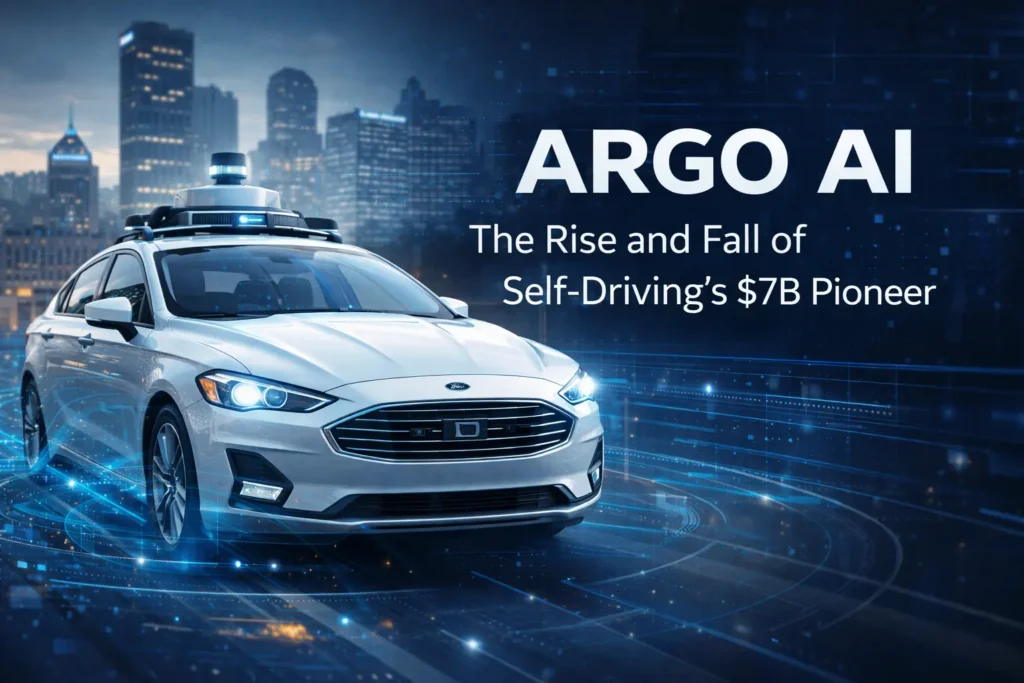
Searching for Argo AI often leads to information about a company that shut down in October 2022. Yet the story of this self-driving technology company from Pittsburgh remains crucial for understanding the autonomous vehicle industry. This comprehensive guide covers Argo AI’s full history, groundbreaking self-driving system, strategic partnerships with Ford Motor Company and Volkswagen Group, the reasons behind its closure, and what its legacy means for the future of autonomous vehicles and self-driving cars.
Founded in 2016, Argo AI quickly became one of the most well-funded and promising players in the autonomous driving space, securing investments totaling over $3.6 billion from two automotive giants. Its journey from startup to industry leader—and ultimately to its unexpected shutdown—offers invaluable lessons about the challenges of developing Level 4 self-driving capabilities.
The Rise of Argo AI: Founding and Vision
Argo AI emerged at a pivotal moment in the autonomous vehicle industry. As technology companies and automakers raced to develop self-driving systems, two robotics veterans saw an opportunity to build a company that could bridge the gap between cutting-edge research and real-world deployment.
Founders Bryan Salesky and Peter Rander
Bryan Salesky and Peter Rander founded Argo AI in Pittsburgh, Pennsylvania, bringing decades of combined experience in robotics and autonomous systems. Salesky previously worked on Google’s self-driving car project (which later became Waymo), where he gained deep expertise in hardware engineering for autonomous vehicles. Rander came from Uber’s Advanced Technologies Group, where he led engineering efforts on self-driving technology.
Both founders had strong ties to Carnegie Mellon University and its National Robotics Engineering Center (NREC), a hub for robotics innovation. This connection to Pittsburgh’s robotics ecosystem would prove crucial, as the city became Argo AI’s headquarters and primary testing ground. The founders envisioned a company that would develop a complete self-driving system—software, hardware, and sensors—capable of handling the complexity of urban environments.
The Ford and Volkswagen Power Play
In February 2017, Ford Motor Company made a bold move by investing $1 billion in Argo AI over five years, acquiring a majority stake in the startup. This investment signaled Ford’s commitment to autonomous driving and its belief that partnering with a specialized technology company was the fastest path to deploying self-driving cars at scale.
The deal structure was unique: Argo AI maintained significant operational independence while gaining access to Ford’s manufacturing capabilities, capital, and global footprint. Ford employees working on autonomous vehicle technology were transferred to Argo AI, strengthening the team’s automotive expertise.
In July 2020, the partnership expanded dramatically when Volkswagen Group invested $2.6 billion in Argo AI, combining its Autonomous Intelligent Driving (AID) division with Argo AI and creating a joint venture. This made Argo AI one of the most valuable autonomous driving companies, with a valuation exceeding $7 billion. The Volkswagen deal gave Argo AI access to European markets and VW’s engineering resources, while both automakers gained access to the same underlying self-driving technology platform.
Argo AI’s Self-Driving Technology Explained
Argo AI differentiated itself by developing a full-stack autonomous driving solution rather than focusing on just one component. This integrated approach meant the company controlled every aspect of the virtual driver system, from perception to decision-making.
Building a Full Self-Driving System (SDS)
The core of Argo AI’s offering was its Self-Driving System (SDS), which combined advanced software with custom-designed hardware. The system integrated multiple sensor types to create a comprehensive understanding of the vehicle’s surroundings:
- LIDAR (Light Detection and Ranging): Argo AI designed its own long-range LIDAR sensors after acquiring Princeton Lightwave in 2017. This proprietary LIDAR technology could detect objects up to 400 meters away, significantly farther than many competitors, giving vehicles more time to react to potential hazards.
- Cameras: Multiple high-resolution cameras provided visual information for object recognition, traffic sign detection, and semantic understanding of the environment.
- Radar: Complementary radar sensors helped detect objects in challenging weather conditions and measured the velocity of surrounding vehicles.
- Hardware Computing Platform: Custom-designed compute units processed the massive amounts of sensor data in real-time, running sophisticated AI algorithms for perception, prediction, and path planning.
The software architecture employed deep learning and machine learning techniques to interpret sensor data, predict the behavior of other road users, and make driving decisions. Argo AI invested heavily in simulation technology, enabling the company to test scenarios that would be rare or dangerous to encounter during real-world testing.
Aiming for SAE Level 4 Autonomy
Argo AI focused on achieving SAE Level 4 autonomy, as defined by the Society of Automotive Engineers (SAE). The SAE framework classifies automated driving systems on a scale from Level 0 (no automation) to Level 5 (full automation everywhere). Level 4 represents high automation where the system can handle all driving tasks within specific operational design domains without human intervention.
For Argo AI, Level 4 meant developing vehicles that could safely navigate complex urban environments—including dense city centers with pedestrians, cyclists, construction zones, and unpredictable traffic patterns—without requiring a human safety driver. The technology was designed specifically for commercial applications like ride-hailing and goods delivery, rather than consumer vehicle sales.
This focus distinguished Argo AI from automakers developing Level 2 and Level 3 Advanced Driver-Assistance Systems (ADAS), which require constant human supervision. Level 4 capability promised to enable true driverless services, fundamentally changing transportation economics by eliminating driver costs.
Road Testing and Key Partnerships
Deploying Level 4 autonomous vehicles required extensive real-world testing across diverse environments. Argo AI adopted a methodical approach to building a robust system capable of handling the full spectrum of driving scenarios.
Mapping Urban Landscapes: Miami, Austin, Washington D.C., and Beyond
Argo AI conducted testing operations in multiple cities across the United States and Germany. The company’s test fleet operated in Pittsburgh (its hometown and initial proving ground), Dearborn (near Ford’s headquarters), Miami, Washington D.C., Austin, Palo Alto, and Munich. Each city was selected to expose the self-driving system to different challenges:
- Pittsburgh’s hilly terrain, unpredictable weather, and aging infrastructure provided a demanding test environment
- Miami offered year-round testing opportunities with intense sun, heavy rain, and a diverse mix of traffic behaviors
- Washington D.C. presented complex urban navigation scenarios with aggressive drivers and heavy pedestrian traffic
- Austin and Palo Alto expanded testing to additional urban and suburban contexts
- Munich represented European driving conditions, regulations, and infrastructure
Test vehicles, modified Ford Fusion Hybrids and later Volkswagen ID.Buzz electric vans, accumulated millions of autonomous miles. The company employed both supervised testing (with safety drivers) and increasingly moved toward unsupervised operations in defined service areas, demonstrating growing confidence in the system’s capabilities.
Strategic Alliances with Lyft and Walmart
Argo AI pursued commercial partnerships to create clear paths to revenue and scale. In 2021, the company announced a collaboration with Lyft to deploy autonomous vehicles on the ride-hailing network. Starting in Miami and Austin, the partnership aimed to give consumers access to self-driving rides through the familiar Lyft app interface. This multi-city, multi-year agreement positioned Argo AI to begin commercial robotaxi operations.
Separately, Argo AI partnered with Walmart to pilot autonomous delivery services in Miami, Austin, and Washington D.C. Using modified Ford vehicles equipped with Argo’s self-driving system, the service enabled Walmart customers to have groceries and other goods delivered without a human driver. These pilots demonstrated the versatility of Level 4 technology for both passenger transport and logistics applications.
Both partnerships represented significant validation of Argo AI’s technology and business model, connecting the company to large-scale commercial networks that could eventually support widespread autonomous vehicle deployment.
The End of the Road: Why Argo AI Shut Down in 2022
Despite substantial funding, technological progress, and commercial partnerships, Argo AI ceased operations in October 2022. The shutdown sent shockwaves through the autonomous vehicle industry and prompted widespread analysis of what went wrong.
Financial Pressures and Strategic Shifts
The closure resulted from converging financial and strategic factors. Ford announced it was taking an $827 million net loss related to Argo AI as it reevaluated its autonomous vehicle strategy. Both Ford and Volkswagen concluded that Level 4 self-driving technology was taking longer and costing more than anticipated to commercialize.
Economic headwinds in 2022, including rising interest rates and recession fears, made it harder to justify continued heavy investment in technology that remained years away from profitability. Ford CEO Jim Farley indicated the company would redirect resources toward Level 2 and Level 3 Advanced Driver-Assistance Systems (ADAS) that could generate nearer-term returns and be deployed across Ford’s vehicle lineup.
Volkswagen similarly decided to focus on driver assistance features rather than fully autonomous driving. This strategic pivot reflected a broader industry reassessment: while Level 4 technology remained the ultimate goal, the path to commercialization was proving longer and more complex than many had predicted.
Reports also suggested that Argo AI had been in discussions with potential investors, including Amazon, to secure additional funding. However, these talks did not result in a deal, leaving the company dependent on its automotive backers. When Ford and Volkswagen decided to reduce their autonomous driving ambitions, Argo AI lost its financial foundation.
The Aftermath: Where Did the Assets Go?
Following the shutdown, Argo AI’s technology, intellectual property, and personnel were distributed between its parent companies. This represents a critical piece of information often missing from coverage of the company’s closure—the technology and expertise did not simply disappear.
Ford created Latitude AI, a new subsidiary focused on developing hands-free and eyes-off highway driving capabilities using technology and talent from Argo AI. Based in Pittsburgh, Latitude AI concentrates on Level 2+ and Level 3 systems that can be integrated into Ford’s consumer vehicles more quickly than Level 4 technology. The company’s work builds directly on Argo AI’s software platform, perception systems, and engineering expertise.
Volkswagen integrated Argo AI personnel and technology into its CARIAD software division, which develops driver assistance and automated driving features for VW Group brands. Additionally, Volkswagen announced partnerships with other autonomous driving companies, including Mobileye, to continue pursuing self-driving capabilities through different approaches.
Many Argo AI employees were offered positions at Ford or Volkswagen, while others joined competing autonomous vehicle companies or started new ventures. The talent pool from Argo AI, particularly engineers with experience in perception, machine learning, and robotics, proved highly sought after across the industry.
Argo AI’s Lasting Legacy and Impact
While Argo AI no longer exists as an independent company, its influence on autonomous vehicle development and the broader self-driving industry continues through multiple channels.
The Carnegie Mellon University Argo AI Center for Autonomous Vehicle Research
In 2019, Argo AI committed $15 million over five years to establish a research center at Carnegie Mellon University. The Argo AI Center for Autonomous Vehicle Research continues to operate even after the company’s closure, conducting fundamental research in perception, decision-making, and machine learning for self-driving vehicles.
The center has released open-source datasets containing real-world autonomous driving data, including sensor information from diverse urban environments. These datasets help researchers worldwide develop and test new algorithms without needing expensive test fleets. The center’s work focuses on addressing remaining technical challenges in autonomous driving, particularly handling edge cases and rare scenarios that current systems struggle with.
By maintaining this academic partnership, Argo AI ensured that its contributions to self-driving research would extend beyond the company’s operational lifetime, benefiting the broader scientific community and future autonomous vehicle development.
Lessons for the Self-Driving Industry
Argo AI’s closure marked a watershed moment for the autonomous vehicle sector, prompting a more realistic assessment of the challenges involved in developing and deploying Level 4 self-driving technology. The shutdown highlighted several critical lessons:
Timeline and Cost Realities: The path from working prototypes to profitable commercial deployment is longer and more expensive than many industry participants initially projected. Even with billions in funding, achieving the reliability and safety required for driverless operation across diverse conditions remains extremely challenging.
Market Timing: The economic environment matters. Argo AI flourished during a period of abundant capital and optimistic technology valuations, but struggled when investors and corporate backers became more risk-averse and focused on near-term profitability.
Business Model Questions: The challenge of monetizing Level 4 technology remains unresolved. Robotaxi and delivery services face regulatory hurdles, public acceptance issues, and operational complexities that complicate the path to profitability.
The Value of Incremental Progress: Ford and Volkswagen’s pivot toward Level 2+ and Level 3 systems reflects a strategic shift across the automotive industry. These advanced driver assistance features can be deployed today, generate revenue through vehicle sales, and incrementally improve over time—potentially providing a more sustainable path toward full autonomy.
Despite its closure, Argo AI demonstrated significant technical achievements. Its proprietary LIDAR technology, integrated sensor fusion approach, and real-world testing experience advanced the state of the art in autonomous driving. Companies like Waymo, Cruise, Zoox, and others continue pursuing Level 4 capabilities, building on the collective knowledge generated by the entire industry, including Argo AI’s contributions.
FAQs
What happened to Argo AI?
Argo AI ceased operations in October 2022 after its major backers, Ford Motor Company and Volkswagen Group, shifted their investment strategies away from Level 4 autonomous driving toward more near-term driver-assist technology. The decision came as both automakers reassessed the timeline and cost required to commercialize fully autonomous vehicles.
Who bought Argo AI?
No company bought Argo AI. Instead, its assets, technology, and personnel were absorbed by its main financial backers. Ford formed a new subsidiary called Latitude AI to continue developing advanced driver assistance systems, while Volkswagen integrated Argo AI technology and talent into its CARIAD software division.
What is Argo AI’s technology being used for now?
The self-driving system research and technology from Argo AI continue through its successor companies. At Ford’s Latitude AI, the focus has shifted to developing Level 2+ and Level 3 Advanced Driver-Assistance Systems (ADAS) for consumer vehicles, including hands-free highway driving features. Volkswagen is similarly using Argo AI technology to enhance driver assistance capabilities across its vehicle brands through CARIAD.
Who were the founders of Argo AI?
Argo AI was founded by Bryan Salesky and Peter Rander, both robotics veterans with extensive experience in autonomous vehicles. Salesky previously worked on Google’s self-driving car project (later Waymo), while Rander came from Uber’s Advanced Technologies Group. Both founders had connections to Carnegie Mellon University’s robotics programs.
Is Argo AI still in Pittsburgh?
The original Argo AI company is no longer operating, but its Pittsburgh engineering talent and legacy continue through successor organizations. Ford’s Latitude AI is based in Pittsburgh, employing many former Argo AI engineers. Additionally, the Carnegie Mellon University Argo AI Center for Autonomous Vehicle Research continues conducting self-driving research in the city.
What competitors are still pursuing Level 4 autonomy?
Several companies continue developing Level 4 autonomous driving technology. Waymo (owned by Alphabet) operates commercial robotaxi services in Phoenix, San Francisco, and other cities. Cruise (backed by General Motors) is testing autonomous vehicles in multiple urban markets. Other players include Zoox (owned by Amazon), Motional (a joint venture between Hyundai and Aptiv), and numerous Chinese companies like Baidu and Pony.ai.
Conclusion: Understanding Argo AI’s Place in Autonomous Vehicle History
Argo AI represents both the promise and challenges of autonomous vehicle development. Founded during the peak of optimism about self-driving technology, the company attracted massive investment, assembled world-class talent, developed sophisticated systems, and forged commercial partnerships that seemed to position it for success.
Yet even this seemingly ideal combination proved insufficient to overcome the fundamental difficulties of achieving safe, reliable, profitable Level 4 autonomy at scale. The company’s closure in 2022 did not represent a failure of technology so much as a recalibration of expectations about timelines and commercial viability.
Today, Argo AI’s legacy lives on through Latitude AI, CARIAD, the Carnegie Mellon research center, and the hundreds of engineers who gained invaluable experience developing autonomous driving systems. The lessons learned—about sensor integration, machine learning for perception, safety validation, and the gap between technical capability and commercial deployment—continue shaping how the industry approaches self-driving vehicles.
For anyone researching autonomous vehicles, understanding Argo AI’s complete story provides crucial context for evaluating current developments in self-driving technology. The company’s history illustrates why this technology is so challenging to develop, why timelines keep extending, and why the industry continues pursuing multiple approaches—from incremental driver assistance to fully autonomous robotaxis—rather than betting everything on a single vision of the future.
As the autonomous vehicle industry continues evolving, Argo AI serves as an important case study in technological ambition, strategic partnership, market dynamics, and the complex path from research breakthrough to commercial reality.

Adrian Cole is a technology researcher and AI content specialist with more than seven years of experience studying automation, machine learning models, and digital innovation. He has worked with multiple tech startups as a consultant, helping them adopt smarter tools and build data-driven systems. Adrian writes simple, clear, and practical explanations of complex tech topics so readers can easily understand the future of AI.