
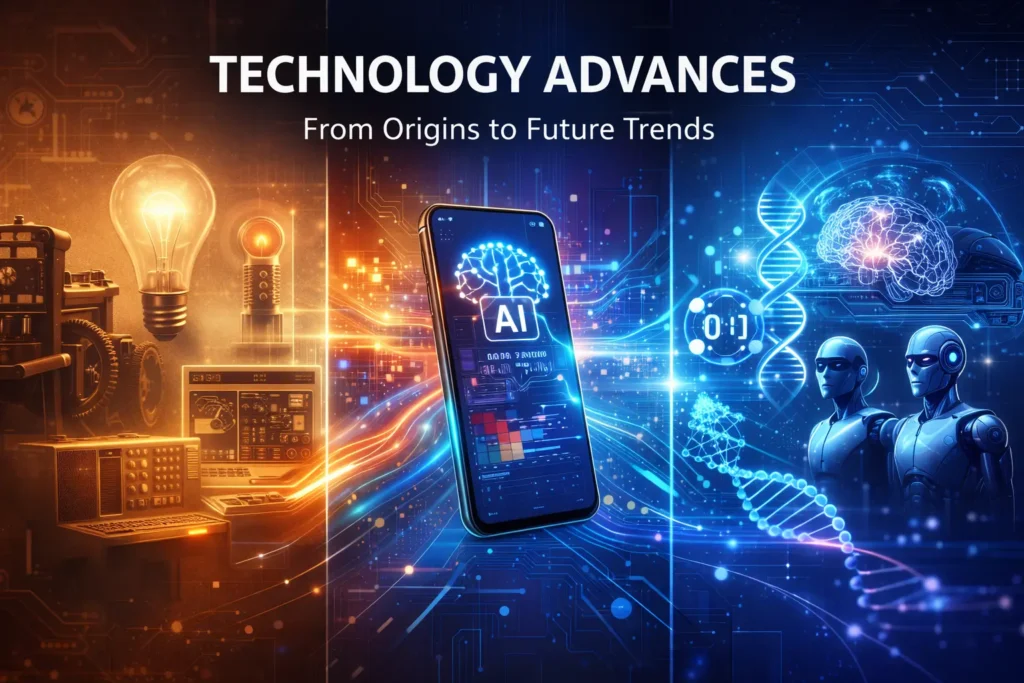
Technology advances represent the continuous process of innovation that fundamentally reshapes how humanity solves problems, communicates, and lives. From the first stone tools chipped by our ancestors over two million years ago to the sophisticated artificial intelligence systems of today, technological advancement has been the defining characteristic of human civilization. Each breakthrough builds upon previous discoveries, creating an accelerating cascade of innovation that has transformed our world beyond recognition.
This transformation has never been more rapid or profound than in our current era. The digital revolution has fundamentally altered every aspect of modern life, from how we work and communicate to how we understand ourselves and our place in the universe. Yet to truly comprehend where we’re headed, we must first understand where we’ve been. This guide traces the arc of technological progress from foundational historical breakthroughs through today’s cutting-edge developments, while examining both the immense benefits and serious challenges these advances present for society.
Understanding technology advances isn’t merely an academic exercise. As innovation continues to accelerate, the decisions we make today about developing, deploying, and regulating new technologies will shape the future of humanity for generations to come. Whether you’re a professional navigating a rapidly evolving workplace, a student preparing for an uncertain future, or simply a curious person trying to make sense of our changing world, grasping the trajectory of technological progress is essential.
The Foundation: Historical Technology Advances That Built the Modern World
Every modern convenience, from the smartphone in your pocket to the electricity powering your home, exists because of a chain of breakthroughs stretching back thousands of years. Understanding these foundational technologies reveals not just historical curiosity, but the very building blocks that enable our contemporary world. Each major advancement solved a fundamental constraint that limited human capability, opening new possibilities that previous generations could scarcely imagine.
From Tools to Systems: The Pre-Digital Leap
The story of human technological advancement begins with the most basic tools. Stone tools, first crafted over two million years ago, represented humanity’s earliest technological breakthrough. These implements extended human physical capability, allowing our ancestors to hunt more effectively, process food, and craft shelter. The mastery of fire followed, providing warmth, protection, and the ability to transform raw materials through heat. These weren’t merely conveniences—they were survival technologies that enabled human expansion across the globe.
The Bronze Age and Iron Age brought metallurgy to the forefront, revolutionizing everything from agriculture to warfare. Iron, in particular, was abundant and durable, democratizing access to effective tools and weapons in ways bronze never could. Agriculture itself, developed around 10,000 BCE, perhaps represents the most transformative technology in human history, enabling settled civilizations, food surpluses, and the specialization of labor that would eventually lead to all other technological development.
The invention of the printing press by Johannes Gutenberg around 1440 fundamentally transformed human communication and knowledge distribution. Before the printing press, books were painstakingly copied by hand, making them rare and expensive. The ability to mass-produce written material democratized knowledge, accelerated scientific discovery, and enabled the spread of ideas that would reshape society through movements like the Renaissance and the Reformation. This was the first true information revolution, creating a blueprint for how transformative communication technologies could be.
The steam engine, refined by James Watt in the late 18th century, launched the Industrial Revolution. By converting heat energy into mechanical work, steam power freed human production from the limitations of muscle power, water wheels, and windmills. Factories could be built anywhere, ships could travel against wind and current, and trains could transport goods and people at unprecedented speeds. This single technology reconfigured global economics, urbanized societies, and set the stage for modern industrial capitalism.
Electricity, harnessed and distributed in the late 19th and early 20th centuries, represents perhaps the most fundamental enabling technology of the modern world. Unlike any power source before it, electricity could be instantly transmitted over distances, converted into multiple forms of energy, and applied to countless applications. From lighting cities to powering computers, electricity undergirds virtually every aspect of contemporary life. Thomas Edison’s light bulb and Nikola Tesla’s alternating current systems didn’t just provide illumination—they created the infrastructure upon which the 20th century would be built.
The Digital Revolution’s Building Blocks
While the steam engine and electricity transformed physical capability, the digital revolution would transform information processing itself. This transformation began with the transistor, invented at Bell Labs in 1947. The transistor could amplify electrical signals and act as an electronic switch, replacing bulky vacuum tubes with a device small enough to fit on a fingernail. This wasn’t simply an improvement—it was a fundamental breakthrough that made miniaturization possible.
The transistor led directly to the development of semiconductor chips and integrated circuits in the 1950s and 1960s. These integrated circuits placed multiple transistors on a single piece of silicon, creating complex electronic systems in tiny packages. Gordon Moore, co-founder of Intel, observed in 1965 that the number of transistors on integrated circuits doubled approximately every two years—a trend that became known as Moore’s Law. This exponential growth in computing power would drive the digital revolution for decades, enabling computers to shrink from room-sized mainframes to pocket-sized smartphones while simultaneously becoming millions of times more powerful.
The development of TCP/IP (Transmission Control Protocol/Internet Protocol) in the 1970s created the foundation for the Internet. These communication protocols established a common language allowing different computer networks to interconnect, creating a “network of networks.” Initially developed for military and academic purposes, the Internet would eventually connect billions of devices worldwide, fundamentally transforming commerce, communication, and culture. The World Wide Web, created by Tim Berners-Lee in 1989, made this network accessible to ordinary people through browsers and hyperlinked documents.
Understanding these building blocks—transistors enabling miniaturization, integrated circuits enabling complexity, and networking protocols enabling connection—is crucial because they demonstrate a key pattern in technological advancement: breakthroughs don’t exist in isolation. Each innovation creates a platform for future developments. The transistor enabled the integrated circuit, which enabled the personal computer, which enabled the Internet, which enabled social media, cloud computing, and artificial intelligence. This compounding effect explains why technological change appears to be accelerating—each new layer of innovation provides a foundation for even more rapid advancement in the next generation.
The Present Frontier: Defining Advances of the 21st Century
If the 20th century was defined by harnessing physical energy and creating digital infrastructure, the 21st century is being defined by making that infrastructure intelligent, autonomous, and interconnected. The technologies emerging and maturing in our era aren’t simply faster or more efficient versions of what came before—they represent fundamental shifts in capability that blur the lines between the physical and digital worlds, between human and machine intelligence, and between what we consider possible and impossible.
The Intelligence Revolution: AI and Machine Learning
Artificial intelligence represents perhaps the most transformative technology of our time. While AI research dates back to the 1950s, only in the past decade have we achieved the combination of data, computing power, and algorithmic sophistication necessary to create truly capable AI systems. Modern AI, particularly through machine learning and deep learning approaches, can now perform tasks that previously required human intelligence: recognizing faces in photos, translating languages, diagnosing diseases from medical images, driving cars, and even engaging in sophisticated conversations.
Machine learning algorithms learn patterns from data rather than following explicitly programmed rules. Feed an ML system millions of labeled images, and it learns to recognize objects. Provide it with vast amounts of text, and it learns language patterns. This ability to improve through experience, rather than through manual programming, has unlocked applications across virtually every industry. Deep learning, which uses artificial neural networks inspired by the human brain’s structure, has proven particularly powerful for complex pattern recognition tasks.
The impact of AI extends far beyond parlor tricks like beating humans at chess or Go, though DeepMind’s AlphaGo achievement in 2016 demonstrated AI’s capability to master complex strategic thinking. In healthcare, AI systems analyze medical images with accuracy matching or exceeding specialist physicians, potentially democratizing access to expert diagnosis. In scientific research, AI accelerates drug discovery, protein folding research, and materials science. Large language models like GPT and Claude can assist with writing, coding, analysis, and creative tasks, augmenting human capability in knowledge work.
Crucially, AI’s current capabilities exist because of specialized hardware developed specifically for neural network computation. Graphics Processing Units (GPUs), originally designed for rendering video game graphics, turned out to be ideal for the parallel calculations AI requires. Companies like NVIDIA have developed even more specialized chips like Tensor Processing Units (TPUs) and dedicated AI accelerators. This hardware-software co-evolution demonstrates again how technological advances build upon each other—the transistor enabled the integrated circuit, which enabled the microprocessor, which enabled specialized AI chips, which enabled modern machine learning.
Beyond Binary: Quantum Computing and Biotechnology
While AI leverages conventional computers pushed to their limits, quantum computing promises to transcend those limits entirely. Classical computers process information as bits—discrete units that are either 0 or 1. Quantum computers use quantum bits, or qubits, which can exist in multiple states simultaneously through a phenomenon called superposition. This allows quantum computers to explore many possible solutions to a problem at once, potentially solving certain types of calculations exponentially faster than any classical computer could.
Quantum computing remains largely experimental, with challenges around maintaining the delicate quantum states required for computation and scaling beyond a few dozen qubits. However, recent advances by companies like IBM, Google, and startups like Rigetti and IonQ suggest we’re approaching the threshold where quantum computers can solve problems classical computers cannot. Potential applications include simulating molecular interactions for drug discovery, optimizing complex logistics problems, breaking current encryption schemes, and advancing materials science.
In biotechnology, CRISPR gene-editing technology has emerged as a revolutionary tool for precisely modifying DNA. Discovered as a bacterial immune system and adapted for genetic engineering in 2012, CRISPR allows scientists to edit genes with unprecedented accuracy and ease. This technology opens possibilities ranging from curing genetic diseases to creating drought-resistant crops to potentially eliminating mosquito-borne illnesses like malaria. The ethical implications are profound—CRISPR gives humanity the ability to directly shape evolution itself.
Synthetic biology extends this further, treating biological systems as programmable systems similar to computers. Researchers are designing organisms that produce biofuels, manufacture pharmaceuticals, or consume plastic waste. The convergence of biotechnology with AI and automation promises to accelerate biological research dramatically, potentially leading to breakthroughs in personalized medicine, life extension, and addressing environmental challenges.
The Connected Fabric: IoT, 5G/6G, and Blockchain
The Internet of Things (IoT) represents the proliferation of internet-connected devices beyond computers and smartphones into virtually every object imaginable. Sensors monitor industrial equipment to predict failures before they occur. Smart home devices adjust heating and lighting automatically. Wearable health monitors track vital signs continuously. Connected cars communicate with traffic infrastructure to optimize routing and safety. Estimates suggest there will be over 75 billion IoT devices by 2025, creating a vast web of connected intelligence.
These connected devices require robust, low-latency networks to function effectively. Fifth-generation (5G) cellular networks, currently being deployed globally, provide dramatically faster speeds and lower latency than previous generations, enabling real-time applications like autonomous vehicles and remote surgery. Research into 6G technology, expected to deploy in the 2030s, promises even greater capabilities including integration with AI at the network level, holographic communications, and potentially connecting not just devices but entire environments.
Blockchain technology, the distributed ledger system underlying cryptocurrencies like Bitcoin, offers a different kind of connectivity—one based on decentralized trust rather than centralized authority. By creating permanent, tamper-proof records distributed across many computers, blockchain enables parties who don’t trust each other to transact directly without intermediaries. Beyond cryptocurrency, potential applications include supply chain verification, digital identity management, voting systems, and smart contracts that execute automatically when conditions are met.
The convergence of these technologies—IoT generating massive data streams, 5G providing the bandwidth to transmit it, AI analyzing patterns within it, and blockchain ensuring its integrity—represents more than the sum of its parts. This interconnected technological ecosystem is creating new capabilities and business models while also raising complex questions about privacy, security, and control in an increasingly instrumented world.
Analyzing the Impact: The Dual Edges of Advancement
Technology has always been a double-edged sword, simultaneously creating benefits and challenges. The printing press democratized knowledge but also enabled propaganda. The automobile provided unprecedented mobility but also pollution and traffic fatalities. Nuclear technology offers clean energy but also existential weapons. Today’s advances continue this pattern, though the scale and complexity of impacts have grown exponentially. Understanding these dual edges is crucial for making informed decisions about technological development and deployment.
The Transformative Benefits
The efficiency and productivity gains from modern technology are staggering. Automation handles repetitive tasks faster and more accurately than human workers ever could. AI-powered tools augment human capabilities across knowledge work, from legal research to software development. Cloud computing allows small businesses to access enterprise-level computing resources on demand. These efficiency improvements translate directly into economic growth and higher living standards, with technology driving productivity increases that have lifted billions out of poverty over recent decades.
Medical breakthroughs enabled by technology have extended human lifespans and improved quality of life dramatically. Imaging technologies like MRI and CT scans allow physicians to see inside the body without surgery. Minimally invasive robotic surgery reduces recovery times and complications. Telemedicine extends specialist care to remote areas. Genomic sequencing, which cost billions for the first human genome in 2003, now costs less than $1,000, enabling personalized medicine tailored to individual genetic profiles. CRISPR offers hope for curing genetic diseases once thought untreatable.
Global communication has been revolutionized beyond recognition. The Internet connects half of humanity, enabling instant communication across any distance. Social media platforms allow individuals to share ideas and organize movements with reach that once required mass media infrastructure. Video conferencing became essential infrastructure during the COVID-19 pandemic, enabling remote work and learning. Translation technologies break down language barriers. The democratization of information access and communication represents one of humanity’s great achievements.
Renewable energy technologies like solar panels and wind turbines, combined with improved battery storage, offer pathways to addressing climate change. Solar panel efficiency has improved dramatically while costs have plummeted, making renewable energy cost-competitive with fossil fuels in many regions. Electric vehicles are becoming mainstream, reducing urban air pollution. Smart grid technologies optimize energy distribution. While environmental challenges remain severe, technology provides essential tools for addressing them.
Job displacement from automation and AI represents one of the most significant economic challenges of our era. While technology historically creates new types of work as it eliminates old ones, the pace of change today may be faster than workers can adapt. Manufacturing jobs have declined dramatically in developed nations due to automation. Self-driving vehicles threaten millions of driving jobs. AI increasingly performs cognitive tasks once thought uniquely human, from legal document review to medical diagnosis. The transition may create significant hardship even if new opportunities eventually emerge.
However, the reality is more nuanced than simple displacement. Technology also creates entirely new categories of employment. The app economy didn’t exist fifteen years ago; now it employs millions. Social media management, data science, AI ethics, and cybersecurity are thriving fields that barely existed a generation ago. The challenge lies not in whether jobs will exist, but in ensuring workers have opportunities to acquire necessary skills and transition to new roles. This requires investment in education, training programs, and social support systems.
Privacy and security concerns have become critical as our lives increasingly occur in digital spaces. Every online action generates data, from browsing habits to location tracking to purchase history. Companies and governments collect, analyze, and monetize this information in ways users often don’t understand or consent to meaningfully. Data breaches expose sensitive personal information. Sophisticated cyber attacks threaten critical infrastructure. Surveillance technologies enable monitoring at scales previously impossible, raising concerns about civil liberties and authoritarian abuse.
The environmental impact of technology itself presents paradoxes. While clean energy technologies offer solutions to climate change, the technology sector also contributes significantly to environmental problems. Data centers consume enormous amounts of electricity. Manufacturing electronics requires rare earth minerals often mined destructively. Electronic waste (e-waste) containing toxic materials accumulates in landfills, particularly in developing nations. Cryptocurrency mining consumes as much electricity as entire nations. Addressing these environmental costs is essential for sustainable technological progress.
Social isolation and mental health impacts have emerged as serious concerns in our hyper-connected world. Social media, while connecting people globally, can also foster comparison, anxiety, and depression. Constant connectivity creates expectations of immediate availability, eroding work-life boundaries. Gaming and smartphone addiction affect millions. Misinformation spreads rapidly through social networks, polarizing communities and undermining shared truth. The psychological impacts of living in always-on digital environments are only beginning to be understood.
The digital divide exacerbates inequality both within and between nations. While technology offers enormous opportunities, those without access to digital tools, high-speed internet, and digital literacy skills are increasingly disadvantaged. Rural areas often lack broadband infrastructure. Low-income families may not afford devices or data plans. Elderly populations may struggle with digital interfaces. As more services and opportunities move online, those on the wrong side of the digital divide face growing barriers to education, employment, healthcare, and civic participation.
The Future Horizon: What’s Next in Technological Innovation
Predicting the future of technology is notoriously difficult—the innovations that matter most are often those we don’t see coming. However, certain trends and emerging technologies show clear potential to shape the coming decades. Understanding these potential developments helps individuals and organizations prepare for change, while recognizing that the future will likely bring surprises we can’t anticipate.
Top Emerging Technologies to Watch
Brain-computer interfaces (BCIs) represent one of the most ambitious frontiers in technology. Companies like Neuralink are developing implantable devices that could allow direct communication between brains and computers. Near-term applications focus on helping paralyzed individuals control computers or prosthetic limbs through thought alone. Longer-term visions include augmenting human cognitive capabilities, enabling direct brain-to-brain communication, or downloading skills directly to the brain. While these remain speculative, progress in neuroscience and miniaturization suggests BCIs will become increasingly practical.
Autonomous robotics extends beyond self-driving cars to encompass a wide range of physical AI systems. Warehouse robots already automate logistics for companies like Amazon. Agricultural robots can plant, monitor, and harvest crops with minimal human intervention. Domestic robots may eventually handle household tasks from cooking to eldercare. Drone delivery systems are being tested globally. The integration of advanced AI with sophisticated sensors and mechanical systems promises to automate physical work much as computers automated information work.
Green technology and sustainable innovation have become urgent priorities as climate change impacts accelerate. Next-generation nuclear reactors promise safer, cleaner energy with reduced waste. Carbon capture technologies aim to remove CO2 from the atmosphere or industrial emissions. Vertical farming and alternative proteins could revolutionize food production with lower environmental impacts. Circular economy innovations focus on eliminating waste through better design and recycling. The World Economic Forum’s 2025 technology trends consistently highlight sustainability solutions as critical developments.
Augmented reality (AR) and virtual reality (VR) technologies are maturing beyond gaming into practical applications. AR overlays digital information onto the physical world through devices like smart glasses, useful for everything from surgical guidance to industrial maintenance to navigation. VR creates fully immersive digital environments for training simulations, virtual meetings, design visualization, and therapeutic applications. As hardware improves and becomes less cumbersome, these technologies may fundamentally change how we interact with information and each other.
Advanced materials science promises innovations that enable other technologies. Graphene, a material just one atom thick but incredibly strong and conductive, could revolutionize electronics, batteries, and structural materials. Self-healing materials that repair damage autonomously could extend product lifespans. Smart materials that change properties in response to environmental conditions enable adaptive systems. Metamaterials with properties not found in nature could enable invisibility cloaks, perfect lenses, or exotic antennas.
Preparing for a World of Continuous Advance
Professional development in an era of rapid technological change requires a fundamentally different approach than in the past. When specific technical skills become obsolete within years or even months, the most valuable capabilities are meta-skills: learning how to learn, adapting to new tools and processes quickly, and thinking critically about which technologies to adopt. Digital literacy—understanding not just how to use technology but how it works and its implications—has become as essential as reading and writing.
Specific skill areas show particular promise for career development. Data literacy—the ability to work with, analyze, and communicate insights from data—proves valuable across industries as data-driven decision-making becomes standard. Understanding AI and machine learning, at least conceptually, helps workers collaborate with AI tools effectively rather than being displaced by them. Cybersecurity expertise remains in high demand as threats grow. Human-centered skills like creativity, emotional intelligence, complex problem-solving, and ethical reasoning become more valuable precisely because they’re difficult for AI to replicate.
Lifelong learning has shifted from optional to essential. Online learning platforms like Coursera, edX, and specialized bootcamps provide accessible paths to acquiring new skills. Many professionals now expect to change careers multiple times, requiring continuous education and skill development. Organizations that invest in employee learning and development gain competitive advantages, while individuals who embrace continuous learning remain adaptable in changing job markets.
Ethical frameworks and responsible innovation have become central concerns as technology’s power and reach expand. How should AI systems make decisions that affect human lives? Who owns data and how can it be used? How do we ensure technological benefits are distributed equitably rather than concentrating in a few hands? What safeguards prevent misuse of powerful technologies? These questions don’t have purely technical answers—they require societal deliberation, democratic input, and thoughtful governance.
Building trust in technology requires transparency about how systems work, accountability when they fail, and meaningful consent for data collection and use. Diversity in technology development ensures different perspectives inform design decisions, helping avoid bias and blind spots. Public participation in technology governance helps align innovation with social values. As technology becomes more powerful and pervasive, these trust signals and democratic practices become more crucial.
Ultimately, preparing for the future means recognizing that change is the only constant. The specific technologies that dominate in 2035 or 2045 may differ radically from today’s predictions. But the fundamental pattern—accelerating innovation building upon previous advances, creating both opportunities and challenges that require thoughtful navigation—will almost certainly continue. Success, both individual and societal, depends on developing the flexibility, learning capacity, and ethical grounding to harness technology’s benefits while mitigating its risks.
Conclusion: Shaping the Trajectory of Progress
Technology advances are not an external force acting upon humanity—they are the result of human choices, investments, and priorities. From the first stone tools to artificial intelligence, each breakthrough emerged from human ingenuity applied to human problems. The trajectory of technological progress is neither predetermined nor uncontrollable. Every day, researchers, entrepreneurs, policymakers, and citizens make decisions that collectively shape which technologies develop, how they’re deployed, and who benefits from them.
The history explored in this guide reveals clear patterns: technological advances build upon each other in compounding ways, creating exponential rather than linear change. What begins as a laboratory curiosity can become world-changing within decades. Foundational technologies like electricity or the Internet enable countless derivative innovations. Each advance creates new possibilities but also new responsibilities and new risks that must be managed thoughtfully.
The present moment is unique in several respects. The pace of innovation appears faster than ever, with multiple transformative technologies maturing simultaneously. The global nature of modern science and engineering means breakthroughs can emerge anywhere and spread everywhere rapidly. The stakes are higher than ever, with technologies capable of both solving existential challenges like climate change and creating new existential risks through biological weapons, AI misalignment, or dystopian surveillance.
Yet despite these challenges and uncertainties, there are compelling reasons for optimism. Humanity has successfully navigated previous technological transitions, from agriculture to industrialization to digitization. Each transition created disruption and hardship but ultimately expanded human capability and opportunity. The same innovation driving change also provides tools to address the problems it creates—AI can detect bias in algorithms, blockchain can increase transparency, renewable energy can mitigate climate change.
The critical question is not whether technology will continue advancing—it almost certainly will. The question is whether those advances will be guided by wisdom, deployed equitably, and governed democratically to maximize benefits while minimizing harms. This requires active engagement from people across society, not just technologists. It requires asking difficult questions about values and priorities, not just celebrating innovation for its own sake.
For individuals, this means developing the knowledge and skills to participate meaningfully in a technological society while maintaining critical perspective. For organizations, it means innovation balanced with responsibility and stakeholder engagement. For societies, it means creating governance structures that can keep pace with technological change while preserving human agency and dignity. The societal transformation driven by technology is not something that happens to us—it’s something we create together through millions of individual and collective choices.
The future of technology advances remains unwritten. The tools and knowledge exist to build futures ranging from dystopian to utopian, with most realistic possibilities lying somewhere between. Shaping the trajectory of progress toward human flourishing requires engagement, vigilance, and the courage to make difficult choices about which innovations to pursue, how to develop them, and how to ensure their benefits serve humanity broadly. That responsibility belongs to all of us.
FAQs
What has been the single most important technological advance in history?
While impossible to identify a single “most important” technology given how advances build upon each other, electricity stands out as perhaps the most foundational enabling technology of the modern world. Electricity can be instantly transmitted over distances, converted into multiple forms of energy, and applied to countless applications from lighting to computing to manufacturing. Virtually every contemporary technology depends on electrical power. The Internet represents another candidate—it has fundamentally transformed human communication, commerce, and knowledge access in ways comparable to the printing press but at far greater scale and speed. Ultimately, the “most important” technology depends on your frame of reference and which aspects of human advancement you prioritize.
What are the most promising emerging technologies today?
Several technologies show exceptional promise for transforming society in coming decades. Artificial intelligence continues advancing rapidly, with applications expanding across healthcare, scientific research, education, and creative fields. Quantum computing, while still largely experimental, could solve problems impossible for classical computers in areas like drug discovery, materials science, and cryptography. CRISPR and other gene-editing technologies offer unprecedented ability to treat genetic diseases and enhance agricultural productivity. Sustainable technologies including next-generation nuclear power, advanced solar panels, battery storage, and carbon capture could be crucial for addressing climate change. Brain-computer interfaces may eventually augment human cognitive capabilities in profound ways. The convergence of these technologies—AI-designed drugs tested with quantum simulations, for example—may prove more transformative than any single advance.
How do technological advances affect employment?
Technology’s impact on employment is complex and often paradoxical. Automation and AI do displace workers from specific tasks and roles—manufacturing automation has eliminated millions of jobs, and AI increasingly performs cognitive tasks from legal research to medical diagnosis. However, technology also creates entirely new categories of employment that didn’t previously exist. The app economy, social media management, data science, cybersecurity, and countless other fields employ millions in roles that barely existed a generation ago. Historically, technology has created more jobs than it eliminates, though transitions can be painful for displaced workers. The challenge today is that change may be happening faster than workers can adapt through retraining. Success requires investment in education, worker retraining programs, and social support systems to help people transition to new opportunities. The most secure careers combine technical skills with uniquely human capabilities like creativity, emotional intelligence, and complex problem-solving.
What are the biggest ethical concerns with new technologies like AI?
AI and other emerging technologies raise several critical ethical concerns. Bias in AI systems can perpetuate or amplify discrimination when algorithms are trained on historical data reflecting societal prejudices. Privacy concerns intensify as AI systems analyze vast amounts of personal data to make consequential decisions about employment, credit, healthcare, and criminal justice. Accountability becomes murky when AI systems make decisions—who is responsible when an autonomous vehicle causes an accident or a hiring algorithm discriminates? Job displacement from automation threatens economic security for millions. Concentration of AI capabilities in a few powerful companies or nations raises concerns about power imbalances. Autonomous weapons systems pose risks of algorithmic warfare. Perhaps most fundamentally, as AI systems become more capable, questions about control and alignment—ensuring AI systems remain beneficial and aligned with human values—become increasingly urgent. Addressing these concerns requires ethical frameworks, thoughtful regulation, transparency in AI development, diversity among technology creators, and meaningful public participation in technology governance.
How can individuals stay updated with rapid technological change?
Staying current with technological change requires developing habits of continuous learning. Follow reputable technology news sources like MIT Technology Review, Wired, Ars Technica, or The Verge for accessible coverage of developments. Academic journals and preprint servers like arXiv provide cutting-edge research, though they require more technical background. Technology companies’ blogs and developer conferences often showcase emerging innovations. Online learning platforms including Coursera, edX, Udacity, and specialized bootcamps offer structured courses on everything from AI to blockchain to data science. Develop a portfolio of skills rather than deep specialization in a single technology that may become obsolete. Most importantly, cultivate a mindset of curiosity and adaptability—the specific technologies that matter in five years may not exist today, but the habit of continuous learning will always remain valuable. Engaging with technology thoughtfully as a user, not just a consumer, helps develop intuitions about how systems work and where innovation is heading.

Adrian Cole is a technology researcher and AI content specialist with more than seven years of experience studying automation, machine learning models, and digital innovation. He has worked with multiple tech startups as a consultant, helping them adopt smarter tools and build data-driven systems. Adrian writes simple, clear, and practical explanations of complex tech topics so readers can easily understand the future of AI.