
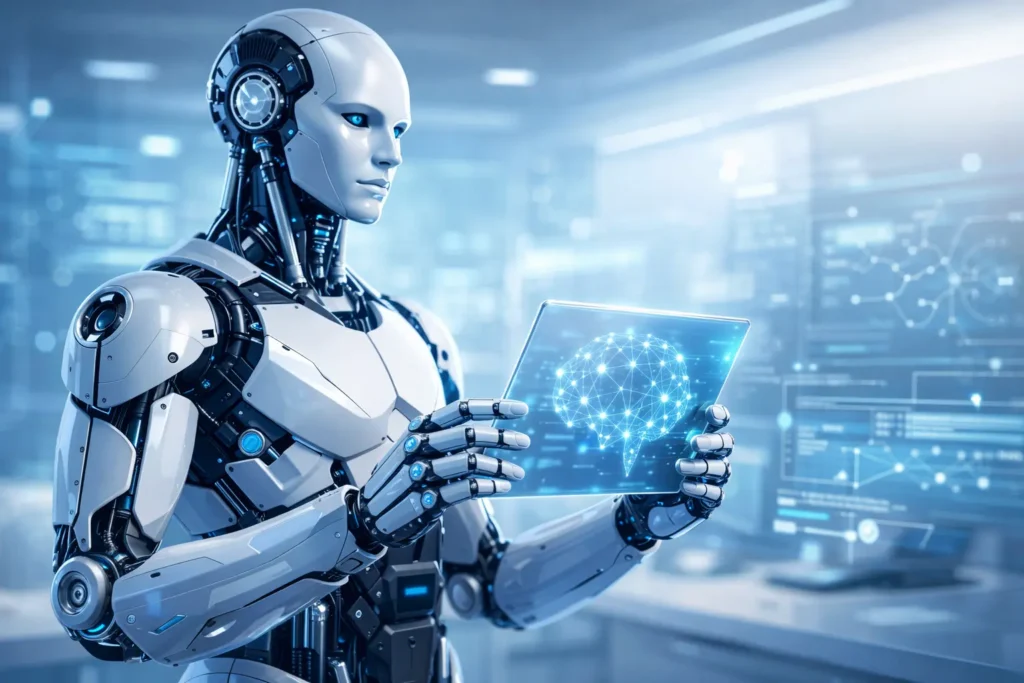
The age of truly intelligent robots has arrived. In 2026, we’re witnessing a remarkable convergence of artificial intelligence and robotics that’s creating machines capable of understanding their environment, learning from experience, and performing complex tasks with minimal human intervention. From humanoid assistants preparing meals in our homes to industrial robots revolutionizing manufacturing floors, AI-powered robots represent one of the most transformative technologies of our time.
This comprehensive guide explores everything you need to know about AI robots: what makes them different from traditional automation, how their sophisticated ‘brains’ actually work, the various types and applications transforming industries, and practical guidance for businesses and enthusiasts looking to engage with this rapidly evolving field.
What is an AI Robot? Beyond Automation to Intelligence
The term AI robot refers to a physical machine that combines robotics hardware with artificial intelligence software, enabling it to perceive its environment, make decisions, and take actions autonomously. Unlike traditional pre-programmed robots that follow rigid sequences of instructions, AI-powered robots can adapt to changing conditions, learn from experience, and handle unpredictable situations.
The key distinction lies in embodied AI and physical AI—the integration of advanced machine learning models with robotic bodies that can interact with the real world. A factory robot welding the same car part repeatedly isn’t truly an AI robot; it’s executing a programmed routine. By contrast, a general-purpose robot like Figure’s Figure 03 or Sanctuary AI’s Phoenix can observe a new task being performed by a human, understand the goal, and replicate it in different contexts—adapting grip pressure, adjusting to object placement variations, and even recovering from errors.
This shift from task-specific programming to autonomous learning and reasoning represents a fundamental evolution in robotics. Modern AI robots don’t just move—they think, perceive, and respond intelligently to their surroundings.
Core Technologies: How AI Robots Think and Act
Understanding how AI robots work requires examining three interconnected systems: the computational ‘brain’ that processes information and makes decisions, the perceptual and reasoning systems that interpret the world and plan actions, and the physical body that executes tasks with precision.
The ‘Brain’: From LLMs to Robotics Foundation Models
The revolution in AI robotics closely parallels the breakthrough in large language models (LLMs). Just as ChatGPT demonstrated that a single model trained on vast amounts of text could perform remarkably diverse language tasks, robotics researchers discovered that foundation models trained on massive datasets of robotic interactions could generalize across different tasks and environments.
Companies like Google DeepMind with their Gemini Robotics platform and Skild AI with their Skild Brain have pioneered this unified model approach. Rather than programming a robot with separate algorithms for navigation, object recognition, grasping, and manipulation, these foundation models learn all these capabilities together through exposure to diverse training data—including millions of hours of human video, simulated environments, and real-world robotic experiences.
What makes this approach powerful is transfer learning. A robot that has learned to pick up and place objects in a warehouse can apply that knowledge to organizing items in a kitchen. The foundation model understands fundamental concepts about physics, object properties, and spatial relationships that apply across contexts.
Perception to Action: VLA and Embodied Reasoning
The nervous system connecting an AI robot’s sensors to its actuators relies on vision-language-action (VLA) models. Think of VLA as the robot’s sensory processing and motor control system working in concert.
Vision components process input from cameras and depth sensors, identifying objects, understanding spatial relationships, and tracking movement. Language capabilities allow the robot to understand natural language commands (‘please fold the towels’) and describe what it’s doing. The Action component translates these high-level understandings into specific motor commands—calculating joint angles, grip forces, and movement trajectories.
Complementing VLA models are embodied reasoning (ER) systems—essentially the robot’s planning cortex. When faced with a multi-step task like preparing a sandwich, the ER system breaks it down into a sequence of actions, predicts the outcomes of different approaches, and adjusts the plan based on what actually happens. If the bread falls, the robot doesn’t freeze—it recognizes the problem, formulates a new plan, and continues toward its goal.
The Body: Humanoid Design and Dexterous Manipulation
While AI provides the intelligence, the physical robot body determines what tasks are actually possible. The trend toward humanoid robots—machines with two arms, two legs, and roughly human proportions—isn’t merely aesthetic. Our world is designed for human bodies: doorways, stairs, tools, and appliances all assume human size and capability.
Critical capabilities that define advanced robotic bodies include:
- Dexterity and fine motor skills: Advanced hands with multiple articulated fingers that can handle delicate objects, from eggs to electronics, with appropriate force control
- Tactile feedback: Pressure sensors in fingertips that allow robots to sense how firmly they’re gripping objects and adjust accordingly
- Manipulation capabilities: The ability to use tools, open containers, press buttons, and perform complex object interactions
- Dynamic balance and navigation: For mobile robots, the ability to walk on varied terrain, climb stairs, and maintain stability when reaching or carrying loads
Types & Applications: From Home Help to Industrial Power
AI robots are being deployed across three major domains, each with distinct technical requirements and development timelines.
Consumer & Home Robots
Representative examples: Figure AI’s Figure 03, 1X Technologies’ Neo
The vision of a home robot that can assist with daily life—loading dishwashers, folding laundry, organizing spaces, or keeping an eye on elderly family members—represents the consumer-facing frontier of AI robotics. Companies like Figure AI and 1X Technologies are developing humanoid robots specifically designed to navigate home environments and perform household tasks that currently require human attention.
Current capabilities include basic object manipulation, simple cleaning tasks, and monitoring functions. The robots can understand verbal instructions, identify objects through computer vision, and execute straightforward sequences like picking up items and placing them in designated locations.
Reality check: Despite impressive demonstrations, truly capable home robots remain years away from widespread deployment. Current systems excel at specific tasks in controlled conditions but still struggle with the infinite variability of real homes—different floor plans, lighting conditions, object types, and unexpected situations. Most companies are pursuing a phased rollout, beginning with trusted tester programs and early adopter communities before eventual mass-market availability.
Industrial & Logistics Robots
Representative examples: Sanctuary AI’s Phoenix, Apptronik’s Apollo
The industrial robot sector represents the most immediate commercial opportunity for AI robotics. Facing acute labor shortages in manufacturing, logistics, packing, and inspection roles, industries are actively seeking automation solutions that can handle tasks currently performed by human workers.
What makes AI robots particularly valuable for these applications is their ability to handle dull, dirty, and dangerous jobs—repetitive assembly line work, warehouse operations in extreme temperatures, or inspection tasks in hazardous environments. Unlike traditional fixed automation that requires extensive custom engineering for each specific task, general-purpose AI robots can be deployed across multiple roles within a facility, retrained for new products, and adapted as operations evolve.
Key applications include:
- Manufacturing: Assembly, quality control, machine tending, and material handling
- Logistics: Order picking, packing, sorting, and inventory management
- Inspection: Visual quality checks, equipment monitoring, and maintenance
- Security: Facility monitoring, perimeter patrols, and anomaly detection
DIY, Educational & Research Platforms
Representative examples: MakeAIRobots.com tutorials, AIRoA consortium initiatives
For students, hobbyists, and researchers, accessible platforms enable hands-on exploration of AI robotics principles without enterprise-scale budgets. Resources like MakeAIRobots.com provide step-by-step tutorials for building basic AI-powered robots using affordable hardware like micro:bit controllers and Google’s Teachable Machine for training custom vision models.
The AI Robotics Open Alliance (AIRoA) and similar consortiums promote open platforms and organize competitions that drive innovation in the field. These initiatives provide researchers with standardized benchmarks, shared datasets, and collaborative development environments that accelerate progress.
Educational applications range from teaching fundamental programming and engineering concepts to advanced graduate research in machine learning, computer vision, and control systems. The democratization of AI robotics tools means that innovative ideas can emerge from anywhere—university labs, maker spaces, or home workshops.
Key Players and Partnerships Shaping the Future
The AI robotics ecosystem involves diverse players working at different layers of the technology stack. Understanding who’s building what clarifies the current landscape and future trajectories.
| Category | Companies | Focus | Key Technology |
| Hardware Companies | Figure AI, 1X Technologies, Sanctuary AI, Apptronik | Humanoid robot platforms for consumer and industrial markets | Advanced dexterity, mobility, sensor integration |
| AI Platform Providers | Google DeepMind (Gemini), Skild AI | Foundation models and ‘robot brains’ that enable general-purpose capabilities | VLA models, embodied reasoning, unified AI architectures |
| Ecosystem Builders | AIRoA (AI Robotics Open Alliance), MakeAIRobots | Open standards, education, developer communities | Open platforms, competitions, educational resources |
Partnerships and collaboration define the development model in this space. Hardware companies integrate AI platform providers’ models into their robots, while participating in trusted tester programs with select industrial customers to refine capabilities in real-world conditions. The developer community benefits from increasingly accessible APIs and SDKs that allow independent innovators to build applications on these platforms.
Getting Started with AI Robotics
Whether you’re a business evaluating automation opportunities or an individual interested in learning AI robotics, clear pathways exist for engagement at different levels.
For Businesses and Developers
Organizations exploring AI robotics should begin with a clear assessment of their needs:
- Identify pain points: Which tasks are repetitive, labor-intensive, or difficult to staff? Where do errors most frequently occur?
- Evaluate AI platforms: Compare offerings from providers like Google’s Gemini SDK and Skild’s API. Consider factors like ease of integration, required compute resources, and support for your specific robotic hardware.
- Explore hardware partnerships: Many robot manufacturers offer pilot programs where they deploy systems in customer facilities to demonstrate value before full-scale investment.
- Start with pilot projects: Begin with contained, well-defined applications that deliver measurable benefits and provide learning opportunities before expanding deployment.
For Hobbyists, Students, and Educators
The barrier to entry for learning AI robotics has never been lower. A suggested learning pathway:
- Start with basics: Follow tutorials like those on MakeAIRobots.com that walk through building simple vision-controlled robots using affordable platforms like micro:bit and Raspberry Pi.
- Learn AI fundamentals: Experiment with tools like Google’s Teachable Machine to understand how machine learning models are trained on visual data.
- Develop programming skills: Python is the primary language for AI robotics. Familiarity with ROS (Robot Operating System) opens access to professional-grade development tools.
- Join communities: Participate in forums, competitions, and open-source projects. The collaborative nature of the field means abundant resources and support are available.
- Progress to advanced platforms: As skills develop, explore more sophisticated research platforms and contribute to open-source robotics projects.
Challenges, Safety, and The Road Ahead
Despite remarkable progress, significant challenges remain before AI robots achieve widespread deployment.
Safety and responsible AI development stand as paramount concerns. Physical robots operating in human spaces must meet extraordinarily high reliability standards. A software bug in a chatbot might produce an embarrassing response; a similar error in a robot manipulating objects near people could cause physical harm. Companies are pursuing responsible AI frameworks that include extensive testing, redundant safety systems, and clear protocols for human oversight.
Technical challenges that require continued innovation include:
- Reliability: Current systems still require human supervision and occasionally fail at tasks that seem simple. Achieving 99.9% success rates necessary for unattended operation remains difficult.
- Cost: Advanced humanoid robots with sophisticated AI currently cost hundreds of thousands of dollars. Mass-market adoption requires order-of-magnitude cost reductions.
- Scalability: Manufacturing thousands or millions of complex robotic systems presents enormous supply chain and quality control challenges.
- Adaptation: While foundation models show impressive generalization, robots still struggle with novel situations that fall outside their training distribution.
Looking forward, the trajectory points toward increasing generality—robots that can perform wider ranges of tasks with less specialized programming. As foundation models continue improving and hardware costs decline, we can anticipate AI robots transitioning from specialized industrial applications to more common presence in businesses and eventually homes.
The 2020s may be remembered as the decade when robots evolved from tools to genuine assistants—machines that don’t just execute commands but understand our world and work alongside us intelligently.
FAQs
What is the difference between an AI robot and a regular robot?
Traditional robots execute pre-programmed sequences of actions and require explicit programming for each task variation. AI robots use machine learning to perceive their environment, make decisions autonomously, and adapt to changing conditions. They can learn new tasks from observation, handle unpredictable situations, and generalize knowledge across different contexts—capabilities that traditional automation lacks.
What are AI robots used for today?
Current applications span three main areas: industrial settings (manufacturing assembly, warehouse logistics, quality inspection), research and education (university labs, competitions, learning platforms), and limited consumer pilots (early home assistant programs with trusted testers). Industrial and logistics applications are the most mature, with growing commercial deployments.
How much does an advanced AI robot like Figure or Neo cost?
Most companies haven’t announced final consumer pricing, as these robots are still in development or early deployment phases. Industrial humanoid robots currently cost roughly $100,000-$200,000+ per unit when including hardware, AI software, and integration support. Consumer pricing for eventual mass-market home robots is anticipated to be significantly lower—possibly in the $20,000-$50,000 range—but this remains speculative. Costs depend heavily on capabilities, production volume, and whether the robot includes AI processing on-device or relies on cloud services.
How do AI robots like those powered by Gemini learn new tasks?
AI robots learn through multiple methods: training on massive datasets of human videos showing task execution, practicing in simulated environments where they can attempt millions of variations safely, learning from demonstrations where humans physically guide the robot through desired movements, and reinforcement learning where they receive feedback on task success and gradually improve performance. Modern foundation models combine all these approaches to develop general understanding that transfers across different tasks and environments.
Are AI robots safe to work alongside humans?
Current AI robots in deployment operate under careful supervision and incorporate multiple safety systems: force-limiting capabilities that prevent injury from contact, emergency stop mechanisms, perception systems that detect human presence and adjust behavior accordingly, and protocols requiring human oversight during operation. Companies developing these systems prioritize responsible AI development with extensive testing. However, fully autonomous operation in uncontrolled environments remains an active area of research and development, with current deployments typically requiring some degree of human monitoring.
How can I learn to build or program AI robots?
Start with accessible platforms like micro:bit or Raspberry Pi paired with tutorials from sites like MakeAIRobots.com. Learn Python programming and experiment with machine learning tools like Google’s Teachable Machine. As you progress, explore ROS (Robot Operating System) for more advanced development. Consider online courses in robotics, computer vision, and machine learning. Join maker communities, participate in robotics competitions, and contribute to open-source projects. Many universities also offer robotics programs ranging from undergraduate courses to specialized graduate degrees.
Conclusion: The Intelligent Machine Era
AI robots represent the convergence of decades of progress in artificial intelligence, computer vision, sensor technology, and mechanical engineering. We’ve moved beyond the science fiction fantasy of thinking machines to the engineering reality of systems that can perceive, reason, and act in our physical world.
The field is advancing rapidly. Technologies that seemed impossibly complex just five years ago—like vision-language-action models and embodied reasoning systems—are now being deployed in commercial products. Foundation models trained on diverse robotic experiences are demonstrating genuine generalization across tasks and environments. Humanoid platforms are achieving levels of dexterity and mobility that approach human capabilities in specific domains.
For businesses, AI robots offer solutions to pressing challenges: labor shortages, quality consistency, workplace safety, and operational efficiency. For individuals, they promise assistance with daily tasks and potentially transformative changes to how we organize our lives and homes. For researchers and enthusiasts, they present an endlessly fascinating frontier of technical challenges and creative possibilities.
The journey from today’s supervised, specialized robots to tomorrow’s fully autonomous, general-purpose assistants will require continued innovation in AI capabilities, hardware reliability, safety protocols, and cost reduction. But the trajectory is clear: intelligent machines are becoming an integral part of our physical world, and the era of truly capable AI robots has begun.

Adrian Cole is a technology researcher and AI content specialist with more than seven years of experience studying automation, machine learning models, and digital innovation. He has worked with multiple tech startups as a consultant, helping them adopt smarter tools and build data-driven systems. Adrian writes simple, clear, and practical explanations of complex tech topics so readers can easily understand the future of AI.