
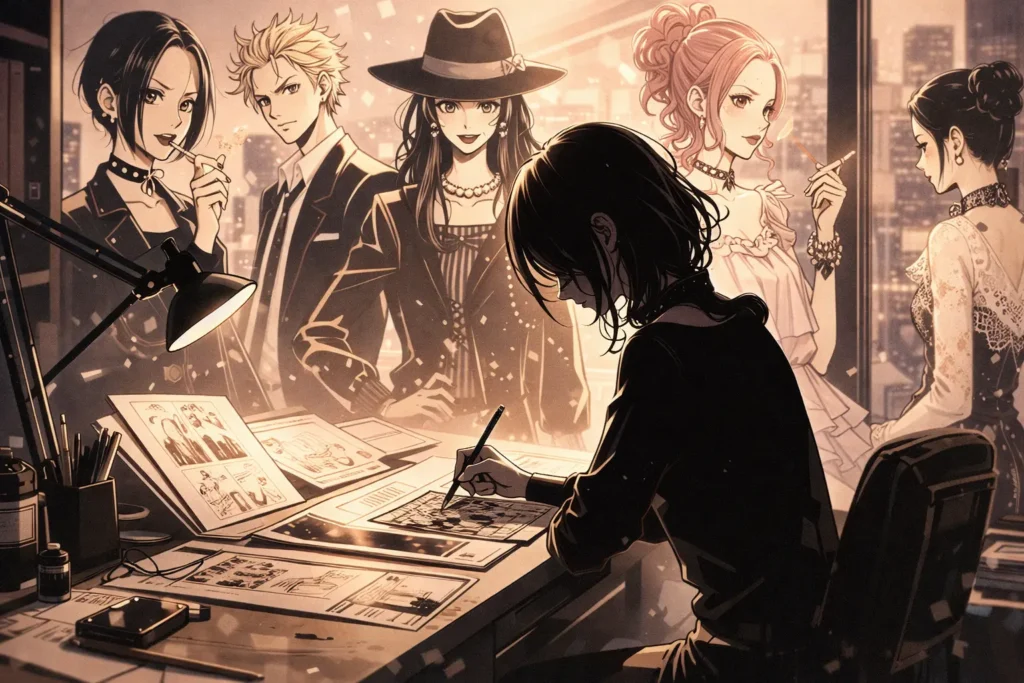
Meta Description: Explore the life, iconic works (Nana, Paradise Kiss), and enduring legacy of manga artist Ai Yazawa. Dive into her themes of fashion, music, friendship, and the pursuit of dreams.
Few manga artists have achieved the global influence and cultural resonance of Ai Yazawa. Celebrated for her nuanced storytelling and stunning visual artistry, Yazawa has created works that transcend the boundaries of traditional shojo manga, resonating with audiences across generations and continents. Her most famous series—
Nana, Paradise Kiss, and Gokinjo Monogatari—have become cultural touchstones, influencing not just manga but fashion, music, and youth culture worldwide. With her intricate character development, unflinching examination of human relationships, and masterful integration of fashion and music, Yazawa has carved out a unique space in the manga landscape that continues to inspire and captivate readers decades after her debut.
This definitive guide explores the life and legacy of Ai Yazawa, diving deep into the themes that make her work timeless, examining her most iconic series, and understanding why her influence extends far beyond the page into fashion, music, and contemporary popular culture.
The Life and Career of Ai Yazawa
Early Life and Debut
Born on March 7, 1967, in the Hyogo Prefecture city of Amagasaki near Osaka, Ai Yazawa grew up immersed in the vibrant cultural atmosphere of Japan’s Kansai region. Her early interest in fashion and design led her to enroll at Osaka Mode Gakuen, a prestigious design school, where she honed the aesthetic sensibilities that would later define her manga work. This formal training in fashion design proved invaluable, giving Yazawa an authentic understanding of clothing construction, style theory, and the fashion industry—knowledge she would weave seamlessly into her narratives.
Yazawa made her professional manga debut in 1985 with a short story published in Ribon Original, one of Japan’s leading shojo manga magazines. From these early works, her distinctive artistic style was already apparent—detailed fashion illustrations, expressive character designs, and an emotional depth that set her apart from her contemporaries. Unlike many manga artists who focused purely on romantic fantasy, Yazawa displayed a keen interest in the messy, complicated realities of young adulthood from the very beginning.
Evolution of a Storyteller
Yazawa’s early works, including Tenshi Nanka Ja Nai (I’m Not an Angel, 1991-1994), established her trademark approach: realistic teenage characters navigating romance, friendship, and self-discovery with humor and heartache. These formative series showcased her willingness to present flawed, sometimes frustrating protagonists whose mistakes and growth felt authentic rather than idealized.
Her breakthrough came with Gokinjo Monogatari (Neighborhood Story, 1995-1997), which followed a group of high school students at a fashion design school. The series was a critical and commercial success, demonstrating Yazawa’s ability to balance ensemble casts, interweaving storylines, and her deep knowledge of the fashion world. Gokinjo Monogatari also marked the beginning of Yazawa’s interconnected manga universe, with characters and references that would reappear in later works.
Paradise Kiss (1999-2003) represented a mature evolution in Yazawa’s storytelling. Set in the same universe as Gokinjo Monogatari but featuring an older cast, this series explored the fashion world with even greater sophistication. The story of Yukari, a directionless high school student who becomes the muse for an avant-garde fashion design collective, tackled themes of identity, ambition, and the often-painful trade-offs between love and personal dreams. Its bittersweet ending—realistic rather than traditionally romantic—cemented Yazawa’s reputation for emotional honesty.
Then came Nana (2000-2009), Yazawa’s magnum opus. This story of two young women both named Nana—one a punk rock singer, the other a romantic dreamer—became a cultural phenomenon. Nana represented the culmination of all Yazawa’s strengths: complex characterization, sophisticated exploration of adult relationships, stunning fashion illustration, and a raw emotional authenticity that resonated globally. The series was adapted into anime and live-action films, spawned countless merchandise lines, and influenced fashion trends across Asia. Though the series went on hiatus in 2009 due to Yazawa’s health issues, its impact continues to reverberate today.
The Ai Yazawa Universe: Themes and Iconic Works
Signature Themes: Authenticity, Dreams, and Imperfect Love
What distinguishes Ai Yazawa from other manga artists is her unwavering commitment to emotional authenticity and narrative realism. Her works consistently explore several interconnected themes that give her body of work a cohesive, distinctive voice:
The Tension Between Love and Dreams: Perhaps the most recurring theme in Yazawa’s work is the painful reality that pursuing your dreams often requires sacrifices in your personal life, and vice versa. Her characters constantly grapple with this dilemma. In Paradise Kiss, Yukari must ultimately choose between following George to Paris and building her own modeling career. In Nana, both protagonists struggle with balancing their romantic relationships with their personal ambitions. Yazawa refuses to provide easy answers, acknowledging that sometimes there are no perfect solutions—only choices with consequences.
Flawed, Multidimensional Characters: Yazawa’s characters are refreshingly imperfect. They make mistakes, harbor contradictions, and sometimes behave in ways that frustrate readers. Nana Komatsu (Hachi) is dependent, occasionally selfish, and makes questionable romantic decisions. Nana Osaki can be cold, emotionally unavailable, and self-destructive. Yet these flaws make them human and relatable. Yazawa understands that people are complex, and she grants her characters the dignity of that complexity rather than flattening them into simple archetypes.
Friendship as Central Narrative Force: While romance features prominently in Yazawa’s work, the relationships she treats with the most care and depth are often friendships. The bond between the two Nanas forms the emotional core of Nana, explored with more nuance and intensity than any romantic relationship in the series. Yazawa portrays friendship as something that requires work, communication, and sacrifice—as profound and complicated as any romantic love.
Coming-of-Age Beyond Adolescence: Unlike typical shojo manga that focuses on high school romance, Yazawa extends her coming-of-age narratives into the early twenties and beyond. Her characters don’t stop growing when they graduate; they continue to evolve, make mistakes, and learn about themselves well into adulthood. This maturity in perspective allows Yazawa to explore themes of career building, financial independence, and the loss of youthful idealism—topics rarely addressed in manga aimed at young women.
Diversity and Representation: For her era, Yazawa was notably progressive in her character representation. Her works feature characters with diverse body types, aesthetic styles, and sexual orientations. While not always explicit in labeling, her narratives contain clear queer subtext, particularly in the intense emotional bonds between female characters. She also addresses issues like reproductive choice, economic inequality, and the pressure women face to conform to societal expectations—all handled with sensitivity and without didacticism.
Nana: A Cultural Phenomenon
Nana remains Ai Yazawa’s most acclaimed and influential work. The series follows two twenty-year-old women who share the same name and meet by chance on a train to Tokyo. Nana Osaki is a punk rock vocalist with dreams of musical stardom, fierce independence, and emotional walls built from a traumatic past. Nana Komatsu (nicknamed Hachi) is a romantic, somewhat naive young woman following her boyfriend to Tokyo, searching for love and belonging. When they decide to become roommates, their friendship becomes the emotional anchor through a turbulent journey of love, loss, betrayal, and ambition.
The series is notable for its unflinching examination of romantic relationships. Yazawa portrays love as messy, often painful, and rarely resembling fairy-tale narratives. Characters cheat, lie, hurt each other, and struggle with codependency. Yet the manga never judges its characters harshly; instead, it seeks to understand the circumstances and emotional needs that drive their behavior. This empathetic approach allows readers to connect deeply with even characters making questionable choices.
Music forms the backbone of Nana‘s world. Nana Osaki’s band BLAST and their rival band TRAPNEST are portrayed with impressive authenticity, from recording sessions to tour logistics to the music industry’s darker aspects. Yazawa’s detailed knowledge of punk rock culture—particularly her references to bands like the Sex Pistols and visual aesthetics drawn from the British punk movement—gives the series a credibility that resonates with actual musicians and music fans.
Fashion plays an equally crucial role. Nana Osaki’s punk rock aesthetic, heavily influenced by designer Vivienne Westwood, became iconic. Westwood’s distinctive tartan patterns, bondage-inspired accessories, and rock-and-roll glamour appear throughout the series, with Yazawa even collaborating with Vivienne Westwood on official merchandise. The contrast between Nana O’s edgy punk style and Hachi’s softer, more feminine aesthetic visually reinforces their different personalities and worldviews while celebrating both as valid expressions of identity.
The series went on indefinite hiatus in 2009 after 21 collected volumes, when Yazawa fell ill. This unexpected pause has left the story unresolved, creating a poignant parallel to one of the manga’s central themes: life doesn’t always provide closure or neat endings. Fans continue to hope for a conclusion, and Yazawa has occasionally expressed her desire to finish the story when her health permits. The uncertainty surrounding Nana‘s ending has only intensified the emotional investment of its dedicated fanbase, who have kept the series culturally relevant through fan art, fashion tributes, and ongoing discussions about the characters and their unresolved fates.
Paradise Kiss and the World of High Fashion
Paradise Kiss represents Yazawa’s most sophisticated exploration of the fashion industry. The series follows Yukari Hayasaka, a studious high school student trapped in the conventional path toward university entrance exams, who is suddenly swept into the world of avant-garde fashion when she’s recruited as a model by a group of design students from Yazawa Art Academy (a continuation of the school setting from Gokinjo Monogatari).
The titular Paradise Kiss is the brand created by the story’s central fashion collective, led by the enigmatic designer George Koizumi. George himself is one of Yazawa’s most complex creations—brilliant, manipulative, vulnerable, and deeply passionate about his craft. His relationship with Yukari forms the emotional center of the story, a intense but ultimately unsustainable romance between two people at different life stages with incompatible needs.
What sets Paradise Kiss apart is its maturity and its willingness to prioritize personal growth over romantic resolution. In a genre that typically rewards love with a happily-ever-after, Yazawa ends the series with Yukari and George going their separate ways—not because they don’t love each other, but because they recognize that their paths are diverging. Years later, both have built successful careers but haven’t reunited. It’s a bittersweet ending that acknowledges the transformative power of a relationship without insisting it must last forever.
The fashion in Paradise Kiss is spectacular, showcasing Yazawa’s design education to full effect. From Gothic Lolita to punk-influenced streetwear to high-fashion runway pieces, the series serves as a visual feast. Yazawa drew inspiration from real-world sources, including Japanese fashion magazines like Zipper and the Harajuku street fashion scene. The detailed clothing illustrations aren’t just decorative—they’re integral to character development and thematic exploration, showing how fashion serves as both artistic expression and identity formation.
Paradise Kiss was adapted into an anime series in 2005, introducing Yazawa’s work to a broader international audience. The anime’s distinctive art direction, contemporary music soundtrack, and faithful adaptation of the manga’s mature themes helped solidify the series’ status as a cult classic.
Gokinjo Monogatari & Tenshi Nanka Ja Nai: Foundational Stories
Gokinjo Monogatari (Neighborhood Story) follows Mikako Koda, a spirited student at Yazawa Art Academy who dreams of becoming a fashion designer, along with her childhood friend and rival Tsutomu Yamaguchi. The series expertly balances ensemble cast dynamics, with a large group of friends navigating romance, creative ambitions, and the transition from adolescence to young adulthood.
What makes Gokinjo Monogatari particularly significant is how it established the interconnected universe that would continue through Paradise Kiss and beyond. Characters from this series make cameo appearances in later works, and readers delight in spotting these connections. The manga was also adapted into an anime in 1995, helping establish Yazawa’s reputation beyond print.
Tenshi Nanka Ja Nai (I’m Not an Angel) was Yazawa’s first serialized work and showcases many elements that would become her trademarks. The story of Midori Saejima, a high school student navigating first love and friendship, demonstrates Yazawa’s early skill with character-driven storytelling and her interest in portraying teenage life with both humor and emotional honesty.
Other notable works include Kagen no Tsuki (Last Quarter), a more supernatural departure that explores themes of reincarnation and lost love. While stylistically different from her fashion-focused series, it demonstrates Yazawa’s versatility and willingness to experiment with different genres while maintaining her core focus on complex emotional relationships.
Style and Legacy: Beyond the Page
Fashion as Narrative: From Harajuku to Vivienne Westwood
Ai Yazawa’s influence on fashion cannot be overstated. Her manga series have functioned as fashion catalogs, style guides, and cultural documentation of youth fashion movements from the 1990s through the 2000s. Her detailed illustrations of clothing—from the construction of garments to how they drape and move—reflect her formal training at Osaka Mode Gakuen and elevate her work beyond typical manga fashion representation.
Yazawa has been particularly influential in documenting and popularizing Harajuku street fashion and the broader Japanese youth fashion scene of the late 1990s and early 2000s. The Ura-Harajuku area’s eclectic mix of punk, Lolita, gyaru, and avant-garde styles appears throughout her work, particularly in Paradise Kiss. For many international readers, Yazawa’s manga served as their first introduction to Japanese street fashion, inspiring interest in brands and styles that were previously unknown outside Japan.
Her collaboration with British designer Vivienne Westwood stands as one of the most significant crossovers between manga and high fashion. Nana Osaki’s wardrobe draws heavily from Westwood’s punk-inspired designs—the iconic orb logo, tartan patterns, corsets, and bondage-style accessories appear throughout Nana. This wasn’t just artistic homage; Westwood officially licensed her designs for Nana merchandise, creating a unique synergy between the manga world and the fashion industry. Fans could actually purchase Nana’s iconic accessories and clothing, bringing the fantasy of the manga into reality.
In 2025, commemorating the 40th anniversary of Yazawa’s debut, UNIQLO released a special Ai Yazawa collection featuring designs from her most iconic series. The collection’s success demonstrated the enduring commercial viability of her work and introduced her aesthetic to a new generation. Social media platforms exploded with fans—both longtime devotees and newcomers—sharing photos of themselves in the collection, creating a real-world fashion community centered around Yazawa’s fictional universes.
Beyond specific brands and collaborations, Yazawa’s work has influenced how manga artists approach fashion illustration more broadly. Her attention to detail, understanding of fashion construction, and ability to use clothing as character development have set a standard that subsequent artists reference and aspire to match.
Enduring Influence and Modern Revival
Ai Yazawa’s influence extends far beyond her native Japan. Her work has been translated into dozens of languages, with particularly strong followings in the United States, Europe, and throughout Asia. The anime adaptations of Nana and Paradise Kiss, along with live-action film adaptations, have introduced her stories to audiences who might not typically read manga, broadening her cultural impact.
In recent years, Yazawa’s work has experienced a significant revival among Generation Z, driven largely by the broader Y2K aesthetic trend. Young people discovering or rediscovering her manga through social media platforms like TikTok, Instagram, and Pinterest have embraced the fashion, music, and emotional authenticity of her stories. The visual aesthetics of Nana and Paradise Kiss—the punk rock style, Gothic Lolita fashion, and early 2000s Tokyo street style—align perfectly with contemporary interest in Y2K fashion revival.
This new generation of fans approaches Yazawa’s work with fresh perspectives, often highlighting aspects that were less discussed during the original run. Contemporary readers have particularly embraced the queer subtext in her work, the feminist themes of female independence and ambition, and the realistic portrayal of mental health struggles and toxic relationships. Online fan communities actively discuss and analyze the series with a sophistication that demonstrates the depth of Yazawa’s storytelling.
The manga artist community itself has been profoundly influenced by Yazawa’s work. Numerous contemporary shojo and josei manga artists cite her as an inspiration, particularly her willingness to tackle mature themes, her fashion-forward aesthetic, and her complex character psychology. Her impact can be seen in how the genre has evolved to embrace more realistic, sometimes darker storylines that don’t shy away from depicting the messy realities of relationships and adulthood.
Despite her hiatus from creating new work, Yazawa’s legacy continues to grow. The incomplete status of Nana has, paradoxically, contributed to the series’ mystique and ongoing relevance. Fans continue to hope for a conclusion while simultaneously creating their own interpretations, artwork, and theories about how the story might end. This active engagement keeps the work alive in cultural consciousness in a way that completed series sometimes don’t achieve.
Ai Yazawa FAQs
Is Nana based on Ai Yazawa’s own life?
This is one of the most persistent questions among fans, and it’s easy to see why. The emotional authenticity and specific details in Nana feel deeply personal. However, Yazawa has never claimed the work is autobiographical in a literal sense. While she certainly draws on her own experiences and observations—as all writers do—Nana is a work of fiction. Yazawa’s background in fashion design rather than music, combined with the carefully constructed fictional elements of the story, suggests that while emotional truths may be drawn from life, the specific narrative is created rather than recounted. The confusion likely stems from Yazawa’s remarkable ability to capture genuine human emotions and experiences, making the characters feel real even when they’re not directly based on real people.
Will Nana ever be finished?
This question weighs heavily on the hearts of millions of fans worldwide. Nana went on hiatus in 2009 after Yazawa fell ill, and it has not resumed serialization since. Over the years, Yazawa has occasionally communicated through her publisher that she wishes to complete the series when her health permits. However, no concrete plans for resumption have been announced. Fans remain hopeful, particularly given the series’ continued popularity and cultural relevance. Whether Nana will ever reach its planned conclusion remains uncertain, but the fanbase’s dedication ensures that the story will remain culturally significant regardless. Some fans have found a certain poetic appropriateness in the open ending—much like the characters’ unresolved lives, the manga exists in a state of suspension that mirrors its themes of uncertainty and incomplete narratives.
What is the best order to read Ai Yazawa’s works?
For newcomers to Ai Yazawa’s work, there are several potential entry points depending on your interests. If you’re drawn to music, punk culture, and intense character drama, start with Nana. Be aware that it’s her most mature work and ends on a hiatus, but it’s also her most acclaimed. If you’re particularly interested in fashion and prefer a complete story with closure, Paradise Kiss is an excellent choice—it’s sophisticated, beautifully drawn, and has a definitive (if bittersweet) ending. For those who want to experience her universe chronologically and appreciate interconnected storylines, begin with Gokinjo Monogatari, then proceed to Paradise Kiss, and finally Nana. This approach lets you see Yazawa’s evolution as an artist and pick up on the subtle connections between series. Tenshi Nanka Ja Nai and her other early works are also worth exploring for completists interested in seeing where her distinctive style originated.
How did Ai Yazawa influence fashion?
Ai Yazawa’s influence on fashion operates on multiple levels. First, her manga served as documentation and popularization of Japanese street fashion, particularly Harajuku and Ura-Harajuku styles from the 1990s and 2000s. International readers gained exposure to brands, styles, and subcultures they might never have encountered otherwise. Second, her collaboration with Vivienne Westwood created a unprecedented crossover between manga and high fashion, legitimizing manga as a serious fashion reference. Third, her characters’ distinctive styles became aspirational, with fans actively seeking out similar clothing and accessories. The 2025 UNIQLO collaboration demonstrated that her fashion influence remains commercially viable decades later. Finally, within the manga industry itself, Yazawa raised the bar for fashion illustration and established that detailed, accurate fashion representation could be integral to storytelling rather than mere decoration. Her work proved that fashion in manga could be both aesthetically stunning and narratively meaningful.
Where can I buy Ai Yazawa’s manga and merchandise?
Ai Yazawa’s major series are widely available in English translation. Nana and Paradise Kiss have been published by VIZ Media and can be found at major bookstores, online retailers like Amazon, and digital platforms. Japanese bookstore chains like Kinokuniya often carry both English editions and Japanese originals, sometimes including exclusive merchandise items not available elsewhere. Art books, such as The World of Nana, provide gorgeous compilations of Yazawa’s color illustrations and character designs. Official merchandise, including the Vivienne Westwood collaborations and the UNIQLO collection, periodically becomes available through official channels—following Yazawa-related social media accounts and fan communities is the best way to stay informed about new releases. For collectors seeking vintage or out-of-print items, second-hand markets and specialized manga retailers often carry older editions and rare merchandise.
Ai Yazawa stands as one of the most influential manga artists of her generation, with a body of work that transcends genre boundaries and continues to resonate across cultures and generations. Her commitment to emotional authenticity, her sophisticated understanding of fashion and music, and her willingness to portray the messy complexities of human relationships have created stories that feel timeless despite being rooted in specific cultural moments. Whether you’re drawn to the punk rock world of Nana, the high fashion universe of Paradise Kiss, or the coming-of-age narratives of her earlier works, Yazawa’s manga offer richly rewarding experiences that reward both initial readings and repeated engagement.
As we await news of Nana‘s potential conclusion and celebrate the 40th anniversary of her debut, Ai Yazawa’s legacy continues to grow. New generations discover her work, finding in it the same emotional truths, fashion inspiration, and narrative complexity that captivated readers decades ago. In an era where manga has achieved global mainstream acceptance, Yazawa’s contributions to elevating the medium’s artistic and thematic possibilities cannot be overstated. She remains not just a manga artist, but a cultural icon whose influence extends far beyond the page.
Which Ai Yazawa character do you relate to most, and why? Share your thoughts with the community!

Adrian Cole is a technology researcher and AI content specialist with more than seven years of experience studying automation, machine learning models, and digital innovation. He has worked with multiple tech startups as a consultant, helping them adopt smarter tools and build data-driven systems. Adrian writes simple, clear, and practical explanations of complex tech topics so readers can easily understand the future of AI.