If you’ve sat in on a leadership meeting lately, scanned a company careers page, or browsed LinkedIn job posts, you’ve probably seen the acronym floating around: DEI.
But what does DEI stand for in business — and why has it become one of the most discussed, debated, and misunderstood concepts in the corporate world?
DEI stands for Diversity, Equity, and Inclusion. On paper, that sounds simple. In practice, it’s a powerful framework that shapes how companies hire, promote, compensate, communicate, and build culture.
And here’s the truth most blog posts won’t tell you: DEI is not just an HR initiative. It’s a business strategy.
In this comprehensive guide, you’ll learn:
- What DEI really means (beyond the buzzword version)
- Why it matters to profitability, innovation, and brand reputation
- How companies implement DEI step by step
- The tools and frameworks that actually work
- Common mistakes organizations make — and how to fix them
- FAQs that leaders, HR professionals, and employees frequently ask
Whether you’re a founder, HR leader, manager, or employee trying to understand company culture, this guide will give you clarity and practical direction.
Let’s start at the foundation.
What Does DEI Stand for in Business?
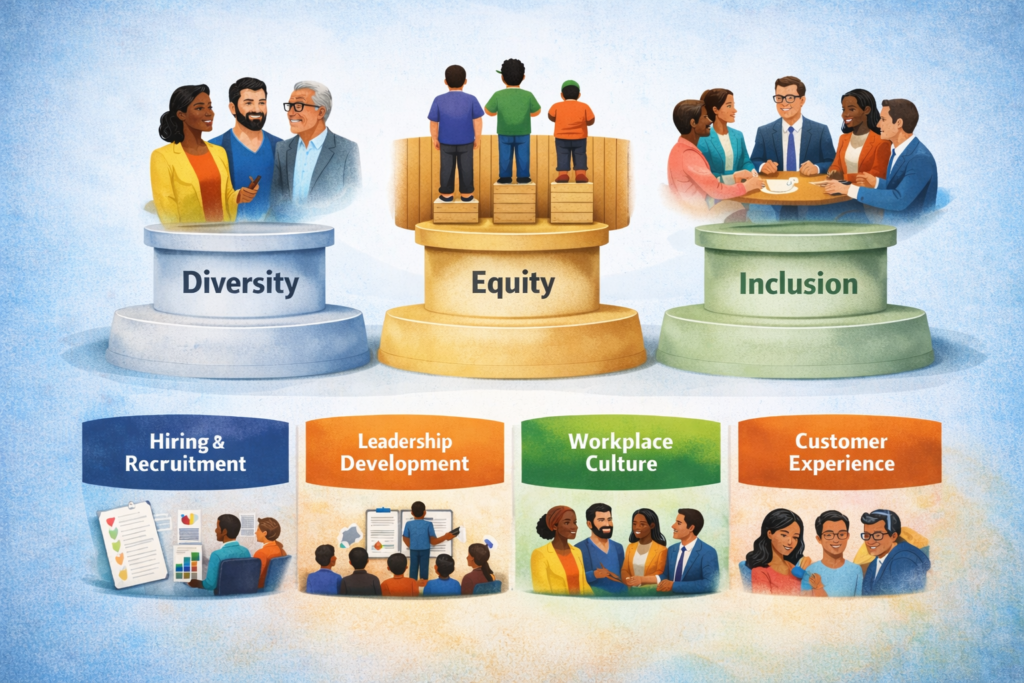
At its core, DEI in business stands for Diversity, Equity, and Inclusion. These are three interconnected principles that shape how organizations treat people and build workplace environments.
Here’s a simple breakdown:
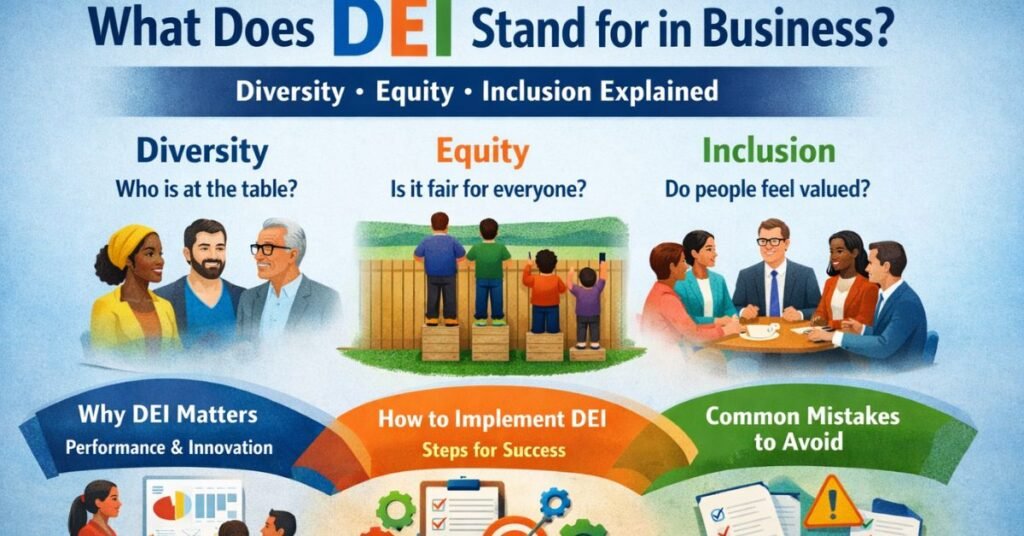
- Diversity refers to representation. Who is at the table?
- Equity refers to fairness. Are systems designed to provide fair access to opportunity?
- Inclusion refers to belonging. Do people feel respected, heard, and valued?
Think of it like hosting a dinner party.
- Diversity is inviting people from different backgrounds.
- Inclusion is making sure everyone feels comfortable speaking.
- Equity is ensuring everyone has the right utensils and access to food that meets their needs.
In business terms, DEI impacts:
- Hiring practices
- Compensation systems
- Promotion pathways
- Leadership development
- Workplace culture
- Company policies
- Brand messaging
Many organizations have formalized DEI efforts through roles like Chief Diversity Officer, internal committees, or structured frameworks supported by organizations such as Society for Human Resource Management and research bodies like McKinsey & Company.
But the concept itself is bigger than a title or department.
It’s about building sustainable, high-performing organizations where opportunity is not limited by bias, background, or systemic barriers.
Breaking Down DEI: Diversity, Equity, and Inclusion Explained
To truly understand what DEI stands for in business, we need to unpack each component deeply — not just define it.
Diversity in Business
Diversity refers to the presence of differences within a given setting. In business, that includes:
- Race and ethnicity
- Gender and gender identity
- Age
- Disability status
- Sexual orientation
- Cultural background
- Religion
- Socioeconomic background
- Educational paths
- Professional experience
But diversity also includes cognitive diversity — differences in thinking styles, problem-solving approaches, and perspectives.
Companies with diverse teams often outperform homogenous ones in innovation and decision-making. Why? Because varied viewpoints reduce groupthink.
However, diversity alone isn’t enough.
You can hire diverse talent — but if the environment isn’t inclusive or equitable, those employees won’t stay.
That’s where the next two pillars come in.
Equity in Business
Equity is often confused with equality.
Equality means giving everyone the same resources.
Equity means giving people what they need to succeed.
Imagine two employees:
- One had access to elite education and strong networks.
- The other is a first-generation professional without corporate exposure.
Treating them “equally” ignores starting differences. Equity acknowledges structural barriers and adjusts support accordingly.
In business, equity might look like:
- Transparent promotion criteria
- Bias-resistant performance reviews
- Pay equity audits
- Mentorship programs for underrepresented groups
- Accessible work environments
Equity addresses systems — not just individuals.
And systems are where most inequities hide.
Inclusion in Business
Inclusion is the lived experience of employees.
It answers questions like:
- Do I feel respected here?
- Are my ideas valued?
- Can I speak up without fear?
- Do I belong?
You can have a diverse workforce — but if meetings silence certain voices, if leadership pipelines exclude certain groups, or if policies ignore real-life needs, inclusion fails.
Inclusion is culture in action.
It shows up in:
- Meeting dynamics
- Feedback systems
- Leadership behaviors
- Recognition practices
- Communication tone
Without inclusion, diversity becomes optics.
And without equity, inclusion becomes performative.
Why DEI Matters in Business Today
If DEI were only about moral responsibility, it would still matter.
But it’s also about performance.
Organizations across industries increasingly recognize that DEI directly impacts:
- Revenue growth
- Innovation capacity
- Employee retention
- Employer branding
- Customer loyalty
Research from McKinsey & Company consistently shows that companies with more diverse executive teams are more likely to outperform financially.
Why does this happen?
Because businesses operate in diverse markets.
If your customers are global, multicultural, multi-generational, and digitally connected — your workforce should reflect that complexity.
Here’s how DEI drives business value:
- Better Decision-Making
Diverse teams consider more angles before committing to a strategy. - Higher Employee Engagement
Employees who feel included are more likely to stay and perform. - Stronger Employer Brand
Candidates increasingly evaluate companies on culture and values. - Risk Reduction
Equity audits and inclusive policies reduce legal exposure and PR crises. - Innovation Advantage
Different life experiences fuel creative problem-solving.
In short: DEI is not a cost center. It’s a competitive advantage.
Benefits and Real-World Use Cases of DEI in Business
Understanding what DEI stands for in business is one thing. Seeing how it works in practice is another.
Let’s look at real-world applications.
Hiring and Recruitment
Companies that implement structured DEI hiring practices:
- Use diverse interview panels
- Standardize interview questions
- Remove biased language from job descriptions
- Expand recruiting beyond elite universities
This widens the talent pool and improves quality of hire.
Leadership Development
Equitable promotion systems ensure leadership pipelines don’t unintentionally favor certain demographics.
Practical examples:
- Sponsorship programs
- Transparent performance metrics
- Leadership training access for all
Product Development
Consider tech companies building global products. If development teams lack diverse perspectives, blind spots emerge.
For example:
- Accessibility features may be overlooked
- Cultural nuances in marketing may be missed
- Product design may unintentionally exclude certain users
DEI in product strategy reduces these risks.
Customer Experience
Inclusive customer service policies recognize diverse customer needs — from language accessibility to disability accommodations.
Internal Culture
Companies that prioritize inclusion often implement:
- Employee Resource Groups (ERGs)
- Inclusive holiday policies
- Flexible work arrangements
- Clear anti-discrimination protocols
These build trust internally — which reflects externally.
Step-by-Step Guide: How to Implement DEI in Business
Understanding what DEI stands for in business is step one. Implementation is where transformation happens.
Here’s a structured approach.
Step 1: Conduct a DEI Assessment
Start with data.
- Workforce demographics
- Pay equity analysis
- Promotion rates
- Employee engagement surveys
- Exit interview patterns
Without data, DEI becomes guesswork.
Step 2: Define Clear Goals
Avoid vague statements like “improve diversity.”
Instead, define measurable objectives:
- Increase leadership diversity by X%
- Reduce pay gaps
- Improve inclusion survey scores
Specific goals drive accountability.
Step 3: Secure Leadership Buy-In
DEI cannot live only in HR.
Executives must:
- Communicate commitment publicly
- Tie DEI metrics to performance
- Allocate budget and resources
Leadership modeling sets the tone.
Step 4: Revise Policies and Systems
Review:
- Hiring processes
- Promotion criteria
- Compensation structures
- Performance evaluations
Remove structural bias.
Step 5: Provide Training and Education
Effective DEI training focuses on:
- Unconscious bias
- Inclusive leadership
- Cultural competence
- Psychological safety
But training must be ongoing — not one-off workshops.
Step 6: Build Inclusion Into Daily Operations
Encourage:
- Rotating meeting facilitators
- Structured feedback loops
- Recognition equity
- Inclusive language guidelines
Culture changes through repetition.
Step 7: Measure, Report, and Adjust
Track:
- Retention by demographic
- Promotion rates
- Employee engagement
- Recruitment diversity
Transparency builds trust.
Tools, Comparisons, and Recommendations
Implementing DEI often requires external support and structured systems.
Here are categories to consider.
DEI Survey Tools
- Culture Amp
- Qualtrics
- Glint
These measure belonging, engagement, and inclusion metrics.
Free options:
Basic Google Forms surveys (less sophisticated, but accessible).
Paid options:
Advanced analytics and benchmarking tools.
Pros of Paid Tools:
- Data segmentation
- Predictive insights
- Professional dashboards
Cons:
- Cost
- Setup complexity
DEI Training Platforms
Companies may partner with training providers for structured modules.
Pros:
- Professional facilitation
- Updated research
- Scalable delivery
Cons:
- Can feel generic
- May lack company-specific nuance
Pay Equity Analysis Software
Tools help identify compensation disparities by demographic category.
Investing here reduces legal risk and builds fairness.
External Consultants
DEI consultants can guide strategy design and audits.
Pros:
- Objective perspective
- Expertise
- Structured implementation
Cons:
- Expensive
- Requires internal buy-in to sustain results
Free alternative:
Internal DEI committees — though success depends heavily on leadership support.
Common Mistakes in DEI Initiatives — and How to Fix Them
Even well-intentioned companies make mistakes.
Here are the most common ones.
Mistake 1: Treating DEI as a PR Strategy
Posting statements without systemic change damages credibility.
Fix:
Align messaging with measurable internal progress.
Mistake 2: Focusing Only on Hiring
Recruiting diverse employees without inclusive culture leads to turnover.
Fix:
Pair hiring efforts with retention and development strategies.
Mistake 3: One-Time Training
One workshop does not change culture.
Fix:
Embed ongoing education into leadership development programs.
Mistake 4: Ignoring Data
Without metrics, bias persists invisibly.
Fix:
Conduct annual audits and publish progress reports.
Mistake 5: Lack of Accountability
If leaders are not measured on DEI goals, change stalls.
Fix:
Tie executive compensation to DEI performance indicators.
The Future of DEI in Business
DEI is evolving.
Some organizations now use expanded frameworks like DEIB (adding Belonging) or JEDI (Justice, Equity, Diversity, Inclusion).
As workforce expectations shift, younger generations prioritize purpose-driven workplaces.
Global expansion also increases cultural complexity.
Future-focused companies will:
- Integrate DEI into ESG reporting
- Use AI responsibly in hiring
- Strengthen inclusive remote work policies
- Build global cultural intelligence
DEI is not static. It adapts to societal and workforce change.
Conclusion: What DEI Really Means for Your Business
So, what does DEI stand for in business?
Diversity. Equity. Inclusion.
But in practice, it stands for something bigger: sustainable performance through fair systems and inclusive culture.
It’s about:
- Who gets hired
- Who gets promoted
- Who feels heard
- Who stays
- Who thrives
Companies that approach DEI strategically — not symbolically — build stronger teams, better products, and more resilient brands.
If you’re a leader, start with data.
If you’re an employee, ask thoughtful questions.
If you’re building a company, embed equity from day one.
DEI is not a trend.
It’s infrastructure.
FAQs
What does DEI stand for in business?
DEI stands for Diversity, Equity, and Inclusion. It refers to organizational efforts to create diverse workforces, fair systems, and inclusive cultures.
Is DEI only about race and gender?
No. DEI includes many dimensions such as age, disability, socioeconomic background, education, culture, religion, and cognitive diversity.
Why is DEI important for businesses?
DEI improves innovation, employee retention, decision-making quality, brand reputation, and financial performance.
What is the difference between equity and equality?
Equality gives everyone the same resources. Equity provides resources based on need to ensure fair outcomes.
How can small businesses implement DEI?
Start with inclusive hiring practices, transparent pay structures, leadership modeling, and regular employee feedback surveys.

Michael Grant is a business writer with professional experience in small-business consulting and online entrepreneurship. Over the past decade, he has helped brands improve their digital strategy, customer engagement, and revenue planning. Michael simplifies business concepts and gives readers practical insights they can use immediately.