
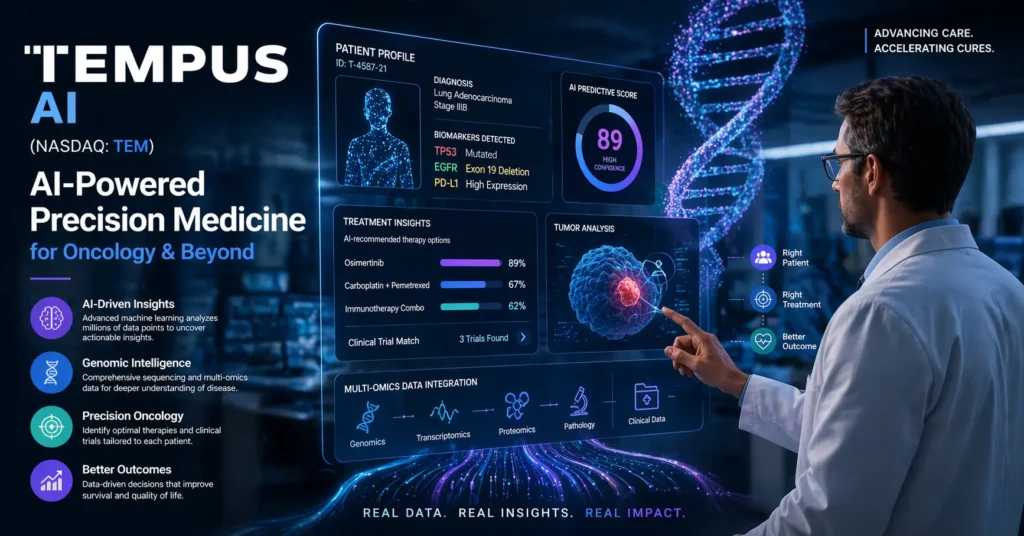
What Is Tempus AI? A Company Overview
Tempus AI is a technology company at the forefront of precision medicine, leveraging artificial intelligence to help clinicians, researchers, and pharmaceutical companies make more informed, data-driven healthcare decisions. Headquartered in Chicago, Illinois, and publicly traded on Nasdaq under the ticker symbol TEM, Tempus AI is one of the most ambitious companies operating at the intersection of genomics, clinical data, and artificial intelligence.
Founded in 2015 by Eric Lefkofsky — the co-founder of Groupon — Tempus was born out of a deeply personal experience. When a family member was diagnosed with breast cancer, Lefkofsky was struck by the fragmented, inconsistent, and often non-digital nature of medical data. He recognized that the same data-driven approaches revolutionizing industries like finance and logistics were largely absent from oncology and broader healthcare. That realization sparked the creation of Tempus AI.
From Founding to IPO — The Tempus Story
Tempus AI was incorporated in 2015 and rapidly built a reputation as a serious player in genomic data and AI-powered diagnostics. Over nearly a decade, the company assembled one of the world’s largest and most diverse libraries of multimodal clinical and molecular data, forming partnerships with academic medical centers, major health systems, and pharmaceutical companies across the globe.
In June 2024, Tempus completed its initial public offering (IPO) on Nasdaq, marking a major milestone for both the company and the broader AI-in-healthcare sector. The IPO reinforced investor confidence in precision medicine as a transformative long-term investment theme, with Tempus positioned as a category leader.
Mission — “It’s About Time”
Tempus AI’s mission is captured in its guiding principle: each patient should benefit from those who came before them. The company believes that the vast, largely untapped reservoir of clinical and molecular data — when structured, standardized, and analyzed using AI — can fundamentally change how diseases are diagnosed and treated. Tempus builds the tools that learn from real-world patient data to generate insights that doctors can act on at the point of care.
| Key Fact: Tempus AI has assembled over 350 petabytes of de-identified clinical and genomic data from more than 40 million patient records — one of the largest multimodal healthcare datasets in the world. |
How Tempus AI Works — Technology & Data Platform
At the core of Tempus AI is a sophisticated data infrastructure and AI platform designed to ingest, harmonize, and analyze multiple types of healthcare data simultaneously. Unlike traditional genomic testing companies that work with a single data type, Tempus integrates molecular data, clinical notes, medical claims, imaging, and pathology images into a unified multimodal framework.
The Multimodal Data Advantage
The scale and depth of the Tempus dataset is a foundational competitive advantage. The company’s platform draws from:
- Genomic sequencing data from millions of tumor and germline samples
- Electronic health record (EHR) data from hospital and clinic partners
- Medical claims data reflecting real-world treatment patterns
- Pathology images analyzed using computer vision and foundation models
- Radiology imaging data contributing to diagnostic AI development
This multimodal dataset — totaling 350+ petabytes and covering 40 million+ de-identified records — is unprecedented in the healthcare AI space. Tempus AI has partnerships with 65% of academic medical centers in the United States and serves over 50% of US-based oncologists, giving the company unparalleled reach into clinical practice.
Core AI Products & Assays
Tempus offers a suite of AI-enabled products across sequencing, diagnostics, and platform tools. These are grouped into three primary product families:
Tempus xR IVD — FDA-Cleared RNA Next-Generation Sequencing
The Tempus xR IVD is the company’s flagship in vitro diagnostic (IVD) test cleared by the FDA under the 510(k) pathway. This RNA-based next-generation sequencing (NGS) panel is designed to detect actionable biomarkers in solid tumors and helps oncologists select targeted therapies, enroll patients in clinical trials, and monitor disease progression. As an FDA-cleared diagnostic, the xR IVD carries significant regulatory authority, distinguishing Tempus from many competitors offering laboratory-developed tests (LDTs) without formal regulatory clearance.
PurIST Algorithm — AI for Pancreatic Cancer Subtyping
The PurIST (Purity-Independent Subtyping of Tumors) algorithm is a machine learning model developed to classify pancreatic ductal adenocarcinoma (PDAC) into two molecularly distinct subtypes — classical and basal-like — with significant therapeutic implications. Validated in a landmark study published in JCO Precision Oncology, PurIST allows oncologists to better predict which patients will respond to chemotherapy regimens like FOLFIRINOX versus gemcitabine-based therapy. This represents one of Tempus’s strongest examples of clinical AI translating into direct patient benefit.
Paige Predict — Digital Pathology AI
Through its collaboration with Paige.AI, Tempus integrates digital pathology models that analyze hematoxylin and eosin (H&E) stained slides to predict tumor behavior, treatment response, and survival outcomes. Paige Predict uses deep learning models trained on large-scale pathology image libraries to augment pathologist workflows, reducing diagnostic variability and identifying patterns invisible to the human eye. This technology is particularly valuable in resource-limited settings and high-volume cancer centers seeking efficiency.
GenoPredicta — Hematologic Malignancy Profiling
GenoPredicta is a specialized AI-driven assay targeting hematologic malignancies — cancers of the blood, bone marrow, and lymph nodes, including leukemia, lymphoma, and multiple myeloma. The platform integrates genomic sequencing results with clinical features to generate risk stratification and prognostic scores, enabling hematologists to personalize treatment intensity and timing for individual patients.
Real-World Evidence & Clinical Trial Matching
One of Tempus’s highest-value offerings for biopharma partners is its real-world evidence (RWE) generation capability. By linking de-identified genomic data with longitudinal clinical outcomes, Tempus can produce evidence that supports regulatory submissions, label expansions, and comparative effectiveness research.
Equally important is Tempus’s clinical trial matching engine, which leverages AI to cross-reference patient molecular profiles against eligibility criteria for active clinical trials. This platform has been used to identify over 40,000 patients for potential trial enrollment — a metric that reflects enormous value for pharma sponsors struggling with slow recruitment timelines.
| Partnership Scale: Tempus AI works with 95% of the top 20 global pharmaceutical companies and has established 250+ biopharma partnerships — making it the leading data and insights partner for clinical-stage drug development. |
Tempus AI Applications by Medical Specialty
While oncology remains Tempus AI’s founding domain and commercial core, the company has aggressively expanded its platform into adjacent medical specialties where AI and data can generate similar clinical value.
Oncology — Precision Cancer Care
Cancer treatment is at the heart of Tempus’s mission. The company provides comprehensive genomic profiling across virtually all solid and liquid tumor types, including:
- Non-small cell lung cancer (NSCLC) — the most common form of lung cancer
- Pancreatic cancer — where early biomarker detection is critical
- Prostate cancer — including genomic risk stratification
- Hematologic malignancies — leukemia, lymphoma, and myeloma profiling
- Minimal residual disease (MRD) monitoring — tracking cancer recurrence
Tempus’s oncology platform enables oncologists to move beyond one-size-fits-all treatment protocols to individualized, biomarker-driven therapy selection. The company’s 50%+ penetration of US oncologists is a testament to the clinical utility and physician trust Tempus has built over nearly a decade.
Cardiology & Pharmacogenomics
Tempus entered the cardiology space with AI models designed to analyze electrocardiograms (ECGs) and other cardiac data to detect abnormalities, predict adverse events, and stratify cardiovascular risk. Pharmacogenomics — the study of how genes affect drug response — is another growth area, where Tempus helps clinicians prescribe medications with optimal efficacy and minimal adverse reactions based on each patient’s genetic makeup.
Radiology with Foundation Models
Radiology represents a frontier for Tempus’s foundation model strategy. By training large-scale AI models on de-identified pathology images and radiology scans — linked to genomic and outcomes data — Tempus is building multimodal foundation models capable of detecting subtle imaging biomarkers that predict diagnosis, prognosis, and treatment response. This approach mirrors the success of large language models (LLMs) in natural language processing, applied to the visual domain of medical imaging.
Neuropsychiatry & Depression
Perhaps the most ambitious expansion for Tempus is into neuropsychiatry, where AI models are being developed to assist in diagnosing and treating depression and other psychiatric conditions. By integrating genomic data with behavioral and clinical phenotypes, Tempus aims to identify biological subtypes of depression that predict response to antidepressants, antipsychotics, and emerging treatments like ketamine or transcranial magnetic stimulation (TMS).
Infectious Disease
Tempus’s infectious disease platform leverages genomic sequencing and clinical data to understand pathogen evolution, antibiotic resistance patterns, and host response to infection. This capability gained new relevance during the COVID-19 pandemic and continues to support surveillance and outbreak management efforts in partnership with public health institutions.
Tempus AI Financial & Stock Information (TEM)
Tempus AI completed its Nasdaq IPO in June 2024 under the ticker symbol TEM. As an AI healthcare company still in its growth phase, Tempus is not yet profitable but has demonstrated impressive revenue growth and a clear path to expanding its data monetization and SaaS-like revenue streams.
TEM Stock Performance Overview
As of early 2026, TEM stock has delivered a year-to-date return of +5.99% and a 1-year return of +28.41%, significantly outperforming many healthcare peers. The consensus analyst price target stands at $72.40, with earnings scheduled for May 5, 2026.
Key Financial Metrics
| Metric | Value | Notes |
| Revenue (2024) | $1.27 Billion | Up 36% YoY |
| Net Income | -$245 Million | Loss (growth phase) |
| Total Cash | $755 Million | Strong liquidity |
| Market Cap | $9.96 Billion | As of April 2026 |
| Debt/Equity Ratio | 270% | High leverage |
| EPS | -$1.41 | Negative (pre-profit) |
| 52-Week Range | $41.67 – $104.32 | High volatility |
| Avg. Daily Volume | 5.45 Million shares | Active trading |
| YTD Return | +5.99% | Modest gains |
| 1-Year Return | +28.41% | Strong performance |
| Analyst Target | $72.40 | Consensus estimate |
Analyst Ratings & Earnings Calendar
| Rating | Percentage | Consensus |
| Buy | 60% | Positive Outlook |
| Hold | 35% | Cautiously Optimistic |
| Sell | 5% | Minimal Downside Risk |
Analyst sentiment toward Tempus AI is predominantly positive, driven by the company’s dominant market position in genomic data, accelerating revenue growth, and diversifying product portfolio. The primary near-term concern centers on the path to profitability and the high debt-to-equity ratio resulting from strategic acquisitions. The next quarterly earnings release on May 5, 2026 will be closely watched for updates on the Ambry Genetics integration and international expansion.
Tempus AI vs. Traditional Genomic Testing — Comparison
| Feature | Tempus AI | Traditional Genomic Testing |
| Data Scale | 350+ PB, 40M+ records | Limited, fragmented sources |
| AI Integration | Multimodal AI + foundation models | Standard bioinformatics tools |
| Specialties | Oncology, cardiology, radiology, neuro | Primarily oncology |
| Trial Matching | 40,000+ patients identified | Manual or basic filters |
| Pharma Reach | 95% of top 20 pharma companies | Selective partnerships |
| Regulatory | FDA 510(k) cleared (xR IVD) | Varies by product |
| Data Sharing | Vivli platform (de-identified) | Proprietary, limited access |
| Public Status | Nasdaq: TEM (IPO June 2024) | Mostly private or acquired |
Strategic Partnerships & Acquisitions
Tempus AI has pursued an aggressive partnership and acquisition strategy to scale its data assets, expand geographically, and deepen its capabilities across the healthcare ecosystem.
SoftBank Group — SB Tempus Japan Joint Venture
In 2024, Tempus AI announced the formation of SB Tempus, a joint venture with SoftBank Group Corp., to bring the Tempus AI platform to Japan — the world’s third-largest healthcare market. Japan has a rapidly aging population and significant unmet need in precision oncology. The JV will leverage Tempus’s AI platform and data infrastructure combined with SoftBank’s deep relationships with Japanese health systems and corporations. This partnership represents a major international expansion milestone and validates the global applicability of the Tempus model.
Acquisition of Ambry Genetics — $600 Million Deal
Tempus’s acquisition of Ambry Genetics for approximately $600 million is one of the most significant transactions in the clinical genomics space in recent years. Ambry is a leading clinical genetic testing laboratory with deep expertise in hereditary cancer, cardiovascular disease, and rare diseases. The acquisition adds Ambry’s CLIA-certified laboratory capabilities, germline testing portfolio, and extensive patient database to Tempus’s existing somatic sequencing and AI platform — creating a comprehensive offering spanning the full spectrum of genomic medicine.
ARPA-H ADAPT Program Collaboration
Tempus AI is a collaborator in the ARPA-H (Advanced Research Projects Agency for Health) ADAPT program, a U.S. government initiative aimed at accelerating the development of AI tools for cancer diagnosis and treatment. This collaboration provides Tempus with access to federal research infrastructure, funding, and validation opportunities, while positioning the company as a trusted partner for public-sector health innovation.
Other Strategic Investors & Partners
Tempus has attracted a blue-chip roster of institutional investors and strategic partners, including:
- Google LLC — strategic investment and potential cloud/AI infrastructure partnership
- Baillie Gifford — major institutional shareholder known for long-term growth investing
- New Enterprise Associates (NEA) — leading venture capital backing from early stages
- Novo Holdings — investment arm of the Novo Nordisk Foundation, reinforcing pharma alignment
- Bristol Myers Squibb — biopharma partnership for real-world data and trial matching
Clinical Validation & Regulatory Approvals
Trust in an AI healthcare platform depends on rigorous clinical validation, peer-reviewed evidence, and regulatory oversight. Tempus AI has invested heavily in all three areas, making it one of the most credible and defensible players in AI diagnostics.
FDA 510(k) Clearance — Tempus xR IVD
The Tempus xR IVD has received 510(k) clearance from the U.S. Food and Drug Administration — the gold standard for diagnostic test approval. This clearance means the test has been evaluated by the FDA for safety and effectiveness, and can be marketed to healthcare providers as a cleared diagnostic tool. Very few AI-powered genomic diagnostics have achieved this level of regulatory rigor, giving Tempus a meaningful competitive and reimbursement advantage.
Peer-Reviewed Research
Tempus AI products and algorithms have been validated through peer-reviewed publications in leading medical journals, including JCO Precision Oncology. The PurIST validation study, for example, demonstrated the algorithm’s clinical utility in an independent patient cohort — a level of evidence required for physician adoption and payer coverage decisions. Tempus continues to invest in research collaborations with academic medical centers to generate ongoing evidence for its expanding product portfolio.
Data Sharing via Vivli Platform
Tempus participates in the Vivli platform — an independent, non-profit data-sharing environment — to make de-identified, patient-level clinical and genomic data available to qualified researchers worldwide. Access to Tempus data via Vivli requires a structured research proposal, analysis plan, publication plan, and data dictionary, along with IRB approval where applicable. All shared data is anonymized in compliance with HIPAA de-identification standards, ensuring patient privacy while advancing medical science.
HIPAA Compliance & Data Ethics
Patient data privacy is foundational to Tempus’s operating model. The company applies HIPAA-compliant de-identification protocols to all data shared externally, and employs internal data governance frameworks to limit data use to approved research and analytical purposes. Tempus does not sell identifiable patient data. All data monetization occurs through de-identified aggregate datasets, licensed AI models, and software-as-a-service arrangements with biopharma and health system partners.
How to Access Tempus AI — For Physicians, Researchers & Patients
One of the most underappreciated aspects of Tempus AI is its accessibility across three distinct user groups: clinicians ordering tests at the point of care, researchers seeking real-world data for scientific studies, and patients navigating complex cancer diagnoses. Each group interacts with Tempus differently.
For Physicians — Ordering a Tempus Test
Oncologists, pathologists, and other clinicians can order Tempus genomic tests directly through the Tempus portal or via their institution’s electronic health record (EHR) system. Key ordering options include:
- xF Assay — a comprehensive liquid biopsy panel for cell-free DNA (cfDNA) analysis
- IHC (Immunohistochemistry) panels — protein expression markers for therapy selection
- Hotspot panels — focused sequencing for specific actionable mutations
- Whole-genome sequencing (WGS) — comprehensive genomic profiling for complex cases
Tempus is particularly valued in cases of tissue scarcity — where tumor biopsy material is limited — because the liquid biopsy options can generate actionable data from a simple blood draw. Results are delivered through a physician-facing portal with AI-generated interpretation support and clinical context from the Lens platform.
For Researchers — Requesting Real-World Data
Academic researchers, epidemiologists, and pharmaceutical scientists can access de-identified Tempus datasets through the Vivli platform. The process involves:
- Step 1: Submit a detailed research proposal outlining scientific objectives and hypotheses
- Step 2: Provide a complete analysis plan specifying statistical methods and endpoints
- Step 3: Submit a publication plan describing the intended dissemination strategy
- Step 4: Receive access to the relevant data dictionary and variable definitions
- Step 5: Complete IRB review where required by institutional policy
Approved researchers gain access to one of the world’s richest repositories of linked clinical, genomic, and outcomes data — enabling studies that would be impossible with conventional clinical trial datasets alone.
For Patients — Understanding Your Options
Patients rarely interact with Tempus AI directly, but they benefit from it through their treating physicians. If you have been diagnosed with cancer, you can:
- Ask your oncologist whether a Tempus genomic panel is appropriate for your tumor type
- Request information about clinical trial matching — Tempus has identified 40,000+ patients for trials
- Ask whether your cancer center uses Tempus AI to guide treatment decisions
- For hereditary cancer risk, inquire about Ambry Genetics testing (now part of Tempus)
While Tempus tests are typically ordered by a physician, patients are encouraged to be advocates for their own genomic testing, particularly in cases where standard treatments have failed and emerging targeted therapies or immunotherapies may offer a path forward.
Future Roadmap — What’s Next for Tempus AI
Tempus AI has laid the foundation for what could become one of the most consequential healthcare infrastructure companies of the 21st century. Looking ahead, several strategic priorities are expected to shape the company’s trajectory:
- Global expansion — building on the SB Tempus Japan JV as a template for additional international markets in Europe and Southeast Asia
- New disease targets — expanding from oncology and cardiology into rare diseases, autoimmune conditions, and metabolic disorders
- Foundation model scaling — training increasingly large and capable AI models on the Tempus multimodal dataset to unlock new diagnostic and predictive capabilities
- Developer API access — enabling third-party health technology developers to build applications on top of the Tempus real-world data platform
- Payer engagement — working toward reimbursement coverage for more Tempus assays, reducing financial barriers for patients
- Profitability pathway — scaling SaaS-like data licensing revenues while managing acquisition-related debt from the Ambry Genetics deal
faqs
What does Tempus AI do?
Tempus AI is a precision medicine company that uses artificial intelligence to analyze genomic, clinical, and imaging data to help physicians personalize cancer care, enable drug development, and advance medical research. Its products include FDA-cleared diagnostic tests, AI-powered algorithms for cancer subtyping, and a large-scale real-world data platform used by biopharma companies.
Is Tempus AI a public company?
Yes. Tempus AI completed its IPO in June 2024 and trades on the Nasdaq stock exchange under the ticker symbol TEM. The company is headquartered in Chicago, Illinois, and is led by founder and CEO Eric Lefkofsky.
Who is the CEO of Tempus AI?
Eric Lefkofsky is the founder and Chief Executive Officer of Tempus AI. He is also the co-founder of Groupon and a serial entrepreneur with a focus on data-driven technology companies. His personal experience with a family member’s cancer diagnosis directly inspired the founding of Tempus in 2015.
How does Tempus AI use artificial intelligence in healthcare?
Tempus applies AI across multiple healthcare domains: machine learning models analyze genomic sequences to identify actionable mutations; computer vision models interpret pathology images; natural language processing extracts clinical insights from physician notes; and predictive algorithms match patients to clinical trials. These tools are trained on Tempus’s proprietary dataset of 40 million+ de-identified patient records and 350+ petabytes of multimodal data.
What types of cancer does Tempus AI cover?
Tempus AI provides genomic profiling and AI-driven insights across virtually all cancer types, with particular depth in non-small cell lung cancer (NSCLC), pancreatic cancer, prostate cancer, hematologic malignancies (leukemia, lymphoma, myeloma), and cancers with minimal residual disease (MRD) monitoring needs. The platform also supports rare tumors through its whole-genome sequencing capabilities.
Has Tempus AI received FDA approval?
Yes, the Tempus xR IVD test has received FDA 510(k) clearance — a formal regulatory authorization that allows it to be marketed and used as an in vitro diagnostic. This clearance distinguishes Tempus from many competitors offering laboratory-developed tests (LDTs) that are not subject to formal FDA review. Tempus continues to pursue additional regulatory clearances for its expanding product portfolio.
How much does Tempus AI testing cost?
Tempus AI does not publish a standardized price list for its diagnostic tests, as costs vary depending on the specific panel ordered, the institution’s payer contracts, insurance coverage, and any applicable patient assistance programs. Patients are advised to consult with their healthcare provider and insurance company regarding coverage and out-of-pocket costs before ordering a Tempus test. The company has been working to expand payer coverage, particularly for its FDA-cleared xR IVD product.
Does Tempus AI sell patient data?
No. Tempus AI does not sell identifiable patient data. All external data sharing occurs through de-identified, HIPAA-compliant datasets where patient identity has been removed. Data monetization is achieved through licensed de-identified datasets, AI model licensing, and SaaS platform access provided to biopharma and health system partners. Patient-level data shared through the Vivli platform undergoes additional anonymization and is governed by strict research use agreements.
How do I access Tempus AI clinical trial matching?
Clinical trial matching through Tempus AI is typically initiated by a treating oncologist who orders a Tempus genomic panel. Once the molecular profile is generated, the Tempus platform automatically cross-references the patient’s biomarkers against active clinical trials and presents relevant matches to the physician. Patients interested in clinical trial participation should speak directly with their oncologist and ask whether a Tempus genomic test could help identify applicable trial opportunities.
How does Tempus AI compare to Flatiron Health and Foundation Medicine?
Tempus AI, Flatiron Health, and Foundation Medicine each occupy slightly different niches in the precision oncology ecosystem. Flatiron Health (owned by Roche) focuses primarily on structured oncology electronic health records and real-world evidence for regulatory submissions. Foundation Medicine (also Roche) is known for its comprehensive tumor profiling panels. Tempus distinguishes itself through its larger and more diverse multimodal dataset — spanning genomics, imaging, and clinical notes — its growing suite of FDA-cleared diagnostics, and its AI foundation model strategy aimed at unlocking entirely new diagnostic categories beyond what any single data type could reveal alone.
Conclusion
Tempus AI stands at a genuinely important inflection point in the history of healthcare. The company has assembled one of the world’s most powerful collections of multimodal clinical and genomic data, built an AI platform sophisticated enough to generate clinically actionable insights, and secured partnerships with the most influential institutions in medicine, pharmaceuticals, and government research.
The path ahead is not without risk. Profitability remains elusive, the debt load from acquisitions like Ambry Genetics requires careful management, and competition in AI-enabled precision medicine is intensifying from both established genomics companies and technology giants entering healthcare. Regulatory evolution around AI diagnostics also introduces uncertainty.
Yet the case for Tempus AI’s long-term significance is compelling. Precision medicine is not a trend — it is the inevitable future of how complex diseases will be diagnosed and treated. And Tempus, with its scale, its clinical relationships, its regulatory approvals, and its AI infrastructure, is better positioned than perhaps any other company to lead that transition. For investors, clinicians, researchers, and patients, understanding Tempus AI is not merely about understanding one company — it is about understanding the future of medicine.

Adrian Cole is a technology researcher and AI content specialist with more than seven years of experience studying automation, machine learning models, and digital innovation. He has worked with multiple tech startups as a consultant, helping them adopt smarter tools and build data-driven systems. Adrian writes simple, clear, and practical explanations of complex tech topics so readers can easily understand the future of AI.