Introduction to The Ideal AI Device
For all the marketing gloss and speculative futurism surrounding consumer technology, The Ideal AI Device is less a product and more a systems problem: one part cognition, one part hardware pragmatism, and one part human anthropology. To define it requires not only understanding what artificial intelligence can do today, but what constraints shape its evolution tomorrow.
Intelligence, Not Just Functionality
AI-powered hardware has matured, but intelligence remains brittle. Devices automate tasks without fully understanding them — efficient, yet unaware.
To advance, intelligence must shift from instruction-following to contextual reasoning.
Cause → Effect:
When the machine perceives context (time, routine, emotion, proximity), automation becomes intent-driven rather than event-triggered. This transforms the personal assistant model from command-response to proactive collaboration.
The future device must operate inside its environment rather than adjacent to it — sensing more than it is explicitly told.
Hardware as Cognition
We rarely discuss silicon as thought, yet the Neural Processing Unit is the brainstem of modern generative systems. A device that interprets language, emotion, or gesture in real time depends less on cloud infrastructure than on localized processing capacity.
Condition → Constraint → Strategy:
- Condition: Intelligence requires real-time computation.
- Constraint: Network latency limits autonomy.
- Strategy: Edge computing shifts decision-making closer to the user.
This is not about raw speed — it is about decision sovereignty. The device becomes private, responsive, and available even when the network is not.
Interaction Beyond the Screen
The Ideal AI Device will likely not resemble a phone. Touchscreens solved navigation, but they confined interaction to rectangles of glass. As AI untethers interface from physical input, multi-modal communication becomes the defining shift.
Voice recognition is one modality; gesture interpretation another. Over time, UI dissolves into ambient computing — the device listens, watches, feels patterns, and responds organically.
Not passive. Not surveillant. Simply present.
Mobility and Embodiment
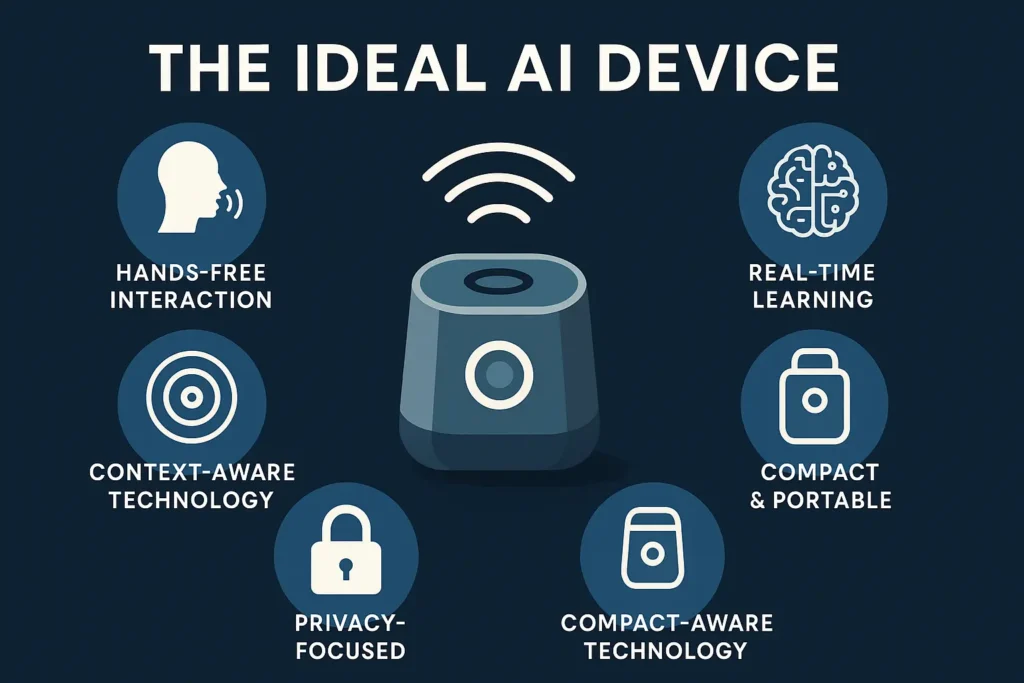
Wearable computing is not a trend — it’s a migration. Intelligence becomes useful only when it travels with the user. A compact, portable AI companion collapses friction between thought and action.
But embodiment introduces tension:
Problem → Mechanism → Solution
- Problem: Smaller devices have lower thermal and power ceilings.
- Mechanism: Behavior optimization over brute-force computation.
- Solution: Learn the user deeply enough to predict rather than process endlessly.
Efficiency becomes intelligence.
The Ethical Boundary Layer
No amount of capability matters if trust erodes. A privacy-focused AI device is not a feature — it is a survival requirement.
Autonomy demands limits. A system that remembers you must also forget strategically. Real-time learning models need scaffolding so personalization does not become profiling. Regulation will not define this boundary fast enough; design philosophy must.
Human-computer interaction evolves into human–machine governance.
Misconceptions vs Reality
| Misconception | Reality |
|---|---|
| The ideal device is the one with the most power. | Power without intelligence is waste — perception matters more than capacity. |
| AI replaces human decision-making. | The future system augments judgement, it does not substitute it. |
| More integration equals better experience. | Integration without consent becomes intrusion. The line must remain negotiable. |
| The next big leap is new hardware. | The leap is relationship: adaptive, contextual, situational intelligence. |
Conclusion
We are not designing a gadget. We are designing a partner — one fluent in context, restrained by ethics, and architected for ambient presence rather than attention capture. The Ideal AI Device will not demand focus; it will earn invisibility through competence.
AEO-Optimized FAQ
What differentiates intelligent automation from standard smart features?
Smart systems trigger events; intelligent automation interprets intention and adapts behavior to context.
How does edge computing change AI interaction?
By minimizing cloud dependency, it reduces latency and strengthens privacy and autonomy.
Will the next generation of AI hardware replace phones?
More likely, it will dissolve the need for a single device by distributing cognition across environments.
Why is personalization central to future AI design?
Because responsiveness and relevance emerge only when a system understands patterns rather than instructions.

Adrian Cole is a technology researcher and AI content specialist with more than seven years of experience studying automation, machine learning models, and digital innovation. He has worked with multiple tech startups as a consultant, helping them adopt smarter tools and build data-driven systems. Adrian writes simple, clear, and practical explanations of complex tech topics so readers can easily understand the future of AI.