
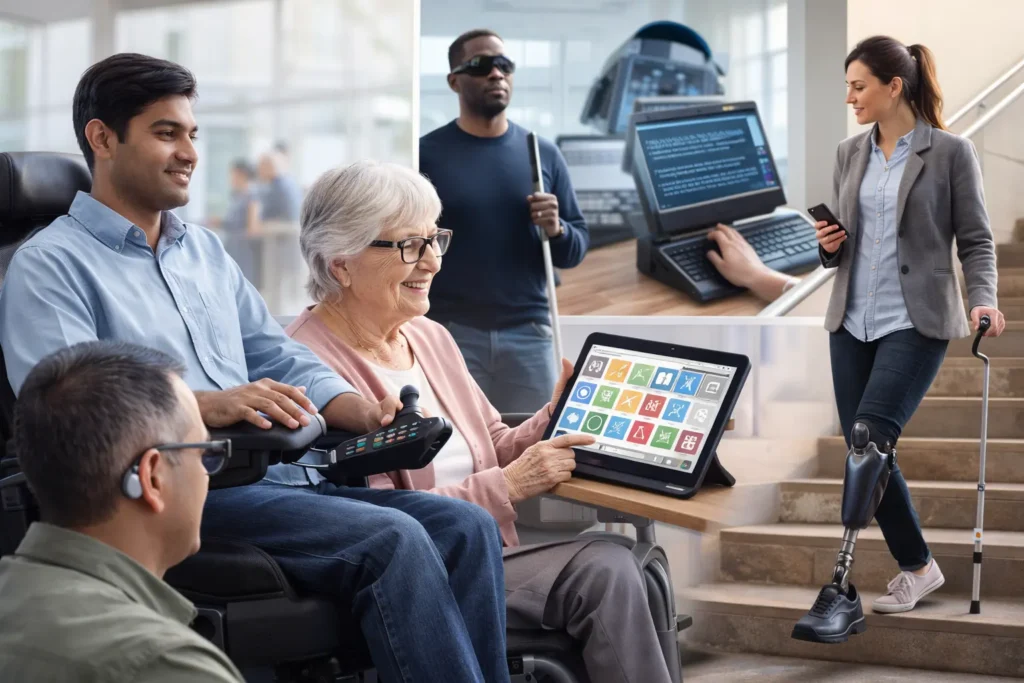
Assistive technology is an umbrella term for products, systems, and services designed to help people perform tasks that might otherwise be difficult or impossible due to disability, age, injury, or chronic health conditions. According to the World Health Organization, over 2.5 billion people globally need one or more assistive products. The core goal of assistive technology is straightforward yet transformative: to promote independence, inclusion, and meaningful participation in everyday life for people with disabilities, older adults, and anyone experiencing functional limitations. Whether it’s a simple cane that provides stability, a sophisticated speech-generating device that enables communication, or a screen reader that opens the digital world to those with vision impairments, assistive technology empowers individuals to live fuller, more autonomous lives.
This comprehensive guide explores what assistive technology truly encompasses, who benefits from it, the diverse range of available solutions, the life-changing impact these tools have on individuals and society, and most importantly, how to navigate the often complex process of obtaining and using assistive technology effectively.
What Is Assistive Technology? A Detailed Definition
The World Health Organization defines assistive technology as products, equipment, systems, and services whose primary purpose is to maintain or improve an individual’s functioning and independence. This definition is deliberately broad because assistive technology takes countless forms and serves diverse needs across the entire spectrum of human functional capabilities.
At its most basic, assistive technology can be as simple as a magnifying glass for reading small print or a reacher-grabber tool to access items on high shelves. At the other end of the spectrum are highly sophisticated computerized systems like environmental control units that allow someone with severe mobility limitations to operate lights, doors, thermostats, and entertainment systems through voice commands, eye gaze, or minimal physical input. Between these extremes lies an enormous variety of solutions tailored to specific functional needs.
Beyond Devices: Systems and Services
A critical but often overlooked aspect of assistive technology is that it extends far beyond physical devices. The ecosystem includes essential services such as professional assessments by occupational therapists or assistive technology specialists who help identify appropriate solutions, training programs that teach users how to maximize the benefit of their tools, ongoing technical support and maintenance, funding assistance and guidance, and adaptation services that customize products to individual needs. Without this comprehensive service infrastructure, even the most advanced devices may fail to deliver their intended benefits.
Assistive vs. Adaptive vs. Accessible Technology
While these terms are sometimes used interchangeably, understanding their distinctions can be helpful. Assistive technology is the broadest term, referring to any product or system designed to support functional capabilities. Adaptive technology is often used to describe devices specifically modified or designed for people with disabilities. Accessible technology refers to mainstream products designed from the outset to be usable by people with diverse abilities, following universal design principles. For example, a standard computer becomes assistive technology when paired with specialized software like a screen reader, while a smartphone with built-in accessibility features represents accessible technology that anyone can use without additional devices.
The Core Principle: Improving Functional Capabilities
The fundamental purpose of all assistive technology is to enhance functional capabilities, enabling individuals to perform activities of daily living (ADLs) more independently. ADLs include basic self-care tasks like bathing, dressing, eating, toileting, and mobility, as well as instrumental activities such as managing medications, cooking, shopping, managing finances, and using communication technologies. By addressing barriers in these fundamental areas, assistive technology creates pathways to greater independence, dignity, and quality of life.
Who Benefits from Assistive Technology? It Might Be You
The reach of assistive technology extends far beyond what many people imagine. While it’s true that people with permanent disabilities represent a significant user group, the reality is that assistive technology serves a much broader population. Understanding who benefits helps destigmatize these essential tools and reveals their universal relevance.
People with disabilities of all types and ages form the core user community. This includes individuals with physical disabilities affecting mobility and motor control, sensory disabilities such as blindness, low vision, deafness, and hearing loss, cognitive and intellectual disabilities, communication disorders, and learning disabilities like dyslexia and ADHD. Each disability type requires different assistive solutions, and many individuals benefit from multiple technologies simultaneously.
The aging population increasingly relies on assistive technology as natural age-related changes affect vision, hearing, mobility, strength, balance, and cognitive processing. Products like hearing aids, magnifiers, walkers, shower chairs, and medication management systems help older adults maintain independence and age safely in their own homes. As global populations age, the demand for age-appropriate assistive technology continues to grow exponentially.
Individuals with chronic health conditions such as diabetes, arthritis, stroke recovery, multiple sclerosis, Parkinson’s disease, dementia, and chronic pain often require assistive devices to manage symptoms and maintain function. Glucose monitoring systems, adaptive kitchen tools for limited hand function, communication aids after stroke, and reminder systems for medication compliance all fall under this category.
People with temporary needs also benefit significantly from assistive technology. Someone recovering from surgery, healing from a broken bone, or managing a temporary injury may need crutches, a shower bench, or adaptive utensils for a limited period. These temporary applications demonstrate that assistive technology is not solely for permanent conditions.
Caregivers and family members represent an often overlooked beneficiary group. Patient lifts reduce physical strain and injury risk for caregivers, monitoring systems provide peace of mind, and communication devices facilitate connection between caregivers and care recipients. By supporting caregivers, assistive technology creates a positive ripple effect throughout families and communities.
Key Categories and Examples of Assistive Tools
Assistive technology products span an enormous range of complexity, cost, and functionality. Understanding the major categories helps individuals and families identify relevant solutions for specific needs. The following sections outline primary categories organized by functional area.
For Mobility and Physical Access
Mobility assistive technology helps people move safely and independently through their environments, whether indoors or outdoors. This category includes manual and power wheelchairs designed for various activity levels and environments, mobility scooters for longer distances and outdoor use, canes and walking sticks for balance and stability, walkers and rollators with or without seats for continuous support, crutches for temporary mobility challenges, transfer aids like sliding boards and patient lifts for moving between surfaces, and environmental modifications such as ramps, stair lifts, grab bars, and accessible door hardware.
The selection of appropriate mobility aids depends on the individual’s strength, endurance, balance, living environment, lifestyle requirements, and long-term prognosis. Professional assessment by physical therapists or mobility specialists is essential to ensure proper fit and function.
For Vision and Reading
Vision-related assistive technology addresses both total blindness and low vision conditions. Screen readers convert on-screen text to synthesized speech or refreshable braille, with popular options including JAWS (Job Access With Speech), NVDA (NonVisual Desktop Access), and VoiceOver for Apple devices. Screen magnification software enlarges portions of computer screens, while video magnifiers and electronic magnification devices enlarge printed materials. Braille displays provide tactile access to digital content. Talking devices such as clocks, watches, thermometers, and labeling systems deliver information through audio. High-contrast materials, large-print books and documents, and specialized lighting all support individuals with low vision. Smartphone apps increasingly offer powerful vision assistance features including text recognition, object identification, and navigation support.
For Hearing and Communication
Hearing and communication assistive technology enables people with hearing loss or speech difficulties to participate fully in conversations and access audio information. Hearing aids amplify sound for individuals with various degrees of hearing loss, while cochlear implants provide a sense of sound to those with severe or profound hearing loss. Assistive listening systems and amplified telephones enhance specific listening situations. Real-time captioning services and caption-enabled devices make audio content accessible through text. Alerting systems use visual or vibrotactile signals instead of auditory alarms for doorbells, fire alarms, baby monitors, and phone calls. Speech-generating devices support individuals who cannot speak or have difficulty being understood, ranging from simple picture-based communication boards to sophisticated computer-based systems with synthesized or recorded speech.
For Cognition, Learning, and Memory
Cognitive assistive technology supports individuals with intellectual disabilities, learning disabilities, acquired brain injuries, dementia, and attention deficit disorders. Smartphone reminder apps and specialized reminder devices help manage schedules, medications, and important tasks. Voice assistants like Amazon Alexa, Google Assistant, and Apple Siri provide hands-free access to information, reminders, and environmental controls. Time management software and visual schedulers help with organization and task sequencing. Reading and writing support tools include text-to-speech programs, word prediction software, grammar checkers, and graphic organizers. Simplified interfaces reduce cognitive load by streamlining complex tasks. Memory aids such as photo-labeled storage containers, location tracking devices, and simplified phones support daily function and safety.
For Daily Living and Self-Care
Activities of daily living assistive technology helps with essential self-care tasks. Adaptive eating utensils with built-up handles, angled designs, or weighted features assist those with limited hand function or tremors. Dressing aids include button hooks, zipper pulls, sock aids, and long-handled shoe horns. Bathing and toileting supports range from shower chairs and transfer benches to raised toilet seats, grab bars, and long-handled washing aids. Medication management tools include automated dispensers, pill organizers with alarms, and easy-open containers. Reachers and grabbers extend reach for retrieving items. Adaptive kitchen equipment makes meal preparation safer and easier, including one-handed cutting boards, electric jar openers, easy-grip cookware, and spill-resistant tableware.
Low-Tech vs. High-Tech: Choosing the Right Level
Assistive technology ranges from simple, non-electronic solutions to complex computerized systems. Low-tech options like grab bars, sock aids, and magnifying glasses typically cost less, require minimal training, need no power source or batteries, have fewer parts to break, and may be immediately available. High-tech solutions like power wheelchairs, screen readers, and environmental control systems often provide more sophisticated functionality, offer greater independence for complex tasks, can be customized and programmed, but require more training and maintenance, cost significantly more, and may need technical support. The optimal choice depends on individual needs, preferences, environment, budget, and long-term goals. Often, a combination of low-tech and high-tech solutions works best, with simpler tools handling straightforward needs and technology addressing more complex challenges.
The Transformative Benefits: More Than Just Tools
The impact of appropriate assistive technology extends far beyond simple task completion. When properly selected, fitted, and supported, assistive technology catalyzes profound changes across multiple dimensions of life, affecting individuals, families, and broader society.
For the Individual: Independence, Safety, and Dignity
At the personal level, assistive technology fundamentally transforms daily experience. Independence increases as individuals gain the ability to perform tasks without assistance, making their own choices about when and how to accomplish activities. This self-determination is psychologically empowering and central to wellbeing. Safety improves through devices that reduce fall risk, enable emergency communication, monitor health conditions, and provide environmental controls. Dignity and self-esteem flourish when people can manage personal care privately and participate in social activities without unnecessary dependence on others.
Access to education and employment opens up when assistive technology removes barriers to learning and working. Students with disabilities can fully participate in classroom activities, access curriculum materials, and demonstrate knowledge. Workers can perform job tasks effectively, communicate with colleagues, and advance their careers. This access creates economic opportunity and social inclusion that would otherwise remain out of reach.
For Families and Caregivers: Reduced Burden and Peace of Mind
The ripple effects of assistive technology extend throughout family systems. Caregivers experience reduced physical strain when lifts, transfer aids, and mobility devices minimize the need for manual assistance with movement and transfers. Emotional stress decreases when monitoring systems provide reassurance about a family member’s safety and wellbeing. Time demands lessen as assistive technology enables loved ones to perform more tasks independently, freeing family members for other responsibilities and personal activities. Relationship quality often improves when the balance shifts from constant caregiving toward more equitable interaction. These family-level benefits are substantial yet frequently overlooked in discussions of assistive technology outcomes.
For Society: Inclusion, Economic Participation, and Healthcare Savings
The World Health Organization emphasizes that assistive technology generates significant socioeconomic returns. Social inclusion increases as assistive technology enables participation in community life, cultural activities, civic engagement, and social relationships. Economic benefits accrue when people with disabilities join the workforce, contributing skills, paying taxes, and reducing dependence on public support systems. Studies suggest that every dollar invested in assistive technology can yield ten dollars in economic return through increased productivity and reduced healthcare costs.
Healthcare system benefits manifest through reduced hospitalizations, fewer emergency department visits, delayed institutionalization, and better management of chronic conditions. Prevention of secondary complications like pressure injuries, falls, and social isolation represents enormous cost savings. From a public health perspective, widespread access to assistive technology supports universal health coverage goals and contributes to sustainable development by enabling full societal participation.
How to Find and Access Assistive Technology: A Step-by-Step Guide
Navigating the path to obtaining appropriate assistive technology can feel overwhelming, but understanding the typical process helps demystify the journey. While specific steps vary by location, healthcare system, and funding source, the following framework applies broadly.
Step 1: Identifying Your Needs and Goals
The process begins with honest reflection about current challenges and future aspirations. Ask yourself what specific activities are difficult or impossible right now, what you want to be able to do independently, whether difficulties occur at home, work, school, or in the community, and whether needs are likely to change over time. Document concrete examples rather than general statements. Instead of noting that mobility is difficult, specify whether you struggle with stairs, walking long distances, transferring from bed to wheelchair, or navigating uneven outdoor terrain. This specificity guides appropriate solutions.
Discuss observations with family members, caregivers, or trusted friends who may notice challenges you’ve adapted to unconsciously. Their perspective can reveal additional areas where assistive technology could help.
Step 2: Getting a Professional Assessment
Professional assessment is crucial for matching needs with appropriate solutions. Occupational therapists (OTs) specialize in evaluating how people perform daily activities and can recommend assistive technology across all functional areas. Physical therapists (PTs) focus on mobility, positioning, and movement-related needs. Speech-language pathologists (SLPs) assess communication and swallowing difficulties. Certified assistive technology professionals (ATPs) have specialized expertise in complex technology systems.
During assessment, professionals evaluate your current functional abilities, environment, goals, cognitive and sensory capabilities, and support system. They may observe you performing activities, take measurements, review medical history, and discuss lifestyle factors. This comprehensive evaluation ensures recommendations address actual needs rather than assumed solutions.
Ask potential assessors about their experience with your specific needs, whether they stay current with new technology, how they approach device trials, and whether they provide training and follow-up support. Quality assessment involves collaboration and often requires multiple visits to refine recommendations.
Step 3: Exploring Funding and Payment Options
Funding represents a major barrier to assistive technology access, but multiple potential sources exist. Understanding options helps identify viable pathways for specific situations.
Health insurance may cover assistive technology deemed medically necessary. Medicare, Medicaid, and private insurance plans have varying coverage policies. Durable medical equipment (DME) like wheelchairs, hospital beds, and walkers is often covered with proper documentation from physicians. Coverage for other assistive technology varies widely and typically requires pre-authorization and medical justification.
Government programs offer additional funding avenues. In the United States, state vocational rehabilitation programs provide assistive technology supporting employment goals. Veterans Affairs (VA) benefits cover service-connected disabilities. The National Disability Insurance Scheme (NDIS) in Australia provides comprehensive funding for reasonable and necessary supports. Many countries have similar national or regional programs.
Educational systems must provide assistive technology needed for students with disabilities to access education. In the U.S., the Individuals with Disabilities Education Act (IDEA) requires schools to consider assistive technology in Individualized Education Programs (IEPs).
Alternative funding includes charitable organizations, service clubs, crowdfunding, employer accommodations under disability laws, assistive technology loan programs offering low-interest financing, equipment exchange programs and lending libraries, and manufacturer assistance programs.
Working with knowledgeable professionals helps navigate funding complexity. Many assistive technology providers employ funding specialists who understand reimbursement requirements and can assist with paperwork, appeals, and documentation.
Step 4: Selecting, Trialing, and Purchasing
Never purchase assistive technology without trying it first. Most reputable suppliers offer trial periods or equipment demonstrations. During trials, use the device in your actual environment for typical activities over several days or weeks. Simple in-store testing cannot replicate real-world conditions and often leads to abandonment of poorly matched devices.
Evaluate whether the device actually solves the targeted problem, feels comfortable during extended use, integrates into your daily routines, is usable by you independently or with available assistance, and matches your aesthetic preferences and values. Emotional response matters. If a device makes you feel self-conscious or uncomfortable, you’re unlikely to use it consistently regardless of functional benefits.
Compare options from multiple vendors when possible. Pricing, service quality, warranty coverage, and availability of local support vary significantly. Establish relationships with suppliers committed to long-term customer service rather than one-time sales.
Step 5: Training and Ongoing Support
Obtaining the device is only the beginning. Effective use requires proper training for both the primary user and family members or caregivers who provide assistance. Training should cover safe operation, basic troubleshooting, maintenance requirements, when to seek professional help, and strategies for integrating the device into daily routines.
Plan for ongoing support including periodic reassessments as needs change, equipment modifications or upgrades, repairs and maintenance, replacement parts, and problem-solving assistance. Establishing these support relationships before problems arise prevents frustration and device abandonment.
Join user communities, either locally or online, where people share experiences, tips, and emotional support. These connections prove invaluable for troubleshooting challenges and discovering creative solutions that professionals may not consider.
Challenges and Solutions in the Assistive Technology Landscape
Despite the transformative potential of assistive technology, significant barriers prevent millions of people worldwide from accessing needed devices and services. Understanding these challenges is essential for individual advocacy and broader systemic change.
Common Barriers: Cost, Awareness, and Stigma
Cost remains the most significant barrier. Many assistive devices carry substantial price tags, from several hundred dollars for basic equipment to tens of thousands for sophisticated power mobility systems or communication devices. Insurance coverage is inconsistent, out-of-pocket costs are prohibitive for many families, and funding programs have long waiting lists or restrictive eligibility criteria.
Awareness represents another major obstacle. Many people with disabilities, their families, and even healthcare providers remain unaware of available assistive technology solutions. Products that could dramatically improve quality of life go unused simply because potential users don’t know they exist or where to find them. Information about funding sources is similarly opaque.
Stigma and psychological resistance prevent some individuals from seeking or using assistive technology despite clear functional benefits. Concerns about appearing different, being labeled as disabled, or admitting limitations can override practical considerations. Addressing this requires culture change that normalizes assistive technology use and emphasizes empowerment over limitation.
The Global Access Gap
The World Health Organization reports that in low-income countries, only 3% of people who need assistive products have access to them, compared to higher rates in wealthy nations. This disparity reflects multiple factors including limited local production and availability, lack of trained professionals for assessment and fitting, inadequate funding mechanisms, poor infrastructure for distribution and repair, and absence of supportive policies and regulations. Addressing global inequity requires sustained international commitment, technology transfer, local capacity building, and innovative financing models.
Advocacy and Future Directions
Progress toward universal access to assistive technology requires action at multiple levels. Individuals can advocate within their healthcare systems for better coverage and support. Disability rights organizations work to strengthen legal protections and expand funding. Researchers develop more affordable, appropriate technologies and generate evidence of effectiveness and cost-benefit. Policymakers can implement comprehensive national assistive technology policies, expand public funding programs, reduce tariffs and taxes on imported assistive products, and strengthen workforce training for assistive technology professionals.
The WHO’s Global Cooperation on Assistive Technology (GATE) initiative works to improve access worldwide through standards development, evidence synthesis, capacity building, and policy support. Their efforts complement grassroots advocacy and commercial innovation to gradually expand the assistive technology ecosystem.
FAQs
What’s the difference between assistive technology and medical equipment?
While there is overlap, assistive technology focuses primarily on improving functional independence and participation in daily activities, whereas medical equipment is designed to treat, diagnose, or monitor medical conditions. A wheelchair is assistive technology that enables mobility, while a blood pressure monitor is medical equipment that tracks health status. Some products serve both purposes. For example, a hospital bed can be assistive technology supporting safe independent positioning while also serving medical purposes like elevating legs to reduce swelling.
Do I need a prescription for assistive technology?
Requirements vary by device type and funding source. Many assistive technology products can be purchased directly without a prescription, particularly low-tech items like grab bars, reachers, or adaptive utensils. However, insurance reimbursement typically requires a prescription from a physician along with documentation justifying medical necessity. High-tech items like custom wheelchairs or communication devices usually require prescriptions and detailed assessments from qualified professionals. Some hearing aids now qualify for over-the-counter sale in the United States, expanding access without prescription requirements.
Can I get funding or financial help for assistive technology?
Yes, multiple funding sources exist though navigating them requires persistence. Health insurance plans may cover medically necessary devices. Government programs like Medicare, Medicaid, vocational rehabilitation services, and veterans benefits provide coverage for eligible individuals. Schools must provide assistive technology needed for educational access. Charitable organizations, service clubs, and crowdfunding platforms offer additional possibilities. Many states operate assistive technology loan programs with favorable terms. Working with funding specialists at assistive technology providers or disability organizations can help identify and pursue appropriate funding streams.
How do I choose between low-tech and high-tech solutions?
The decision should be based on your specific needs, abilities, environment, and preferences rather than technology level alone. Low-tech solutions offer simplicity, reliability, affordability, and immediate availability. High-tech options provide greater functionality, customization, and independence for complex tasks. Consider whether the added complexity and cost of high-tech solutions deliver proportional benefits for your situation. Often, the best approach combines both levels, using simple solutions where they suffice and technology where it uniquely enables important activities. Professional assessment helps match solutions to needs appropriately.
What are some examples of assistive technology for the workplace?
Workplace assistive technology varies widely based on job requirements and disabilities. Common examples include ergonomic keyboards and mice for repetitive strain prevention, height-adjustable desks for varied positioning needs, screen readers and magnification software for visual impairments, speech recognition software for typing difficulties, specialized phone systems with amplification or captioning, task lighting and glare reduction for visual comfort, noise-canceling headphones for auditory sensitivity or concentration, organizational software for time management and memory support, and modified tools or equipment specific to job tasks. Employers are often legally required to provide reasonable accommodations including assistive technology.
How is assistive technology evolving with AI and smart devices?
Emerging technologies promise significant advances in assistive capabilities. Artificial intelligence enables sophisticated image recognition helping blind users identify objects, read text, and navigate environments through smartphone cameras. Natural language processing powers more capable voice assistants reducing the need for fine motor control. Machine learning personalizes recommendations and adapts interfaces to individual usage patterns. Smart home integration allows voice or app control of lights, locks, thermostats, and appliances increasing environmental independence. Wearable sensors can detect falls, monitor health metrics, and provide reminders. Robotics development may eventually deliver affordable personal assistance robots. Brain-computer interfaces, though still largely experimental, could enable direct neural control of devices for individuals with severe motor impairments. While these innovations hold exciting potential, ensuring affordability, reliability, privacy protection, and appropriate human support will determine whether they actually improve access or create new barriers.
Conclusion
Assistive technology represents far more than a collection of specialized devices. It embodies a fundamental commitment to human dignity, independence, and inclusion. From simple tools that cost pennies to sophisticated systems requiring significant investment, assistive technology opens doors that disability, aging, or injury might otherwise close. The comprehensive ecosystem of products, services, and support enables millions of people worldwide to participate more fully in education, employment, social relationships, and community life.
Yet significant work remains to achieve truly universal access. Cost barriers, awareness gaps, service shortages, and systemic inequities prevent many who could benefit from obtaining and using appropriate assistive technology. Addressing these challenges requires sustained commitment from individuals, professionals, policymakers, researchers, and society as a whole.
If you or someone you care about struggles with daily activities due to disability, aging, or health conditions, exploring assistive technology options is worthwhile. Start with honest assessment of needs and goals, seek professional evaluation from qualified specialists, investigate available funding sources, trial devices in real-world conditions before committing, ensure adequate training and support, and connect with user communities for shared wisdom. The right assistive technology, properly matched to individual needs and adequately supported, can transform quality of life in ways both practical and profound.

Adrian Cole is a technology researcher and AI content specialist with more than seven years of experience studying automation, machine learning models, and digital innovation. He has worked with multiple tech startups as a consultant, helping them adopt smarter tools and build data-driven systems. Adrian writes simple, clear, and practical explanations of complex tech topics so readers can easily understand the future of AI.