1. What is Duck Creek Technologies? Overview & Mission
Duck Creek Technologies is an intelligent solutions provider for the global P&C insurance industry. Its cloud-native core suite replaces aging legacy systems with a modern, configurable platform that enables insurers to launch new products faster, reduce operational costs, and deliver superior customer experiences. The company’s mission is to help insurers achieve the agility of a startup with the scale of an enterprise.
1.1 Intelligent Solutions for Modern Insurance
Duck Creek’s platform is designed to address the most persistent pain points in insurance technology: long product-launch cycles, expensive legacy maintenance, siloed data, and inability to rapidly adapt to market changes. By combining low-code configurability, pre-built bureau content, and an AI orchestration layer, Duck Creek enables carriers to bring new insurance products to market in as little as 30 days — a fraction of the time required by traditional systems.
1.2 Company Snapshot
| Attribute | Details |
| Founded | 2000 |
| Headquarters | Boston, MA, USA |
| Additional Offices | London, Sydney, Mumbai, Columbia (SC), Bolivar (MO), Levallois-Perret (France) |
| Employees | ~1,891 (flexible-first, remote-friendly culture) |
| Ownership | Private — backed by Vista Equity Partners (taken private from NASDAQ: DCT) |
| Total Funding Raised | $1.02 Billion |
| Investors | Vista Equity Partners, CapitalG (Google) |
| Customers | 200+ insurance carriers globally |
| Implementations | 1,100+ completed implementations |
| Patents | 54 patents (primarily claims processing AI) |
| Annual Conference | Formation ’26 |
2. Duck Creek Product Suite: End-to-End Insurance Lifecycle
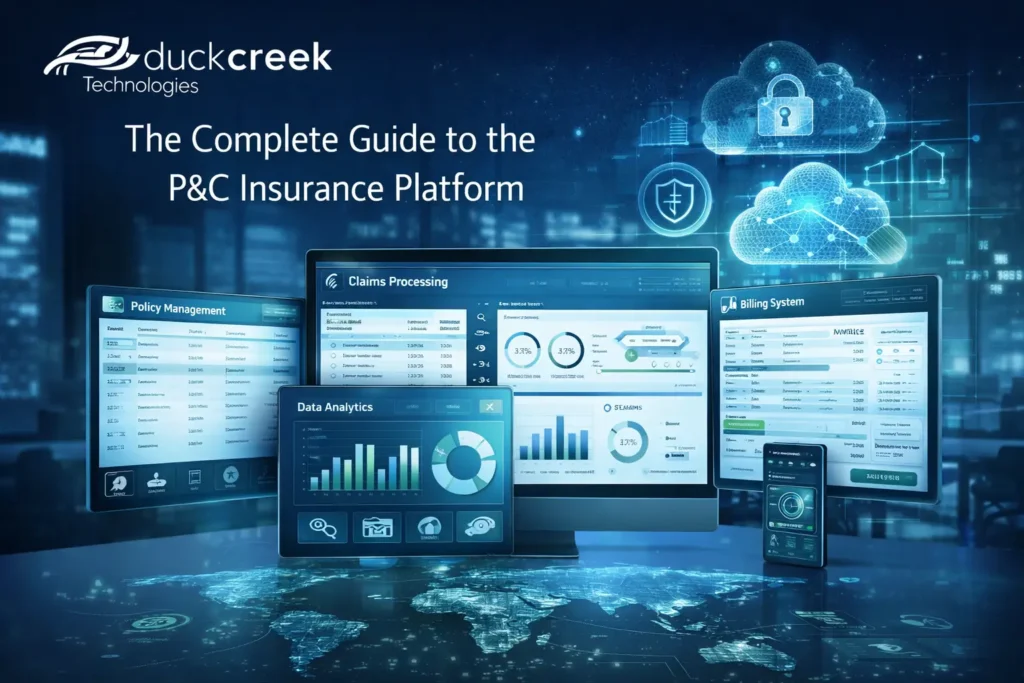
Duck Creek’s platform covers every stage of the insurance policy lifecycle — from product definition and rating through policy administration, billing, claims settlement, reinsurance accounting, and business intelligence. Each module is purpose-built for P&C insurance and can be deployed individually or as an integrated suite on the Duck Creek OnDemand SaaS platform.
2.1 Duck Creek Policy — Rating & Product Definition
Duck Creek Policy is the cornerstone of the platform, providing quote-to-bind workflow management with deep low-code product definition tools. Underwriters and product managers can build, configure, and launch new insurance products without writing extensive custom code.
- Straight-through processing (STP) — automates routine transactions from submission to issuance
- Reusable product modules — line-of-business kits for auto, home, commercial, specialty, and more
- Bureau content pre-loaded — ISO, NCCI, and AAIS templates are included out of the box
- Low-code product configurator — business users can modify coverage, rating factors, and forms without IT dependency
- ACORD form processing — standardized data exchange with agencies and regulators
- Policy lifecycle management — endorsements, cancellations, renewals, and reinstatements handled natively
2.2 Duck Creek Billing — Collections, Commissions & GL
Duck Creek Billing manages all aspects of premium collection, payment processing, commission management, and general ledger integration. It supports flexible billing plans and payment arrangements that match carrier and policyholder needs.
- Flexible billing plans — monthly installments, annual, pay-as-you-go
- Commission management — automated agent and broker commission calculations
- Payment processing — ACH, credit card, lockbox, and digital wallet integrations
- GL integration — real-time synchronization with financial systems
- Accounts receivable automation — reduces manual reconciliation effort
- Multi-currency support — for carriers operating in multiple markets
2.3 Duck Creek Claims — FNOL to Closure & Automation
Duck Creek Claims provides a first notice of loss (FNOL)-to-closure workflow with embedded automation and conversational AI capabilities. The module is designed to reduce claims leakage, improve adjuster productivity, and deliver faster, more accurate settlements.
- Automated task processor — routes claims, assigns adjusters, and triggers next-best actions automatically
- Conversational AI for claims — enables policyholders to file and track claims via chat or voice interfaces
- 30M+ claims already processed in the Duck Creek cloud environment
- Fraud detection integration — connects with third-party analytics tools
- Reserves management — automated reserve setting based on claim characteristics
- Subrogation and salvage — built-in workflows to maximize recoverables
- Litigation management — tracks legal proceedings associated with claims
2.4 Duck Creek Reinsurance Management
Duck Creek Reinsurance Management handles the full spectrum of reinsurance accounting and administration, including treaty and facultative structures. It is designed to eliminate spreadsheet-based workarounds and manual processing that plague many carriers’ reinsurance operations.
- Treaty and facultative reinsurance structures — quota share, excess of loss, aggregate
- Automated premium and loss bordereau generation
- Cession and recovery calculation engines
- Maximize recoverables — automated ceding ensures no recoverable is missed
- GAAP and IFRS 17 reporting capabilities
- Integration with Duck Creek Clarity for reinsurance analytics
2.5 Duck Creek Clarity — Analytics, AI & Data Intelligence
Duck Creek Clarity is the platform’s data analytics and AI module, delivering actionable insights across policy, billing, and claims operations. Clarity transforms raw transaction data into executive dashboards, operational KPIs, and predictive models.
- Pre-built insurance KPI dashboards — loss ratio, combined ratio, policy count trends, claims frequency
- AI and machine learning — predictive models for underwriting risk, claims severity, and fraud detection
- Open data lake architecture — integrates with enterprise BI tools (Tableau, Power BI, Snowflake)
- Real-time reporting — 50,000+ daily policy transactions processed and reportable
- Regulatory reporting — state-specific filing formats and NCCI reporting
2.6 Duck Creek Digital Engagement (Producer) & Distribution Management
Duck Creek Producer and Distribution Management provide digital engagement capabilities for agents, brokers, and direct consumers. These modules bridge the gap between the core system and external distribution channels.
- Agent and broker portal — self-service quoting, binding, and policy servicing
- Consumer-facing digital experience — online quote and buy for personal lines
- Distribution Management — manages relationships with MGAs, program administrators, and wholesale brokers
- Commission and incentive management at the distribution level
- Real-time integration with Duck Creek Policy for seamless transactions
2.7 Duck Creek Loss Control — Risk Inspection
Duck Creek Loss Control enables carriers to manage risk inspection and pre-loss engineering workflows. It connects field inspection data to underwriting decisions, supporting risk selection and portfolio management for commercial lines carriers.
- Mobile inspection tools — field engineers capture property data on mobile devices
- Integration with underwriting — inspection results feed directly into Duck Creek Policy
- Risk score calculation — automated assessment based on inspection findings
3. Key Differentiators: Why Insurers Choose Duck Creek
3.1 Low-Code Configurability vs. Traditional Coding
The most significant differentiator in Duck Creek’s market positioning is its low-code approach to insurance product configuration. Traditional core system replacements required armies of developers and multi-year projects to change a rate factor or add a new coverage. Duck Creek’s platform changes this dynamic fundamentally.
Business analysts and product managers — not just software engineers — can use Duck Creek’s visual configuration tools to:
- Define new insurance products and coverages
- Modify rating algorithms and pricing factors
- Configure billing plans and payment schedules
- Update policy forms and endorsements
- Design claims workflows and assignment rules
This low-code capability directly enables Duck Creek’s headline metric: new insurance products launched in as little as 30 days.
3.2 Evergreen SaaS — Duck Creek OnDemand
Duck Creek OnDemand is the company’s evergreen SaaS delivery model. Unlike traditional software licenses that require painful, disruptive upgrade projects every few years, OnDemand delivers continuous platform updates automatically — keeping all customers on the same, current version at all times.
| What ‘Evergreen’ Means for P&C Carriers Evergreen SaaS eliminates the expensive, time-consuming upgrade cycles that can consume 30-40% of an IT department’s annual budget in traditional on-premise environments. Duck Creek OnDemand handles infrastructure, security patching, and feature releases — freeing carrier IT teams to focus on business value rather than maintenance. |
3.3 Pre-built Bureau Content — ISO, NCCI, AAIS & Line of Business Kits
One of Duck Creek’s most valuable — and hardest to replicate — competitive advantages is its library of pre-built bureau content. Carriers normally spend months building and maintaining ISO, NCCI, and AAIS rate and form content. Duck Creek delivers this content pre-loaded and pre-tested:
- ISO content — Personal and commercial lines rates, rules, and forms for all 50 US states
- NCCI content — Workers’ compensation class codes, rates, and experience modification factors
- AAIS content — Agricultural, inland marine, and specialty program content
- Line of Business Kits — Accelerators for auto, homeowners, commercial package, BOP, workers’ comp, and specialty lines
This pre-built content dramatically reduces implementation timelines and compliance risk.
3.4 Open Architecture & 2,600+ APIs
Duck Creek is built on an open architecture with more than 2,600 published APIs. This enables carriers to integrate Duck Creek with their existing technology ecosystem — including CRM systems, payment processors, fraud detection tools, telematics providers, and third-party data sources — without costly custom integration work.
- RESTful API design — modern standards for enterprise integration
- 130+ pre-built partner integrations — out-of-the-box connectors with leading insurtech vendors
- Ecosystem partnerships — CyberCube (cyber risk analytics), Imburse (payment processing), and others
- Developer-friendly — comprehensive API documentation supports rapid integration development
3.5 AI Orchestration Layer
Duck Creek has invested heavily in embedding artificial intelligence across its platform. The AI orchestration layer connects predictive models, automation rules, and generative AI capabilities across Policy, Claims, and Clarity modules:
- Claims automation — AI routes, prioritizes, and resolves routine claims without adjuster intervention
- Underwriting AI — predictive scoring assists underwriters in risk selection
- GenAI in engineering — accelerates Duck Creek’s own development cycles by 30-50%
- Auditable AI — all AI decisions are explainable and auditable for regulatory compliance
- Agentic AI — autonomous agents that execute multi-step insurance workflows
4. Duck Creek Technology in Action: Capabilities & Benefits
4.1 Speed-to-Market: Deploy Products in 30 Days
The insurance industry has historically moved slowly — legacy systems, regulatory requirements, and complex rate filings meant that launching a new product could take 12-18 months. Duck Creek’s platform collapses this timeline:
- New product launch: As fast as 30 days with Duck Creek’s low-code configurator and pre-built bureau content
- Rate changes: Hours or days, not weeks — business users make changes directly
- Form updates: Automated bureau content updates keep forms current without manual work
- Market expansion: Roll out to new states faster using existing product frameworks
4.2 Lower Total Cost of Ownership (TCO)
Duck Creek’s SaaS model fundamentally changes the total cost of ownership equation for core insurance systems. Traditional on-premise or hosted legacy systems carry significant hidden costs:
| Cost Component | Legacy/On-Premise | Duck Creek OnDemand |
| Infrastructure | Capital purchase + ongoing maintenance | Included in SaaS subscription |
| Upgrades | Major projects every 3-5 years (costly) | Automatic, continuous updates |
| Bureau Content | Manual maintenance teams required | Pre-built and maintained by Duck Creek |
| Integration | Custom code for each integration | 2,600+ APIs + 130 pre-built connectors |
| Security | Internal teams or third parties | SOC-compliant, Duck Creek managed |
| Scalability | Capacity planning and hardware investment | Elastic cloud scaling |
4.3 Scalability & Performance
Duck Creek’s cloud-native architecture is built to handle the transaction volumes of large, complex insurance carriers:
- 50,000+ daily policy transactions — processed reliably on the platform
- 30 million+ claims — processed cumulatively in the Duck Creek cloud environment
- Elastic scalability — automatically scales to handle peak volumes during catastrophe events
- High availability — enterprise-grade uptime SLAs with redundant, multi-region architecture
4.4 Humanized Customer & Agent Experiences
Beyond back-office efficiency, Duck Creek helps carriers deliver modern digital experiences to policyholders, agents, and claimants. The platform supports omnichannel engagement — web, mobile, and conversational AI interfaces — ensuring that interactions with insurers feel as intuitive as consumer apps.
- Self-service policyholder portal — view policies, make payments, file claims online
- Agent productivity tools — streamlined quote, bind, and service workflows
- Conversational AI claims intake — policyholders can report claims via chatbot or voice
- Real-time status updates — automated notifications throughout the policy and claims lifecycle
5. Industry Solutions: P&C Lines of Business Supported
Duck Creek’s platform is designed for the full breadth of Property & Casualty insurance lines, from standard personal auto to complex specialty risks.
5.1 Personal Lines
Duck Creek’s personal lines capabilities cover the full suite of consumer insurance products:
- Private Passenger Auto — liability, collision, comprehensive, PIP, UM/UIM
- Homeowners — dwelling, personal property, liability, additional living expense
- Umbrella — personal excess liability over auto and home policies
- Renters — tenant personal property and liability coverage
- Pet Insurance — veterinary care coverage (growing personal lines segment)
- Recreational — boat, motorcycle, RV coverage
5.2 Commercial Lines
For commercial carriers, Duck Creek supports complex multi-coverage commercial programs:
- Commercial Package Policy (CPP) — bundled commercial coverages for small and mid-size businesses
- General Liability (GL) — occurrence and claims-made forms
- Commercial Property — building, business personal property, business income
- Workers’ Compensation — state-specific class codes, NCCI content, experience modification
- Commercial Auto — fleet and non-fleet, hired and non-owned auto
- Business Owners Policy (BOP) — packaged small business solution
5.3 Specialty Lines
Duck Creek’s open, configurable architecture is well-suited for complex specialty insurance products:
- Cyber Liability — first-party and third-party cyber risk coverage
- Directors & Officers (D&O) — management liability coverage
- Professional Liability / E&O — errors and omissions for service professionals
- Excess & Surplus (E&S) — non-admitted specialty coverage
- Marine — inland marine, ocean cargo, hull
- Agricultural — crop, livestock, farm property (using AAIS content)
6. Duck Creek Platform: Deployment & Technical Architecture
6.1 Cloud-Native Architecture
Duck Creek is cloud-native by design — not a legacy system retrofitted for the cloud. The platform is built on modern cloud infrastructure (AWS and Azure), using microservices architecture, containerization, and continuous integration/continuous deployment (CI/CD) pipelines.
- Microservices — independent, scalable services for each functional domain
- API-first design — all platform capabilities exposed as APIs
- Containerization — Docker-based deployment for consistent, portable environments
- Multi-region deployment — geographic redundancy for disaster recovery
- DevSecOps — security embedded throughout the development and operations lifecycle
6.2 SaaS vs. Private Hosting Options
Duck Creek offers deployment flexibility to meet carrier data residency and governance requirements:
| Deployment Model | Description | Best For |
| Duck Creek OnDemand (SaaS) | Fully managed, evergreen SaaS on shared cloud infrastructure | Most carriers — maximum agility and lowest TCO |
| Private SaaS | Dedicated cloud environment managed by Duck Creek | Carriers with data residency or regulatory requirements |
| Managed Hosting | Customer-controlled infrastructure with Duck Creek support | Large carriers with existing cloud investments |
6.3 Duck Creek OnDemand Explained
Duck Creek OnDemand is the company’s flagship SaaS delivery model, and it is what most evaluators mean when they refer to ‘Duck Creek’ today. Key characteristics:
- Evergreen updates — new features, security patches, and bureau content updates delivered continuously
- Single codebase — all customers run the same platform version, eliminating version fragmentation
- Configuration portability — carrier configurations are isolated from platform code, making updates non-disruptive
- Subscription-based — OpEx pricing model replaces large CapEx software license investments
- Managed operations — Duck Creek handles infrastructure, monitoring, backup, and disaster recovery
6.4 Security, Compliance & Data Residency
Duck Creek maintains enterprise-grade security certifications and compliance standards:
- SOC 2 Type II — independently audited controls for security, availability, and confidentiality
- GDPR compliance — data privacy controls for European operations and data subjects
- Data residency options — US, UK, EU, and APAC data residency available for regulatory compliance
- Auditable AI — all AI-driven decisions are explainable and logged for regulatory review
- Encryption — data encrypted at rest and in transit using industry-standard protocols
- Penetration testing — regular third-party security assessments
7. Duck Creek vs. Competitors: Guidewire, Majesco & Vertafore
The P&C core system market is competitive. The following comparison highlights how Duck Creek positions against its primary alternatives:
| Criteria | Duck Creek | Guidewire | Majesco | Vertafore |
| Primary Market | P&C Carriers, MGAs | P&C Carriers | P&C Carriers, Life | Agencies, Carriers |
| Deployment | Cloud-native SaaS (OnDemand) | Cloud & On-Premise | Cloud SaaS | Cloud SaaS |
| Low-Code Config | Core differentiator — business users configure | Available but more technical | Available | Limited |
| Pre-built Bureau Content | ISO, NCCI, AAIS included | Available as add-on | Limited | Limited |
| Speed to Market | 30 days for new products | Weeks to months | Weeks | Varies |
| Open APIs | 2,600+ APIs | Extensive | Extensive | Limited |
| AI Capabilities | Native AI orchestration layer across all modules | InsuranceSuite AI add-ons | Emerging | Limited |
| Partner Ecosystem | 130+ integrations | Large marketplace | Growing | Established |
| Global Reach | US, UK, EU, APAC | Global | US-focused | North America |
| Reinsurance Module | Native Duck Creek Reinsurance | Separate product | Available | Not native |
| Key Takeaway: Duck Creek’s strongest competitive advantages versus Guidewire are its low-code configurability (business users — not just IT — can change products) and pre-built bureau content (ISO/NCCI/AAIS). Against Majesco, Duck Creek differentiates on its mature AI capabilities and deeper reinsurance functionality. Against Vertafore (which serves agencies more than carriers), Duck Creek serves a fundamentally different buyer. |
8. Customer Success & ROI Evidence
8.1 Case Study Highlight: Cumberland Mutual
Challenge: Cumberland Mutual needed to modernize its product configuration process. Manual, code-heavy changes were slowing product launches and increasing IT dependency.
Solution: Duck Creek Policy with low-code product definition tools, deployed on Duck Creek OnDemand.
Outcome: Business users — not IT staff — now configure product changes directly. New endorsements and coverage modifications that previously required weeks of IT work are completed in days. Cumberland Mutual reduced its time-to-market for product changes significantly and lowered IT labor costs associated with product maintenance.
8.2 Encova Insurance — Distribution Management
Challenge: Encova needed better visibility and control over its distribution channel — managing relationships with agents, MGAs, and program administrators across multiple states.
Solution: Duck Creek Distribution Management, integrated with Duck Creek Policy and Billing.
Outcome: Encova gained a unified view of its distribution network, with automated commission calculations and real-time production reporting. Agent satisfaction improved as self-service quoting and binding capabilities were extended through Duck Creek Producer.
8.3 Fortegra — Reinsurance & Clarity
Challenge: Fortegra’s reinsurance accounting was managed largely in spreadsheets, creating manual effort, error risk, and delayed reporting.
Solution: Duck Creek Reinsurance Management and Duck Creek Clarity, deployed on OnDemand.
Outcome: Reinsurance bordereau generation was automated, reducing manual effort by a significant margin. Duck Creek Clarity provided Fortegra’s leadership with real-time reinsurance analytics, improving decision-making on treaty structures and cession strategies.
8.4 Platform-Wide Statistics
| 200+ Insurance Carriers | 30M+ Claims in Cloud | 1,100+ Implementations | 130+ Integrations | 2,600+ Open APIs | 54 Patents |
9. Financials, Funding & Market Position
9.1 Valuation & Investors
Duck Creek Technologies has a well-documented funding history and institutional backing:
- Total Funding: $1.02 billion raised across multiple rounds
- Vista Equity Partners: Primary investor and controlling shareholder; took Duck Creek private from NASDAQ (ticker: DCT)
- CapitalG: Google’s independent growth equity fund is a strategic investor
- Former Public Company: Duck Creek was listed on NASDAQ under ticker DCT before Vista took it private — providing a level of financial transparency not common in private software companies
9.2 Key Acquisitions
Duck Creek has pursued a strategic acquisition strategy to expand platform capabilities:
| Acquired Company | Capability Added | Strategic Rationale |
| Risk Control Technologies | Loss control and risk inspection software | Expanded Duck Creek’s offering into pre-loss risk management for commercial carriers |
| Imburse | Payment orchestration platform | Enhanced billing capabilities with modern payment processing and embedded insurance payments |
| Effisoft | Reinsurance management software | Deepened Duck Creek Reinsurance with proven reinsurance accounting capabilities from European market |
9.3 Patent Portfolio
Duck Creek holds 54 patents, primarily focused on claims processing automation and AI-driven insurance workflows. This patent portfolio represents a meaningful barrier to competitive replication of Duck Creek’s most advanced capabilities, particularly in automated claims handling and AI orchestration.
10. Implementation & Services
10.1 Typical Implementation Timeline
Implementation timelines vary based on the scope of modules deployed, the complexity of the carrier’s existing products, and the extent of data migration required. General guidance:
| Implementation Scope | Estimated Timeline | Key Factors |
| New product launch (single LOB) | 30 days | Using Duck Creek’s pre-built LOB kits and bureau content |
| Single module (Policy or Claims) | 3–6 months | Configuration, data migration, integration, and UAT |
| Full suite implementation | 9–18 months | All modules, all LOBs, full data migration and ecosystem integration |
| Legacy system replacement | 12–24 months | Complex data conversion, parallel running, and cutover planning |
10.2 Professional Services & Customer Success
Duck Creek offers a comprehensive services organization to support implementation and ongoing success:
- Implementation Services: Duck Creek’s professional services team leads or co-leads implementation projects using a structured delivery methodology
- Partner-led Implementations: Certified SI partners (Accenture, Deloitte, EY, Capgemini, Majesco Services, and others) deliver many implementations
- Customer Success Management: Dedicated CSMs assigned to enterprise accounts for ongoing guidance and adoption support
- Training & Enablement: Duck Creek University provides role-based training for business analysts, developers, and administrators
- Support Plans: Multiple support tiers with defined SLAs for incident response and bug resolution
10.3 Partner Ecosystem
Duck Creek’s 130+ partner integrations span the full insurtech ecosystem:
- Data & Analytics — LexisNexis, Verisk, ISO, NCCI
- Payment Processing — Imburse, PayPal, bank integrations
- Fraud Detection — Verisk, ISO ClaimSearch, SIU tools
- Cyber Risk — CyberCube
- Telematics — connected car and IoT data providers
- Reinsurance Brokers — automated data exchange with major reinsurance brokers
- Regulatory Filing — SERFF, state insurance department integrations
11. Pricing & Licensing Model
| Important Note on Pricing Duck Creek Technologies does not publish standard pricing. Like most enterprise insurance core system vendors, pricing is custom-quoted based on carrier size, module selection, and implementation scope. The following describes the pricing model structure to help buyers understand cost drivers and prepare for vendor conversations. |
11.1 SaaS Subscription Model
Duck Creek OnDemand is priced as a SaaS subscription, replacing the traditional perpetual software license model. This means:
- No large upfront license fee — OpEx rather than CapEx
- Annual or multi-year subscription agreements
- Infrastructure, hosting, and maintenance included in the subscription
- Bureau content updates (ISO, NCCI, AAIS) typically included or available as subscription add-ons
11.2 Key Pricing Factors
The cost of a Duck Creek implementation and subscription is typically driven by:
| Pricing Factor | Description |
| Policy Volume | Number of policies in force — higher volumes generally mean higher subscription fees |
| Modules Selected | Each module (Policy, Billing, Claims, Reinsurance, Clarity, Producer) is priced separately or as a bundle |
| Lines of Business | Number and complexity of LOBs deployed (standard vs. specialty lines) |
| Implementation Scope | Professional services are priced separately based on project complexity |
| Geographic Footprint | Multi-state or international deployments may involve additional licensing |
| User Count | Some modules may have user-based pricing components for portal access |
11.3 How to Get a Quote
Buyers evaluating Duck Creek should follow these steps to get accurate pricing:
- Step 1: Define your current-state inventory — policies in force, lines of business, current system(s)
- Step 2: Identify target modules — which Duck Creek modules are in scope for initial deployment
- Step 3: Request a personalized demo — engage Duck Creek’s sales team to see the platform in action for your specific LOBs
- Step 4: Request a formal quote — Duck Creek’s sales engineers will scope a subscription and implementation estimate
- Step 5: Reference check — speak with existing Duck Creek customers in your segment (Duck Creek can facilitate introductions)
12. FAQ
What does Duck Creek Technologies do?
Duck Creek Technologies provides core system software for P&C insurance carriers. Its cloud-native SaaS platform covers the full insurance lifecycle — policy administration, rating, billing, claims, reinsurance, analytics, and digital distribution. Carriers use Duck Creek to replace or modernize their legacy core systems, launch new insurance products faster, and reduce total cost of ownership.
Is Duck Creek a public or private company?
Duck Creek is currently a private company. It was previously publicly listed on NASDAQ under the ticker symbol DCT. Vista Equity Partners, a leading private equity firm focused on enterprise software, took the company private. Vista remains the controlling investor.
Who are Duck Creek’s main competitors?
Duck Creek’s primary competitors in the P&C core system market include Guidewire Software (the largest competitor, publicly listed on NYSE: GWRE), Majesco (cloud-focused, also private equity-backed), Vertafore (primarily agency management, but also carrier systems), EIS Group, Sapiens International, and Insuresoft. Duck Creek differentiates primarily on low-code configurability and pre-built bureau content.
How much does Duck Creek cost?
Duck Creek does not publish standard pricing. Costs are custom-quoted based on policy volume, module selection, lines of business, and implementation scope. As a SaaS subscription, there is no large upfront license fee — costs are spread as an annual operating expense. Buyers should request a formal quote through Duck Creek’s sales team after defining their scope requirements.
Does Duck Creek offer a low-code platform?
Yes — low-code configurability is Duck Creek’s core differentiator. Business analysts and product managers can configure new insurance products, modify rating algorithms, update forms, and design claims workflows without writing custom software code. This capability is what enables Duck Creek’s 30-day new product launch timeframe.
What is Duck Creek OnDemand?
Duck Creek OnDemand is the company’s evergreen SaaS delivery model. All customers run the same, current platform version, receiving continuous updates automatically. This eliminates the costly upgrade cycles associated with traditional enterprise software. OnDemand includes infrastructure management, security, and bureau content updates.
How long does Duck Creek implementation take?
Implementation timelines vary by scope. New insurance products can be launched in as little as 30 days using Duck Creek’s LOB kits and pre-built bureau content. Full core system implementations typically take 9–18 months for a complete suite deployment, including data migration, integration, configuration, testing, and cutover. Legacy system replacement projects can run 12–24 months for complex carriers.
Does Duck Creek have pre-built insurance content?
Yes — pre-built bureau content is one of Duck Creek’s strongest competitive advantages. The platform includes ISO, NCCI, and AAIS rates, rules, and forms pre-loaded for US P&C carriers. Duck Creek also provides Line of Business Kits — product accelerators for auto, homeowners, workers’ comp, commercial package, BOP, and specialty lines.
13. Conclusion & Next Steps
Duck Creek Technologies stands as one of the most comprehensive and mature platforms in the P&C insurance technology market. Its combination of low-code configurability, evergreen SaaS delivery, pre-built bureau content, and end-to-end insurance lifecycle coverage makes it a compelling choice for carriers seeking to modernize their core systems without the risk and cost of multi-year custom development projects.
The company’s strong financial backing (Vista Equity, CapitalG, $1.02B raised), deep patent portfolio (54 patents), and growing customer base (200+ carriers, 30M+ claims processed in the cloud) provide stability and long-term viability that risk-averse insurance IT leaders require when selecting a core system partner that will anchor their operations for a decade or more.
For carriers evaluating Duck Creek, the recommended path forward is:
- 1. Request a personalized demo — see the platform configured for your specific lines of business
- 2. Review LOB accelerators — assess how Duck Creek’s pre-built content maps to your product portfolio
- 3. Speak with reference customers — Duck Creek can facilitate introductions with carriers in your segment
- 4. Define your scope — determine which modules are in scope for Phase 1 vs. future phases
- 5. Request a formal implementation and subscription estimate — engage Duck Creek’s sales engineers with your defined scope

Adrian Cole is a technology researcher and AI content specialist with more than seven years of experience studying automation, machine learning models, and digital innovation. He has worked with multiple tech startups as a consultant, helping them adopt smarter tools and build data-driven systems. Adrian writes simple, clear, and practical explanations of complex tech topics so readers can easily understand the future of AI.