
If you’ve ever wondered why some digital experiences feel effortless while others feel stitched together with duct tape, you’re already circling the core reason DXL technology exists.
Modern businesses don’t suffer from a lack of software. They suffer from too much of it.
CRMs here. ERPs there. Marketing tools, data warehouses, legacy systems, mobile apps, websites, kiosks, chatbots—all pulling from different sources, updated at different speeds, owned by different teams. The result? Fragmented experiences, slow releases, brittle integrations, and customers who feel the cracks even if they can’t name them.
DXL technology emerged as a direct response to this chaos.
Not as another tool.
Not as a buzzword architecture diagram.
But as a practical, experience-first way to finally connect systems to users without rebuilding everything from scratch.
This guide is written for:
- Digital leaders tired of fragile integrations
- Architects looking to modernize without burning down legacy systems
- Product teams trying to ship faster without breaking things
- Marketers and CX leaders frustrated by inconsistent customer journeys
If you’ve heard the term “DXL” tossed around but never seen a clear, real-world explanation, this article will fix that. By the end, you’ll understand not just what DXL technology is—but when it makes sense, when it doesn’t, and how it actually works in practice.
What Is DXL Technology? A Clear, Human Explanation
At its core, DXL technology stands for Digital Experience Layer technology.
The simplest way to understand it is this:
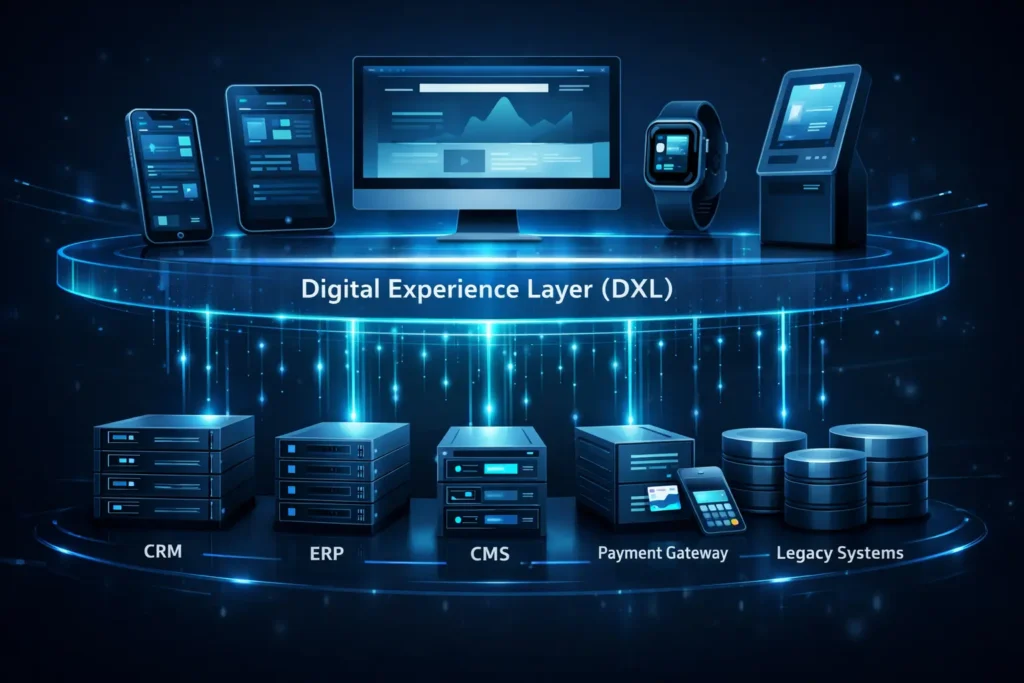
DXL technology is a middle layer that sits between your backend systems and your digital experiences, translating complexity into something fast, flexible, and user-friendly.
Think of your backend systems as a warehouse full of raw materials. Powerful, but not designed for customers to walk through. A DXL is the storefront—clean, organized, and optimized for how people actually browse, buy, and interact.
Without a DXL:
- Frontend teams talk directly to multiple backend systems
- Every app rebuilds the same integrations
- Changes ripple unpredictably
- Performance suffers under load
With DXL technology:
- Frontends talk to one experience-focused layer
- Backend complexity stays hidden
- APIs are tailored to real user journeys
- Experiences evolve without breaking systems underneath
DXL isn’t a single product. It’s an architectural approach made real through APIs, microservices, caching, orchestration, and experience-specific logic.
For beginners, that may sound abstract. So let’s ground it.
Imagine ordering food through a delivery app. The app doesn’t call the restaurant, payment processor, driver system, and loyalty platform separately. It talks to one interface. That interface orchestrates everything behind the scenes.
That interface is a DXL.
How DXL Technology Evolved (And Why It Was Inevitable)
DXL technology didn’t appear overnight. It evolved as a response to real pain.
First came monolithic systems—big, all-in-one platforms. They worked… until they didn’t. Updates were slow. Customization was painful.
Then came service-oriented architecture and APIs. Systems could finally talk to each other. But frontend teams were still forced to understand backend logic deeply.
Next came microservices. Flexibility improved, but complexity exploded. A simple mobile screen might require 15 API calls.
DXL technology emerged as the missing piece: an experience-aware layer that understands users, not just systems.
This shift accelerated with:
- Mobile-first design
- Headless CMS adoption
- Omnichannel expectations
- Real-time personalization
- API-led connectivity
Companies realized that backend systems shouldn’t dictate user experience. DXL flipped that model.
Core Components of DXL Technology
DXLtechnology isn’t one thing—it’s a composition of responsibilities working together.
Experience-Specific APIs
Unlike generic system APIs, DXL APIs are designed around user journeys:
- “Get account overview”
- “Build checkout experience”
- “Load personalized dashboard”
These APIs aggregate data from multiple systems into one response.
Orchestration Logic
DXL handles sequencing:
- Which system to call first
- What to do if one fails
- How to merge responses
- How to apply business rules
This logic lives outside both frontend and backend systems.
Caching & Performance Optimization
DXLs often handle:
- Response caching
- Data shaping
- Rate limiting
- Payload optimization
This dramatically improves performance and resilience.
Security & Governance
Authentication, authorization, and data masking can be centralized in the DXL—reducing risk and duplication.
Channel Awareness
A mobile app, website, kiosk, and smartwatch don’t need the same data. DXL technology adapts responses per channel without duplicating logic everywhere.
Real-World Benefits of DXL Technology
When DXL technology is implemented well, the impact is immediate and measurable.
Faster Time to Market
Teams stop waiting on backend changes. Frontend teams move independently, releasing features faster.
Better Customer Experiences
Consistent data. Faster load times. Fewer errors. More personalization.
Reduced Technical Debt
Instead of spaghetti integrations, there’s a clean, managed layer handling complexity.
Scalability Without Fear
Traffic spikes hit the DXL—not fragile backend systems.
Future-Proof Architecture
New channels plug into the DXL without rewriting everything.
Before DXL:
- Every app builds custom integrations
- Changes are risky
- Experiences drift apart
After DXL:
- One experience layer
- Controlled evolution
- Unified journeys
Step-by-Step: How DXL Technology Is Implemented in Practice
This is where theory becomes reality.
Step 1: Map User Journeys First
DXL technology starts with people, not systems.
Identify:
- Core user journeys
- Data required per journey
- Performance expectations
- Channel differences
This step is often skipped—and it’s why many DXLs fail.
Step 2: Inventory Backend Capabilities
List:
- Systems of record
- APIs available
- Data ownership
- Latency and reliability
You’re not rebuilding these systems. You’re wrapping them intelligently.
Step 3: Design Experience APIs
Create APIs that answer questions users actually ask—not what systems expose.
Example:
Instead of:
/crm/customers/{id}/billing/invoices/loyalty/status
Create:
/experience/account-summary
Step 4: Build Orchestration & Logic
This is where DXL technology shines:
- Aggregate responses
- Apply business rules
- Handle fallbacks
- Normalize formats
Step 5: Secure, Cache, and Monitor
Add:
- Authentication
- Rate limits
- Caching layers
- Observability
DXL becomes a critical system. Treat it like one.
Tools & Platforms Commonly Used for DXL Technology
DXL technology is tool-agnostic, but certain platforms excel here.
API Management & Integration Platforms
- MuleSoft
- Apigee
- Kong
Best for enterprises needing governance, scale, and security.
Headless CMS as DXL Contributors
- Contentful
- Strapi
They often form part of the experience layer for content-heavy journeys.
Custom-Built DXLs
Many mature teams build DXLs using:
- Node.js
- GraphQL
- REST APIs
- Serverless functions
This offers maximum flexibility—but requires discipline.
Common Mistakes with DXL Technology (And How to Avoid Them)
Treating DXL as Just Another API Layer
A DXL that mirrors backend APIs adds no value. Design for experiences, not systems.
Overloading the DXL with Business Logic
DXL should orchestrate—not replace core systems.
Ignoring Governance
Without standards, DXLs turn into the very mess they were meant to solve.
Skipping Performance Testing
DXL sits on the critical path. Latency compounds fast.
Building Too Much Too Soon
Start with one or two high-impact journeys. Expand deliberately.
When DXL Technology Makes Sense—and When It Doesn’t
DXL technology is powerful, but not universal.
It makes sense when:
- You support multiple channels
- Backend systems are complex
- Experience consistency matters
- Teams need autonomy
It may be overkill when:
- You have one simple application
- Systems are already tightly aligned
- Scale is minimal
The key is intent, not trend-following.
The Future of DXL Technology
DXL technology continues to evolve alongside:
- AI-driven personalization
- Real-time data streaming
- Composable commerce
- Experience-driven architectures
The core idea remains the same: optimize for people, not platforms.
Organizations that master DXL thinking gain an unfair advantage—shipping faster, adapting quicker, and delivering experiences customers actually enjoy.
Conclusion: DXL Technology as a Competitive Advantage
DXL technology isn’t about architecture diagrams or buzzwords. It’s about respect—respect for users, developers, and future change.
When implemented thoughtfully, it becomes the silent engine behind seamless digital experiences.
If you’re serious about scaling experiences without scaling chaos, DXL technology isn’t optional anymore—it’s foundational.
Start small. Design for journeys. Build with intent. And let the experience lead.
FAQs
What does DXL technology stand for?
DXL technology stands for Digital Experience Layer technology, a middleware layer focused on delivering optimized user experiences.
Is DXL technology the same as an API gateway?
No. An API gateway manages traffic. A DXL orchestrates experiences.
Can DXL technology work with legacy systems?
Yes. That’s one of its biggest strengths.
Is DXL technology expensive to implement?
Costs vary. Many teams start small and scale gradually.
Does DXL technology replace backend systems?
No. It complements them.

Adrian Cole is a technology researcher and AI content specialist with more than seven years of experience studying automation, machine learning models, and digital innovation. He has worked with multiple tech startups as a consultant, helping them adopt smarter tools and build data-driven systems. Adrian writes simple, clear, and practical explanations of complex tech topics so readers can easily understand the future of AI.