Every generation believes it lives through the most dramatic technological shift in history. For once, that instinct is probably right. The pace at which the world is changing — not just technologically, but socially, economically, and biologically — has reached a velocity that no previous era could have prepared us for. The question is no longer whether the future will look radically different from today. It’s whether we’ll be ready to live in it.
This article does not offer speculation dressed up as prophecy. Instead, it traces the concrete threads that are already weaving themselves into the fabric of 2050 — and, crucially, shows you what you can do right now to be part of shaping that future rather than simply watching it unfold.
The 2050 Landscape: Expert Predictions for Life and Society
Twenty-five years is a deceptively short window. It is long enough for technologies currently in research labs to reach mass adoption, but short enough that the seeds of 2050 are already visible — if you know where to look. The predictions below are not flights of fancy. They are extrapolations from trends that are already compounding.
The Augmented Human: Blurring the Lines Between Biology and Machine
The most unsettling prediction for 2050 is also the most quietly inevitable: humans will begin to merge with their machines in meaningful, biological ways. This is not a metaphor about smartphones becoming extensions of ourselves. It’s about nanotechnology that circulates through the bloodstream, monitoring cardiovascular health in real time and neutralizing threats before symptoms appear. It’s about brain-computer interfaces refined far beyond today’s early-stage implants — devices that don’t just read neural signals but participate in cognition itself, augmenting memory, accelerating learning, and opening entirely new channels of communication.
The field of cybernetics — the study of how biological and artificial systems can work together — will move from academic curiosity to mainstream biomedical practice. Companies and governments are already investing billions in human augmentation research, driven by both the enormous potential for healthcare and the less comfortable reality that cognitive and physical enhancement will become a competitive advantage in the workforce.
| “The boundary between human and machine will not shatter dramatically overnight. It will dissolve quietly — one implant, one interface, one augmentation at a time — until the distinction itself becomes a matter of philosophy rather than biology.” |
AI Everywhere: From Personalized Tutors to Autonomous Cities
By 2050, artificial intelligence will not be a product you use. It will be an environment you inhabit. Education is one of the clearest examples. AI-powered tutoring systems will adapt not just to what a student knows, but to how they think — their pace, their frustration thresholds, their curiosity patterns. A child in Lagos and a child in São Paulo will both have access to teaching intelligence that rivals the best human educator, tailored precisely to their individual mind.
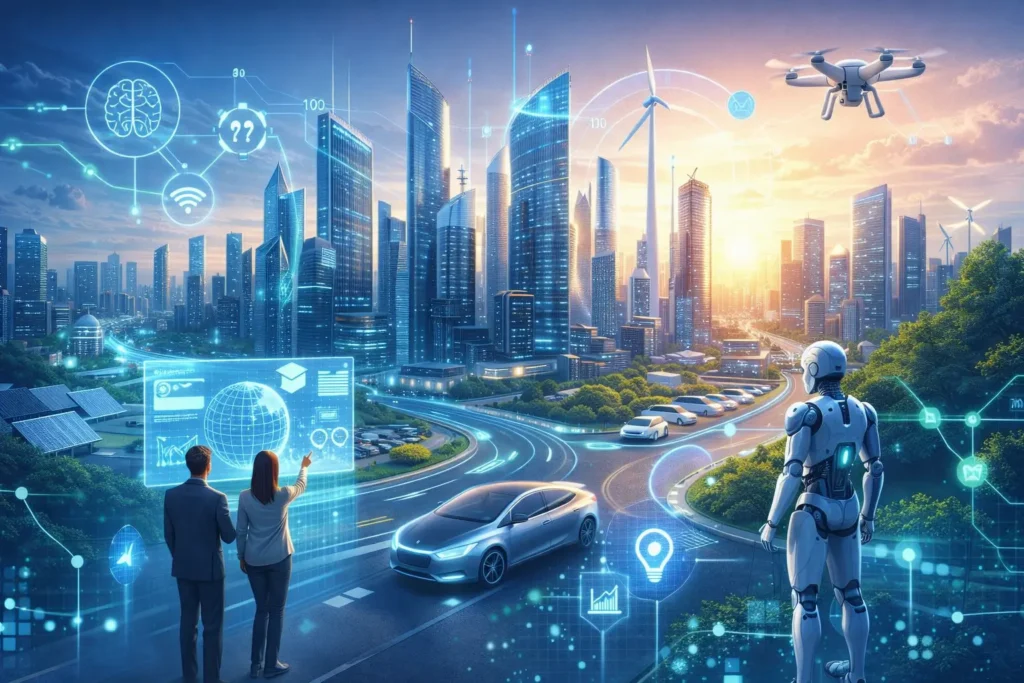
Urban life will shift just as fundamentally. Autonomous transportation networks will reduce commutes to a fraction of their current duration while cutting emissions to near zero. Smart cities will manage energy distribution, waste processing, emergency response, and even air quality with AI systems that operate continuously and adapt to real-time conditions. The city of 2050 won’t just be connected — it will be intelligent, in a sense that feels closer to an organism than a collection of infrastructure.
Foundations of the Future: 5 Key Technologies Driving Change
Predictions are only as credible as the technologies underpinning them. The five fields below are not speculative. Each has measurable momentum, significant funding, and a clear trajectory toward transforming how we live, work, and understand the world.
| 1. AI & Machine Learning The shift from tools to collaborative agents. AI is no longer a calculator — it’s becoming a coworker. |
| 2. Quantum Computing Unlocking problems that are literally impossible for classical machines. From drug discovery to climate modeling. |
| 3. Biotechnology & Nanotech Rewriting biology at the molecular level. Personalized medicine that treats you, not a statistical average. |
| 4. Robotics & Autonomy Robots leaving the factory floor. Adaptive machines in logistics, caregiving, and deep-space exploration. |
| 5. Sustainable Tech Clean energy isn’t the future anymore — it’s the present being scaled. The race is speed, not belief. |
1. Artificial Intelligence & Machine Learning
The popular narrative around AI oscillates between utopian enthusiasm and existential dread. The reality, as usual, is more interesting than either extreme. What is genuinely happening — right now, not in some distant future — is a transition from AI as a tool to AI as a collaborative agent. This is what researchers call agentic AI: systems that don’t just respond to queries but pursue goals, plan multi-step actions, and operate with a degree of autonomy.
In science, AI is already accelerating drug discovery by orders of magnitude, identifying protein structures and molecular interactions that would take human researchers decades to uncover. In business, AI agents are managing supply chains, drafting communications, and making nuanced decisions across complex datasets. The trajectory is clear: within twenty-five years, AI will function less like software and more like virtual coworkers — entities that complement human judgment rather than replacing it.
2. Quantum Computing
Classical computers, no matter how powerful, are fundamentally limited by their binary architecture. They process information as ones and zeros. Quantum computers exploit the principles of superposition and entanglement to process vast numbers of possibilities simultaneously — not faster in the traditional sense, but in an entirely different computational dimension.
The implications are staggering. Problems that are currently intractable — modeling complex molecular interactions for new medications, simulating climate systems with true precision, breaking modern encryption — become solvable. This is why quantum computing is often described as a game-changer rather than an upgrade. It doesn’t make existing computers obsolete. It opens doors that no amount of classical computing power could ever reach. Companies like IBM, Google, and a wave of specialized startups are racing to achieve “fault-tolerant” quantum systems, and the consensus among researchers is that practically useful machines are closer than many people realize.
3. Biotechnology & Nanotechnology
Medicine in 2050 will bear little resemblance to medicine today. The convergence of genetic sequencing, artificial intelligence, and nanotechnology is building toward something extraordinary: truly personalized medicine that treats your specific biology, not a statistical population average.
Imagine nanobots — microscopic machines engineered to travel through the bloodstream — carrying therapeutic payloads directly to cancer cells while leaving healthy tissue untouched. Imagine genetic engineering refined to the point where inherited diseases are not managed but eliminated before they manifest. These are not science fiction scenarios. They are the logical endpoints of research programs that are already well underway and producing results. The connection to human augmentation is direct: once we can reliably edit biology at the molecular level, the line between “treating illness” and “enhancing capability” becomes a matter of intent, not technology.
4. Robotics & Autonomous Systems
The robot of popular imagination — a humanoid figure in a factory — is already being outpaced by reality. Autonomous systems are evolving rapidly from rigid, single-purpose machines to adaptive robots capable of operating in unstructured environments. In logistics, robotic systems are handling warehouses with increasing independence. In elder care, robots are being developed that can assist with mobility, medication management, and companionship — tasks that require sensitivity, not just mechanical precision.
Perhaps the most dramatic frontier is space. NASA and private companies are developing autonomous robotic systems capable of making real-time decisions during deep-space missions, where communication delays with Earth make human control impractical. The robots of 2050 won’t just follow instructions. They will adapt, learn, and operate in conditions no human programmer could fully anticipate.
5. Sustainable Technology & Clean Energy
The energy transition is no longer a question of political will. It is an engineering and economic inevitability. Solar and wind costs have dropped by over 90% in the last decade. But the real breakthroughs that will define 2050 are coming from less visible corners of the energy landscape.
Ocean Thermal Energy Conversion (OTEC) harnesses the temperature difference between warm surface water and cold deep water to generate electricity — a resource that is virtually inexhaustible in tropical regions. Advanced solar technologies, including perovskite cells and transparent solar glass, are integrating energy generation directly into buildings and urban infrastructure. And smart grids powered by AI are learning to balance supply and demand in real time, making renewable energy not just clean but reliably efficient. A sustainable 2050 is not an aspiration. It is a design challenge — and the tools to meet it already exist.
Preparing for Tomorrow: Skills, Careers, and Actions for Today
Here is where this article diverges from most “future of technology” pieces — and where it becomes genuinely useful. Predictions are intellectually satisfying. But the real value of understanding the future lies in what you do with that knowledge today. This section is your practical toolkit.
Future-Proof Your Career: High-Demand Tech Skills
The workforce of 2050 will not be defined by job titles. It will be defined by adaptability — the ability to learn, unlearn, and relearn faster than the technologies around you evolve. That said, certain skill domains are consistently emerging as foundational across nearly every industry:
AI & Machine Learning · Cybersecurity · Cloud Computing · Data Science · Quantum Fundamentals · Biotech Literacy · Systems Thinking · Ethical AI
Mastering AI and machine learning is, at this point, as essential as basic computer literacy was a generation ago. You do not need to become a research scientist, but understanding how these systems work — their capabilities, their limitations, and the data they require — will become a baseline expectation in virtually every professional field. Cybersecurity is the other critical skill, for a simple reason: the more technology we integrate into infrastructure, health, and personal life, the more valuable — and vulnerable — that infrastructure becomes. Cloud computing proficiency (across platforms like AWS and Azure) and data science round out the core, while quantum fundamentals is the high-value early investment for those willing to specialize.
Learning Pathways: From Degrees to Continuous Adaptation
The traditional education model — study for four years, enter a career, repeat a version of that career for thirty years — is already obsolete in technology. The half-life of technical skills is shrinking. A developer’s toolkit from five years ago may be largely irrelevant today.
This doesn’t mean formal degrees are worthless. They remain valuable for building deep foundations and opening doors. But the most resilient professionals are those who layer formal education with online certifications, micro-credentials, and continuous self-directed learning. Platforms offering specialized courses in AI, cloud architecture, and cybersecurity are producing job-ready skills in months, not years. The mindset shift required is less about what you learned and more about how fast you can learn. Lifelong learning is not a platitude — it is the single most important career strategy for the next twenty-five years.
Practical Steps to Stay Ahead of Tech Trends
- Follow the signal, not the noise. Subscribe to research digests from organizations like McKinsey, MIT Technology Review, and the World Economic Forum. These separate substantive trends from hype cycles.
- Build a professional network with intention. Connect with people working at the intersection of technology and your industry. Cross-pollination of ideas is where the most valuable insights emerge.
- Experiment with personal projects. Build something. Break something. Rebuild it better. Hands-on experience with emerging tools — even at a hobbyist level — compounds over time into genuine expertise.
- Engage with ethical debates actively. The professionals who will have the most influence in 2050 are not just technologists — they are people who can navigate the moral and social dimensions of innovation. This is a skill, and it can be practiced.
- Diversify your skill portfolio. Treat your capabilities like an investment portfolio. Don’t put everything into one technology. Spread across AI, security, sustainability, and human-computer interaction.
No honest discussion of the future of technology can avoid the uncomfortable questions. Power, inequality, and moral ambiguity do not disappear because the technology is impressive. They intensify.
The concept of responsible innovation — building ethical considerations into the design process rather than bolting them on afterward — is no longer optional. Algorithmic bias is a concrete example: AI systems trained on historically skewed data reproduce and amplify existing inequalities at scale. In hiring, lending, criminal justice, and healthcare, biased algorithms can cause measurable harm to real people. Solving this requires not just technical solutions but a fundamentally different relationship between technology companies and the societies they serve.
Data privacy is another frontier that will only become more contentious. As technology integrates deeper into our biology — through health monitoring, genetic sequencing, and neural interfaces — the data being collected becomes profoundly intimate. Who owns that data? Who can access it? What recourse does an individual have when it’s misused? These are not abstract policy questions. They are the terms on which personal autonomy will be negotiated in the coming decades.
At the geopolitical level, competition for technological supremacy is reshaping international relations. Nations that lead in AI, quantum computing, and biotechnology will wield disproportionate economic and strategic power. This creates pressure to move fast — sometimes faster than ethics can keep pace. The challenge of the next generation of technologists is not simply to build the future, but to build it wisely. That requires treating ethics not as a constraint on innovation, but as one of its most critical skills.
FAQS about future of technology
What will be the biggest technological change by 2050?
The most transformative shift will likely be the pervasive integration of AI into every system we interact with — combined with the early stages of meaningful human biological augmentation. Neither of these is a single event. They are gradual convergences that will reshape daily life in ways both obvious and invisible.
Should I be worried about AI taking all jobs?
History offers a useful counterpoint: every previous wave of automation eliminated certain tasks while creating entirely new categories of work. AI will follow the same pattern — but with greater speed and breadth. The professionals who thrive will be those who develop skills that complement AI rather than compete with it: creativity, ethical judgment, complex communication, and adaptive problem-solving.
What is the most important technology to learn now for the future?
A strong foundation in AI and machine learning concepts — combined with genuine data literacy — is becoming as essential as basic computer skills were in the 1990s. You don’t need to become an engineer. You need to understand how these systems think, what they can and cannot do, and how to work alongside them effectively.
How accurate are long-term predictions like these?
No prediction about 2050 is precise. But that’s not the point. These forecasts are built from observable R&D trajectories, funding patterns, and technological momentum. Their value is not in pinpointing the future, but in illuminating its direction — which is enough to make meaningfully better decisions today about where to invest your time, skills, and attention.
When will quantum computing be usable for everyday business?
Full-scale, general-purpose quantum computers are still years away from consumer applications. But specialized use cases — particularly in optimization, drug discovery, and financial modeling — are emerging sooner than many expect. Industry leaders have predicted genuinely useful quantum applications within the next two decades, with niche business applications arriving even earlier. The smart move now is to build awareness, not to wait.

Adrian Cole is a technology researcher and AI content specialist with more than seven years of experience studying automation, machine learning models, and digital innovation. He has worked with multiple tech startups as a consultant, helping them adopt smarter tools and build data-driven systems. Adrian writes simple, clear, and practical explanations of complex tech topics so readers can easily understand the future of AI.