
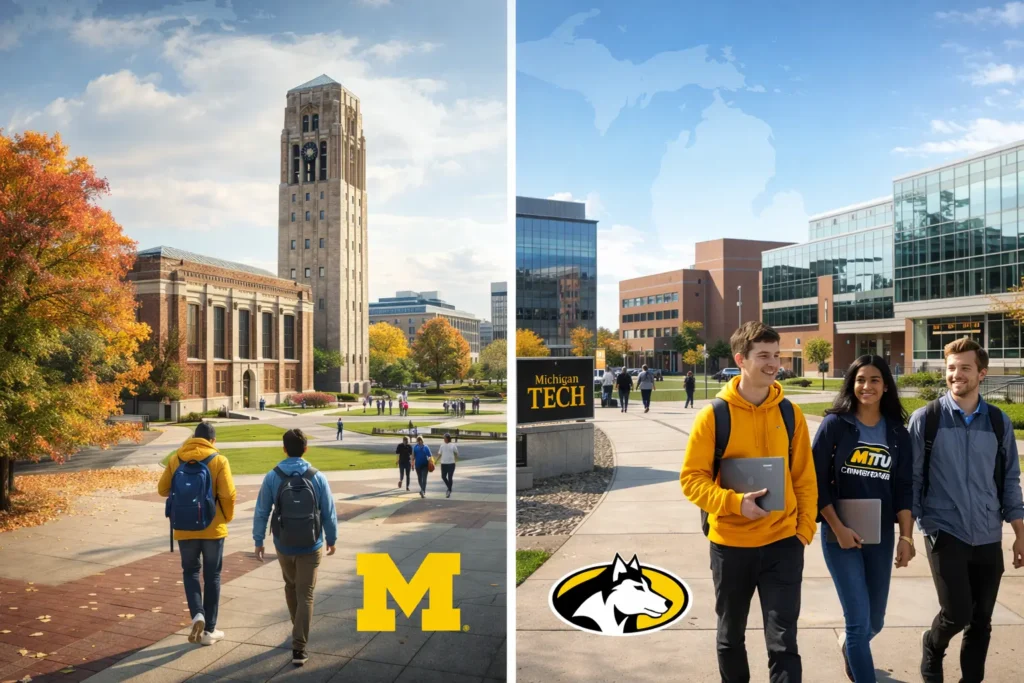
Michigan is home to two outstanding institutions for technology and engineering education: the University of Michigan (U-M) and Michigan Technological University (MTU). While both share the word “Michigan” in their names and a deep commitment to technical excellence, they are entirely separate universities with distinct identities, strengths, and campus cultures. Whether you are searching for “University of Michigan technology programs” or trying to decide between these two schools, this comprehensive guide will help you navigate your options, compare key data points, and choose the path that is right for you.
From sprawling research labs in Ann Arbor to hands-on engineering workshops in the Upper Peninsula, Michigan offers world-class technology education at every scale. Let’s explore what makes each institution unique.
Understanding the Two Giants of Michigan Tech Education
University of Michigan (U-M): The Comprehensive Research Powerhouse
Founded in 1817, the University of Michigan in Ann Arbor is one of the nation’s premier public research universities. With over 47,000 students and consistently ranked among the top public universities in the United States, U-M offers an enormous breadth of programs across virtually every discipline. Its College of Engineering is world-renowned, housing departments in computer science, electrical engineering, mechanical engineering, robotics, aerospace, and data science, among many others.
U-M is a Big Ten school with a vibrant college-town atmosphere. Ann Arbor is consistently rated one of the best cities for young professionals and students, offering a rich mix of arts, culture, technology startups, and proximity to major automotive and tech industry employers. The university’s research enterprise spans billions of dollars annually, with faculty pioneering breakthroughs in artificial intelligence, autonomous vehicles, biomedical engineering, and quantum computing.
For students who want access to a wide variety of academic disciplines, a large and diverse campus community, a powerful alumni network, and proximity to a thriving urban environment, the University of Michigan is a compelling choice.
Michigan Technological University (MTU): The Hands-On Tech Specialist
Michigan Technological University was founded in 1885 as the Michigan Mining School, born out of the copper mining heritage of Michigan’s Upper Peninsula. Today, MTU has evolved into a specialized science and technology university known for rigorous, hands-on learning and intimate class sizes. Located in Houghton, on the scenic shores of Portage Lake, MTU serves approximately 6,000 undergraduate students with a tight-knit campus community that values experiential education.
MTU’s motto—”Tomorrow Needs Michigan Tech”—reflects its forward-looking identity. The university holds Carnegie Classification R1 (Doctoral Universities: Very High Research Activity) status, a distinction shared by only the most research-intensive institutions in the country. Its College of Engineering and newly established College of Computing are its flagship academic divisions. Students at MTU, known as the Huskies, benefit from an exceptional student-to-faculty ratio of 13:1, meaning more direct mentorship and research opportunities than at many larger universities.
MTU’s rural setting is not a drawback—it is a defining feature. Students who thrive in the outdoors, enjoy skiing at Mont Ripley (right on campus), hiking the Tech Trails, and participating in a close community will find MTU’s environment uniquely energizing. The Copper Country region of Michigan’s Upper Peninsula is a spectacular backdrop for four years of technical study.
Head-to-Head: Comparing Technology Programs & Academics
Top-Ranked Engineering Programs
Both institutions house nationally recognized engineering colleges, though their profiles differ significantly. The University of Michigan College of Engineering consistently ranks among the top 10 public engineering schools in the United States according to U.S. News & World Report. It offers more than 20 engineering majors and is particularly celebrated for its programs in electrical engineering and computer science, mechanical engineering, aerospace engineering, and its Institute for Data Science.
Michigan Technological University’s College of Engineering, while smaller in scale, punches well above its weight. MTU ranks among the top 100 national universities (around #158 overall) and is recognized as one of the top 84 public universities in the country. Its engineering programs in mechanical, materials science, civil, chemical, and environmental engineering are well respected by industry recruiters. MTU’s location in a historically industrial and resource-rich region gives its engineering programs a grounded, practical character that alumni consistently cite as a career advantage.
A key differentiator is MTU’s required Enterprise program, where students work in interdisciplinary teams—simulating the structure of a professional organization—to complete real-world projects ranging from electric vehicle design to aerospace systems. This hands-on, project-based learning model is embedded throughout the curriculum.
Computing & Technology: From CS to Data Science
The University of Michigan offers one of the most comprehensive computing and technology curricula in the country. The Department of Electrical Engineering and Computer Science (EECS) is a powerhouse, producing graduates who go on to lead at Google, Apple, Amazon, and every major technology company. U-M also offers a highly regarded online Master of Applied Data Science (MADS) degree through the School of Information, designed for working professionals and accessible to students worldwide. Programs in cybersecurity, human-computer interaction, and information analytics round out an expansive portfolio.
Michigan Technological University’s College of Computing, one of the newer colleges at the institution, signals MTU’s commitment to elevating computer science and software engineering to a central position alongside traditional engineering disciplines. Degrees in computer science, software engineering, cybersecurity, and computer network and system administration are available. Data science is an emerging focus, with programs designed to produce graduates fluent in both quantitative analysis and computational systems. Class sizes are small, and students frequently conduct research alongside faculty, often publishing work before graduation.
Specialized & Emerging Tech Fields
One of U-M’s most exciting areas of growth is robotics. The university is home to a dedicated Robotics Institute, offering bachelor’s, master’s, and doctoral degrees in robotics—a field of critical importance given Michigan’s automotive and manufacturing heritage and the race toward autonomous vehicles. Programs in artificial intelligence, machine learning, and human-centered computing are also thriving at U-M, supported by partnerships with Ford, General Motors, and major Silicon Valley technology firms.
MTU distinguishes itself with unique programs like Forest Resources & Environmental Science, which blends technology with sustainability and natural resource management—an unusual but increasingly relevant specialization in an era of climate change and environmental data analytics. MTU also offers degrees in geological and mining engineering, surveying engineering, and an array of applied sciences that few other institutions can match. These niche specializations make MTU a standout option for students with specific career paths in mind.
Cost, Admissions, and Financial Aid: What You Need to Know
Admissions Snapshot: University of Michigan
The University of Michigan’s College of Engineering is highly selective. The overall university acceptance rate is approximately 17-18%, making it one of the more competitive public universities in the nation. Admitted engineering students typically present a GPA of 3.9 or above, with SAT scores in the 1400-1560 range (middle 50%) or ACT scores between 33 and 35. U-M has adopted a test-flexible policy in recent years, and applicants must apply through the Common Application.
| Metric | University of Michigan (Approx.) |
| Acceptance Rate | ~17-18% (overall); more selective for Engineering |
| Average GPA | 3.90+ (unweighted) |
| Middle 50% SAT | 1360-1560 |
| Middle 50% ACT | 33-35 |
| Application Platform | Common Application |
| Application Deadline (Early Action) | November 1 |
| Application Deadline (Regular) | February 1 |
Admissions Snapshot: Michigan Technological University
Michigan Technological University is notably more accessible than U-M, with an acceptance rate of approximately 84%. However, accessible does not mean lacking in academic rigor. The average admitted student carries a GPA of around 3.8 and test scores in the 1130-1350 SAT range (middle 50%). MTU attracts students who are self-selecting into a demanding technical curriculum, and the academic environment is competitive and rigorous once enrolled. Applications are accepted through the Common Application.
| Metric | Michigan Technological University (Approx.) |
| Acceptance Rate | ~84% |
| Average GPA | 3.8 (unweighted) |
| Middle 50% SAT | 1130-1350 |
| Middle 50% ACT | 24-31 |
| Application Platform | Common Application |
| Application Deadline | Rolling Admissions |
| Test Policy | Test-Optional Available |
Tuition, Fees, and Your Return on Investment
Cost is one of the most critical factors in choosing a university. Here is a comparison of current approximate annual costs and post-graduation financial outcomes for both institutions.
| Cost Factor | University of Michigan | Michigan Tech |
| In-State Tuition & Fees | ~$16,000 – $17,000/yr | ~$16,500 – $17,500/yr |
| Out-of-State Tuition & Fees | ~$53,000 – $55,000/yr | ~$38,000 – $40,000/yr |
| Average Net Price (After Aid) | ~$18,000 – $21,000/yr | ~$18,000 – $22,000/yr |
| 6-Year Graduation Rate | ~91% | ~65-68% |
| Median Salary (6 Yrs Post-Grad) | ~$75,000+ | ~$69,672 |
| Average Student Debt at Graduation | ~$27,000 | ~$30,000 |
Note: Out-of-state students comparing costs will find MTU significantly more affordable than U-M. Both universities offer robust financial aid programs. The average net price—what students actually pay after grants and scholarships—is comparable between the two institutions for eligible students. When factoring in the strong starting salaries in engineering and computing fields (often $70,000-$100,000+), both institutions represent a strong return on investment.
MTU graduates in engineering and computer science consistently report high early-career salaries. Alumni starting salaries vary significantly by major, with computer science, electrical engineering, and mechanical engineering graduates frequently commanding salaries well above the institutional median. U-M graduates similarly command premium salaries, particularly in software engineering, data science, and aerospace fields.
Beyond the Classroom: Campus Life & Location
Life in a College Town: Ann Arbor
The University of Michigan’s home in Ann Arbor is consistently ranked among the best college towns in America. With a city population of around 120,000 and a student body of over 47,000, Ann Arbor offers an extraordinary diversity of experiences. The cultural scene is rich, featuring world-class museums, a thriving restaurant and music scene, and a lively downtown that buzzes year-round. U-M’s Big Ten athletics program—home to the Wolverines—creates an electrifying atmosphere on game days, and the 107,000-seat Michigan Stadium, “The Big House,” is legendary.
The university’s size means there are thousands of student organizations, dozens of Greek life chapters, robust varsity and intramural sports, and a seemingly infinite variety of ways to get involved. Diversity is a core value at U-M, and the student body reflects a global mix of backgrounds, perspectives, and ambitions. For students who want a big, cosmopolitan university experience with world-class resources, Ann Arbor delivers.
Career-wise, U-M’s proximity to Detroit’s automotive industry, a growing Ann Arbor tech corridor, and strong recruiting pipelines to Silicon Valley and New York give graduates unparalleled access to industry. Ford, General Motors, Stellantis, Google, Amazon, and McKinsey are among the prominent employers recruiting heavily from U-M campuses.
Adventure in the Upper Peninsula: Houghton
MTU’s campus in Houghton, Michigan is unlike any other university environment in the Midwest. Nestled in the Keweenaw Peninsula on the shores of Portage Lake, the campus spans 925 acres of forests, trails, and waterways. Houghton is a small city of about 8,000 people, and the MTU community is woven tightly into the fabric of local life. The student-to-faculty ratio of 13:1 means students genuinely know their professors, and mentorship relationships that span entire academic careers are commonplace.
Perhaps the most unique amenity of any engineering school in the country: Mont Ripley, a downhill ski area located directly across the waterway from campus, is operated by MTU and offers free or heavily discounted skiing to students. The Tech Trails, a network of cross-country skiing and mountain biking trails on campus, are maintained in part by student volunteers. Winter in the Upper Peninsula is legendary—Houghton typically receives 200+ inches of snowfall annually—and the community has built an entire culture around embracing it rather than enduring it.
Campus housing is available and widely used by students, with approximately 37% of undergraduates living on campus. The close-knit nature of the community means international students and those from outside Michigan tend to integrate quickly. For students who value outdoor adventure, tight friendships, and a campus environment where everyone knows your name, Houghton and MTU offer something truly distinctive.
Final Comparison: Which School Is Right for You?
Choosing between the University of Michigan and Michigan Technological University ultimately comes down to your personal priorities, academic interests, and the kind of environment where you will thrive. Here is a side-by-side summary of key institutional characteristics to help guide your decision.
| Factor | University of Michigan | Michigan Technological University |
| Location | Ann Arbor, MI (Urban/Suburban) | Houghton, MI (Rural/Upper Peninsula) |
| Campus Setting | Large college town, Big Ten culture | Intimate, outdoor-focused, tight-knit |
| Undergraduate Enrollment | ~32,000 undergraduates | ~6,022 undergraduates |
| Overall Focus | Broad, comprehensive research university | Specialized science, tech & engineering |
| Flagship Programs | Engineering, CS, Data Science, Robotics, LSA | Engineering, College of Computing, Enterprise |
| U.S. News Ranking | Top 25 National Universities | ~#158 National Universities |
| Top Public School Rank | Top 5 Public | #84 Public |
| Student-Faculty Ratio | ~11:1 | 13:1 |
| Acceptance Rate | ~17-18% | ~84% |
| Out-of-State Tuition | ~$53,000-$55,000/yr | ~$38,000-$40,000/yr |
| Median Graduate Salary | $75,000+ | $69,672 |
| Key Strength | Scale, prestige, research breadth, alumni network | Hands-on learning, small classes, ROI, outdoor life |
| Carnegie Classification | R1 (Very High Research Activity) | R1 (Very High Research Activity) |
| Athletics | NCAA Division I, Big Ten | NCAA Division II, GLIACHuskies |
If you are seeking a flagship, highly selective public research university with massive resources, a prestigious engineering program, a vibrant college town, and the full breadth of academic disciplines, the University of Michigan is an exceptional choice. If you are drawn to a smaller, highly focused technical institution where hands-on learning, faculty mentorship, outdoor adventure, and a strong engineering ROI are paramount—and where out-of-state tuition is more manageable—Michigan Technological University is an outstanding fit.
Both schools produce exceptional engineers, computer scientists, and technology leaders. The best school is the one where you will be most engaged, challenged, and inspired.
faqs
Is the University of Michigan the same as Michigan Technological University?
No. These are two entirely separate and independent public universities. The University of Michigan (U-M) is located in Ann Arbor and is a large, comprehensive research university with over 47,000 students. Michigan Technological University (MTU) is located in Houghton in Michigan’s Upper Peninsula and is a smaller, specialized science and engineering university with approximately 6,000 undergraduates. They have different admissions processes, tuition structures, academic programs, and campus cultures.
Which is better for engineering: University of Michigan or Michigan Tech?
Both have strong engineering programs, but “better” depends on your goals. U-M’s College of Engineering consistently ranks in the top 10 among public universities nationally, offering enormous breadth, cutting-edge research infrastructure, and powerful industry partnerships. MTU’s engineering programs offer a more hands-on, project-based experience in a smaller setting, with direct faculty mentorship and strong placement in manufacturing, automotive, and resource industries. Students who want elite prestige and research depth often favor U-M; those who want practical, immersive engineering training and strong ROI in a distinctive environment often prefer MTU.
What are the most popular technology majors at Michigan Tech?
Michigan Tech’s most popular technology and engineering majors include Mechanical Engineering, Computer Science, Electrical Engineering, Civil Engineering, Chemical Engineering, Environmental Engineering, Software Engineering, and Data Science. The Enterprise program—a team-based project learning system—spans multiple majors and is a defining feature of the MTU academic experience.
Does the University of Michigan offer online technology degrees?
Yes. The University of Michigan offers several online technology-focused programs, most notably the Master of Applied Data Science (MADS) through the School of Information. U-M also offers a range of online courses, specializations, and certificates through Coursera and other platforms. Michigan Tech has been expanding its online offerings as well, particularly at the graduate level, with online master’s degrees in engineering and computer science fields.
What is the average starting salary for a graduate from a Michigan tech school?
Starting salaries vary by major, but graduates in engineering and computing fields from both institutions typically earn well above the national average. MTU’s median salary six years after graduation is approximately $69,672 overall, but engineering and computer science graduates commonly report starting salaries between $70,000 and $95,000. U-M graduates in similar fields often start at $75,000 to $100,000+, reflecting the premium commanded by the university’s prestige and alumni network.
Is Michigan Tech a Research 1 university?
Yes. Michigan Technological University holds Carnegie Classification R1 status, which designates institutions with “Very High Research Activity.” This is the highest research classification available and places MTU among an elite group of approximately 140 universities in the United States. This designation means faculty are actively engaged in significant funded research, and undergraduate students have genuine opportunities to participate in and contribute to original research projects.
What is the acceptance rate for the University of Michigan College of Engineering?
The University of Michigan’s College of Engineering is more selective than the university’s overall acceptance rate of approximately 17-18%. Admitted engineering students typically represent the top academic performers in their applicant pools, with GPAs of 3.9 or above and standardized test scores near the top of the admitted range. Prospective students are strongly encouraged to review the College of Engineering’s current admissions data directly on the official university website, as these figures are updated annually.
What is student life like at Michigan Tech in the Upper Peninsula?
Student life at Michigan Tech is shaped by its unique location and tight-knit community. With about 6,000 undergraduates, the campus feels intimate and collaborative. Winter is central to the culture—Houghton receives over 200 inches of snow annually, and students embrace outdoor activities like skiing at Mont Ripley (on campus), snowshoeing, and cross-country skiing on the Tech Trails. The university hosts Winter Carnival, a beloved tradition featuring elaborate snow sculpture competition. Social life revolves around student organizations, sports, and the strong bonds that form in a small, purpose-driven academic community.
Can I get financial aid to study technology at U-M or MTU?
Yes, both universities offer substantial financial aid programs. The University of Michigan meets 100% of demonstrated financial need for in-state students and offers significant merit and need-based scholarships for out-of-state students as well. Michigan Tech offers competitive merit scholarships for incoming students based on academic achievement, including awards specifically for engineering and computing majors. Both universities also participate in federal financial aid programs (FAFSA), and graduate students in research programs are frequently funded through teaching and research assistantships. The average net price at both institutions after aid is considerably lower than published tuition figures.
What are the SAT requirements for Michigan Tech?
Michigan Technological University does not publish a minimum SAT score requirement and has adopted a test-optional policy for many applicants. However, the middle 50% of admitted students typically scored between 1130 and 1350 on the SAT (Evidence-Based Reading and Writing + Math). Submitting strong test scores can strengthen an application, but MTU evaluates candidates holistically, considering GPA, course rigor, extracurricular involvement, and other factors. Prospective students should verify current requirements on the official MTU admissions website.
Start Your Journey in Michigan Technology Education Today
Whether you are drawn to the world-class research enterprise of the University of Michigan in Ann Arbor or the hands-on, adventure-filled technical community of Michigan Technological University in Houghton, you are choosing a path that leads to a rewarding and impactful career in technology and engineering.
Both institutions have earned their reputations through decades of producing graduates who lead in industry, research, government, and entrepreneurship. The question is not which school is objectively better—it is which school is the right fit for you, your learning style, your financial situation, and the life you want to build during and after your undergraduate years.
We encourage you to visit both campuses if possible, speak with current students and alumni, and dig into the specific program data for your intended major. The best technology education is the one that challenges you, connects you to the right opportunities, and prepares you to shape the future.
- University of Michigan Admissions: umich.edu/admissions
- Michigan Technological University Admissions: mtu.edu/admissions
- U-M College of Engineering: engin.umich.edu
- MTU College of Engineering: mtu.edu/engineering
- MTU College of Computing: mtu.edu/computing
- U-M Online Programs: online.umich.edu
Disclaimer: All statistics, rankings, and tuition figures cited in this article are approximate and subject to change. Please verify current data directly with each institution’s official website and admissions office.

Adrian Cole is a technology researcher and AI content specialist with more than seven years of experience studying automation, machine learning models, and digital innovation. He has worked with multiple tech startups as a consultant, helping them adopt smarter tools and build data-driven systems. Adrian writes simple, clear, and practical explanations of complex tech topics so readers can easily understand the future of AI.