
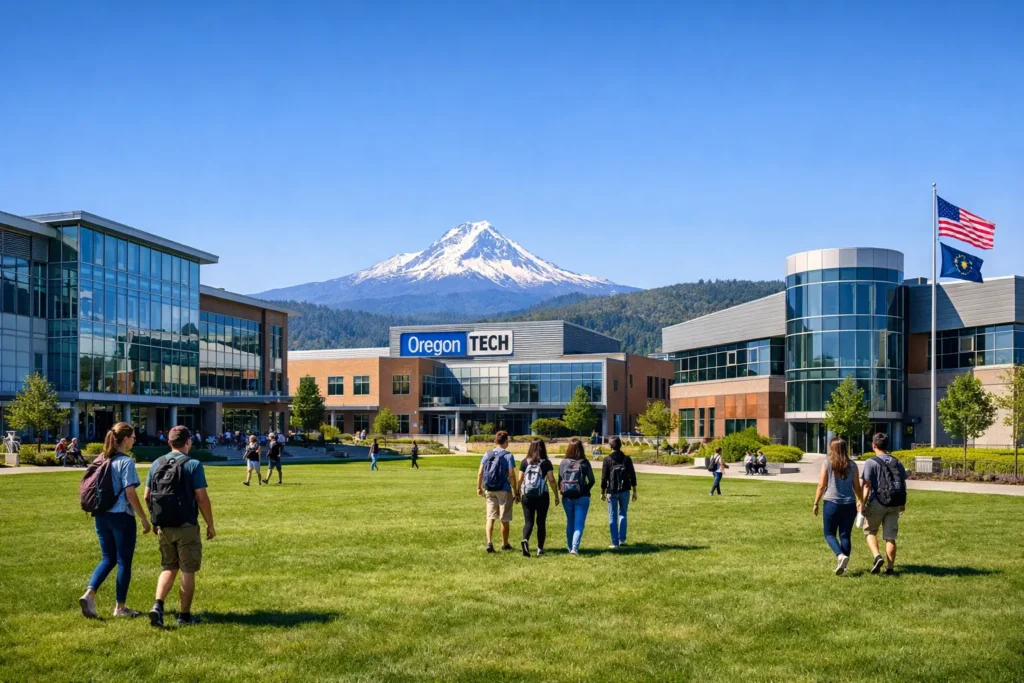
Oregon Institute of Technology — commonly known as Oregon Tech — is Oregon’s only polytechnic university and one of the most distinctive public institutions in the Pacific Northwest. Founded in 1947 to serve World War II veterans seeking practical, career-ready education, Oregon Tech has grown into a nationally recognized leader in hands-on, applied learning. With two main campuses — a residential campus nestled in the Southern Oregon Cascades in Klamath Falls, and an urban campus in the heart of the Silicon Forest in Wilsonville — Oregon Tech offers students a unique blend of rigorous academics, real-world industry connections, and exceptional graduate outcomes. Whether you’re pursuing a degree in engineering, health sciences, business, or technology, Oregon Tech prepares you not just to graduate, but to thrive.
Why Choose Oregon Tech? The Polytechnic Advantage
Oregon Tech’s identity as a polytechnic university is more than a label — it’s a philosophy. Every program is built around the idea that the best way to learn is by doing. Students spend time in labs, on job sites, and in clinics from their very first year, building the skills that employers are actively seeking. This approach, combined with Oregon Tech’s strong industry relationships and small class sizes, consistently produces some of the best-paid and most in-demand graduates in the state.
Hands-On Learning & Industry Connections
At Oregon Tech, “applied learning” is not a buzzword — it’s the foundation of every program. Students have access to state-of-the-art undergraduate labs and simulation centers, externships with regional and national employers, and co-op opportunities that provide real paid work experience before graduation. The university maintains deep industry partnerships with organizations such as Intel, Tektronix, and the Oregon Department of Transportation, ensuring that curricula stay aligned with workforce needs and that students graduate with both a degree and a professional network. With a student-faculty ratio of 15:1, professors know their students by name and serve as mentors as well as instructors, making personalized guidance the norm rather than the exception.
Exceptional Graduate Outcomes & Return on Investment
The numbers tell a compelling story. Oregon Tech graduates earn the highest average starting salaries in the state of Oregon, with an average of $67,200 in their first year out of school. By five years post-graduation, the median earnings climb to $81,249 — a testament to the long-term career trajectories that an Oregon Tech education supports. Within just one year of graduation, 96% of Oregon Tech alumni are employed in their field. Specific programs, such as Civil Engineering, report placement rates as high as 98%. For students and families weighing the cost of a college education, Oregon Tech consistently ranks among the strongest return-on-investment schools in the region.
Two Unique Campus Experiences
One of Oregon Tech’s most distinctive features is that it operates two very different campuses, each offering a unique student experience suited to different lifestyles and goals.
The Residential Campus: Klamath Falls
Oregon Tech’s main campus sits on 305 acres in Klamath Falls, a city nestled in the shadow of the Southern Oregon Cascades. This is a traditional residential campus with on-campus housing (including dorms and apartments), dining facilities, athletic fields, and a vibrant student life scene. For students who want the full college experience — game days, campus clubs, outdoor adventures, and tight-knit community bonds — Klamath Falls delivers. The surrounding region is an outdoor enthusiast’s paradise, with hiking, skiing, camping, and fishing all within easy reach. Students often cite the natural setting and the strong sense of community as two of the most rewarding aspects of life on the Klamath Falls campus.
The Urban Campus: Wilsonville (Portland-Metro)
Oregon Tech’s Wilsonville campus serves the Portland metropolitan area and is strategically located in what many call the “Silicon Forest” — the dense corridor of technology and manufacturing companies stretching from Portland into the southwestern suburbs. This urban campus is particularly appealing to transfer students, working professionals, and those seeking direct access to the tech industry. Students here benefit from proximity to companies like Intel and numerous engineering firms, making internships and co-op placements easier to secure and commute-friendly. Oregon Tech also has additional learning centers in Salem and Seattle to serve students across the broader Pacific Northwest.
Academics & Programs at Oregon Tech
Oregon Tech organizes its academics across five major areas: Engineering & Technology, Health & Applied Sciences, Business, Humanities & Sciences, and Communication. All programs are accredited by the Northwest Commission on Colleges and Universities (NWCCU), and engineering-related programs carry ABET accreditation — the gold standard in technical education. Regardless of your chosen field, you’ll graduate with a combination of theoretical understanding and practical, hands-on experience that sets Oregon Tech alumni apart in the job market.
Top-Ranked Engineering Programs
Engineering is the cornerstone of Oregon Tech’s identity and reputation. The university’s ABET-accredited engineering programs are among the most applied and industry-focused in the Pacific Northwest. Key programs include:
- Civil Engineering — With a 98% placement rate within one year of graduation, Oregon Tech’s Civil Engineering program is one of the strongest in the state. Students gain hands-on experience with infrastructure design, construction management, and environmental systems.
- Mechanical Engineering — Covering thermodynamics, materials science, robotics, and manufacturing, this program produces graduates who are ready to engineer solutions for some of industry’s most complex challenges.
- Electrical Engineering — Students learn to design and analyze electrical systems, from power grids to embedded microcontrollers, with extensive lab hours and industry-facing projects.
- Computer Engineering Technology — This program bridges hardware and software, preparing students for careers in systems design, embedded systems, and technical computing.
All engineering students benefit from access to undergraduate research labs, direct mentorship from faculty with industry backgrounds, and robust co-op programs that facilitate paid work experience with regional employers.
Leading Health & Healthcare Programs
Oregon Tech is one of Oregon’s premier destinations for health sciences education. These programs are highly selective, clinically intensive, and designed in collaboration with healthcare employers to ensure graduates are workforce-ready from day one. Popular health programs include:
- Sonography — One of the most sought-after programs at Oregon Tech, training students in diagnostic medical ultrasound through extensive clinical rotations.
- Dental Hygiene — A rigorous clinical program that prepares graduates for licensure and employment in dental practices across the region.
- Medical Imaging / Radiologic Technology — Students learn to operate imaging equipment and interpret results in clinical settings, graduating eligible to sit for national certification exams.
- Nursing — Oregon Tech’s nursing programs address the Pacific Northwest’s growing demand for qualified nurses, with strong clinical placement networks.
- Respiratory Care — A specialized program training students to treat patients with breathing disorders in hospital and outpatient settings.
State-of-the-art simulation labs and clinical facilities give health sciences students the practice environment they need before entering real patient-care settings.
Business, Technology & Applied Sciences
Beyond engineering and health, Oregon Tech offers strong programs in Business (including management and entrepreneurship), Psychology, Communications, Natural Sciences, Computer Science, Software Engineering, and Applied Computing. These programs share the same applied, outcomes-focused philosophy as the rest of the university, ensuring that graduates are competitive whether they enter the workforce immediately or pursue graduate study. The applied arts and sciences programs are particularly valued for their integration with Oregon Tech’s technology-driven culture, giving students in “traditional” disciplines a technical fluency that distinguishes them in the modern job market.
Online & Graduate Degree Options
Oregon Tech recognizes that not every student can attend classes in person, and has built a robust suite of online and distance learning options. The university currently offers more than nine online bachelor’s degree programs, an online associate degree, and several certificate programs for working professionals and distance learners. Graduate students can pursue master’s degrees in engineering management, operations management, and other applied fields. These programs deliver the same hands-on, industry-connected curriculum Oregon Tech is known for, adapted for flexible, online delivery. For professionals looking to upskill without leaving their current job, Oregon Tech’s online options represent a particularly compelling pathway.
Admissions & Cost: Your Path to Oregon Tech
One of Oregon Tech’s most attractive qualities is its accessibility. With a 92% acceptance rate and a generous financial aid program, Oregon Tech has made it a priority to ensure that qualified students can attend regardless of financial background. Whether you’re a recent high school graduate, a transfer student, or a working adult seeking a degree, the admissions process is designed to be straightforward and supportive.
A Look at the Admissions Process
Applying to Oregon Tech is a manageable process, and the university uses a holistic approach to evaluate applicants. Key details to know:
- Acceptance Rate: 92%, making Oregon Tech an accessible option for most applicants.
- Application Deadline: March 1 (priority deadline for fall admission).
- Application Fee: $50.
- Test Scores: SAT range of 1050–1300 and ACT range of 22–26 are considered, though Oregon Tech has moved toward a test-flexible approach.
- High School GPA: A strong GPA in college-preparatory coursework is expected.
- Common App: Oregon Tech participates in the Common Application, simplifying the process for students applying to multiple schools.
- Direct Admissions: Oregon Tech has partnered with Niche to offer Direct Admissions to qualified students, enabling a faster, simplified path to enrollment.
Note that certain programs — particularly health sciences majors such as Sonography and Dental Hygiene — have competitive supplemental admissions processes with additional requirements beyond general university admission. Prospective students should research program-specific requirements early.
Making It Affordable: Tuition & Financial Aid
Oregon Tech is one of the most affordable pathways to a high-ROI degree in the Pacific Northwest. Here’s what students can expect:
| Cost Category | Amount |
| In-State Tuition | ~$13,000/year |
| Out-of-State Tuition | ~$18,321/year |
| Average Net Price (after aid) | ~$17,274/year |
| Average Financial Aid Awarded | ~$9,018/year |
| Students Receiving Financial Aid | 96% |
The Oregon Tech Foundation awards over $1 million in scholarships each year to students across all programs. These scholarships — which are separate from state and federal financial aid — range from general merit awards to discipline-specific scholarships in engineering, health sciences, and technology. Students are encouraged to apply early and to explore all available scholarship opportunities through the Oregon Tech Foundation, as many are awarded on a rolling basis. Between federal Pell Grants, state aid, institutional scholarships, and work-study programs, 96% of Oregon Tech students receive some form of financial assistance, dramatically reducing the true cost of attendance.
Life as an Oregon Tech Owl
Oregon Tech students join a community with a strong, proud identity. Whether you’re cheering on the Hustlin’ Owls at an NAIA playoff game, exploring the Cascade wilderness on a weekend camping trip, or contributing to KTEC — the campus radio station — there is life beyond the classroom at Oregon Tech. The student experience is shaped by the unique character of each campus, the university’s polytechnic culture, and a student body that tends to be practical, motivated, and closely connected to professional goals.
Campus Life & Community
The Klamath Falls campus is home to a variety of on-campus housing options, including traditional dormitories and apartment-style living. Campus dining provides multiple meal plan options to suit different lifestyles and dietary needs. Students can get involved in a wide range of clubs and organizations, including:
- The International Club, which celebrates cultural diversity and global perspectives
- KTEC Radio, Oregon Tech’s student-run campus radio station
- The Airsoft Club and numerous outdoor recreation groups that take advantage of the stunning Southern Oregon landscape
- Greek life organizations including Alpha Sigma Alpha (sorority) and Phi Delta Theta (fraternity), though student polls indicate Greek life maintains a relatively low-key presence on campus
Oregon Tech receives a B overall safety grade, with the university and surrounding Klamath Falls community both contributing to a relatively safe campus environment. The Wilsonville campus offers a different type of engagement, with students frequently connecting through professional networking events, industry speaker series, and urban recreational opportunities in the broader Portland metro area.
Athletics & School Spirit
Oregon Tech competes at NAIA Division II in the Cascade Collegiate Conference. The teams are called the Owls (or Hustlin’ Owls) and the mascot is Hootie the Owl. Men’s sports include baseball, basketball, cross country, golf, and soccer. Women’s sports include basketball, soccer, softball, volleyball, and cross country. The softball program won the NAIA national championship in 2011. Coach Danny Miles earned fame surpassing 1,000 career wins in men’s basketball. The biggest rivalry is with Southern Oregon University.
A Brief History of Oregon Institute of Technology
Oregon Tech was founded in 1947 under the name Oregon Vocational School, established specifically to provide practical, career-focused education to returning World War II veterans. Under the leadership of visionary founder Winston Purvine, the institution grew rapidly in both size and reputation. It was subsequently renamed the Oregon Technical Institute before taking its current name, Oregon Institute of Technology. Over the decades, Oregon Tech expanded from a regional trades school into a comprehensive polytechnic university offering bachelor’s and master’s degrees across engineering, health, business, and technology. The university’s motto — “Through knowledge, light” — reflects its enduring commitment to practical wisdom and purposeful education. Today, Oregon Tech is governed by a Board of Trustees and continues to evolve its programs in response to workforce trends and community needs, while never losing sight of the applied, student-centered mission that has defined it from the beginning.
Notable Oregon Tech Alumni
Oregon Tech’s alumni network spans industries from professional sports to politics to engineering. Notable graduates include Benny Agbayani, a former Major League Baseball outfielder who played for the New York Mets; Joe Cain and Doug Mikolas, both of whom went on to play in the National Football League; and Tim Freeman, who pursued a career in public service and politics. Beyond these recognizable names, the greater Oregon Tech alumni community is woven into the fabric of Oregon’s tech, healthcare, and infrastructure sectors, with thousands of graduates working at companies like Intel, at regional hospitals, and throughout Oregon’s civil engineering and public works agencies.
faqs
What is Oregon Institute of Technology known for?
Oregon Tech is Oregon’s only polytechnic university, and it’s best known for its hands-on, applied approach to education in engineering, health sciences, and technology. Graduates consistently earn the highest average starting salaries in the state of Oregon, making Oregon Tech a standout for career-readiness and return on investment.
What is the acceptance rate at Oregon Tech?
Oregon Tech has a 92% acceptance rate, making it accessible to most applicants. However, specific programs — particularly in health sciences — may have additional competitive requirements beyond general admission to the university.
What are the most popular majors at Oregon Institute of Technology?
Among the most popular and competitive programs are Sonography, Dental Hygiene, Computer Engineering Technology, Mechanical Engineering, and Radiologic Technology. Health sciences and engineering programs tend to attract the largest number of applicants and have strong placement outcomes.
How much does it cost to attend Oregon Tech?
The average net price after financial aid is approximately $17,274 per year. In-state tuition is around $13,000, while out-of-state tuition is approximately $18,321. Notably, 96% of students receive some form of financial aid, and the Oregon Tech Foundation awards over $1 million in institutional scholarships each year.
Is Oregon Tech a good school?
Yes — Oregon Tech receives strong marks from students and outside evaluators alike. It earns a B overall from Niche, with especially high marks for academic value (A-) and the quality of professors (B+). Most compellingly, graduates report average starting salaries of $67,200, the highest of any public university in Oregon.
What is the difference between the Klamath Falls and Wilsonville campuses?
Klamath Falls is Oregon Tech’s main residential campus, offering on-campus housing, dining, athletics, and the full traditional college experience set against a stunning outdoor backdrop in southern Oregon. Wilsonville is an urban campus in the Portland-metro area, primarily serving transfer students, commuters, and working professionals who want access to Oregon Tech’s programs alongside proximity to the Silicon Forest tech industry.
Does Oregon Tech have online degree programs?
Yes. Oregon Tech offers more than nine online bachelor’s degree programs, an online associate degree, and several certificate programs. These are designed to give working professionals and distance learners access to the same applied, career-focused curriculum available on campus.
What athletic division is Oregon Tech?
Oregon Tech competes in NAIA Division II as a member of the Cascade Collegiate Conference. Their athletic teams are known as the Owls (or the Hustlin’ Owls), and the university fields teams in baseball, basketball, soccer, softball, track and field, golf, volleyball, and cross country.
What is the student-faculty ratio at Oregon Institute of Technology?
The student-faculty ratio at Oregon Tech is 15:1. Students frequently cite this as one of the university’s greatest strengths, noting that small class sizes enable strong relationships with professors and personalized academic mentorship.
What is the job placement rate for Oregon Tech graduates?
Within one year of graduation, 96% of Oregon Tech graduates are employed in their field. Individual programs exceed even that impressive baseline — Civil Engineering, for example, reports a 98% job placement rate. These outcomes reflect both the quality of the education and the strength of Oregon Tech’s industry networks.
Start Your Journey at Oregon Tech
Oregon Tech is not a university for everyone — and that’s by design. It’s built for students who want to roll up their sleeves, build real skills, and graduate ready to work. If you’re drawn to engineering, health sciences, technology, or business, and you want a degree that pays off — financially and professionally — Oregon Tech deserves a close look.
Here are your next steps:
- Take a Virtual Tour — Explore both the Klamath Falls and Wilsonville campuses online to get a feel for your future home.
- Request Information — Connect with Oregon Tech’s admissions team to get your questions answered and receive personalized guidance.
- Schedule a Visit — If you’re able to visit in person, Oregon Tech hosts Preview Days and open campus events throughout the year.
- Apply Online — With a straightforward application process, a $50 fee, and a March 1 priority deadline, there’s no reason to wait. Apply through the Common App or Oregon Tech’s own portal.
Oregon’s only polytechnic university is ready for students who are ready for the future. The Owls are waiting.

Adrian Cole is a technology researcher and AI content specialist with more than seven years of experience studying automation, machine learning models, and digital innovation. He has worked with multiple tech startups as a consultant, helping them adopt smarter tools and build data-driven systems. Adrian writes simple, clear, and practical explanations of complex tech topics so readers can easily understand the future of AI.