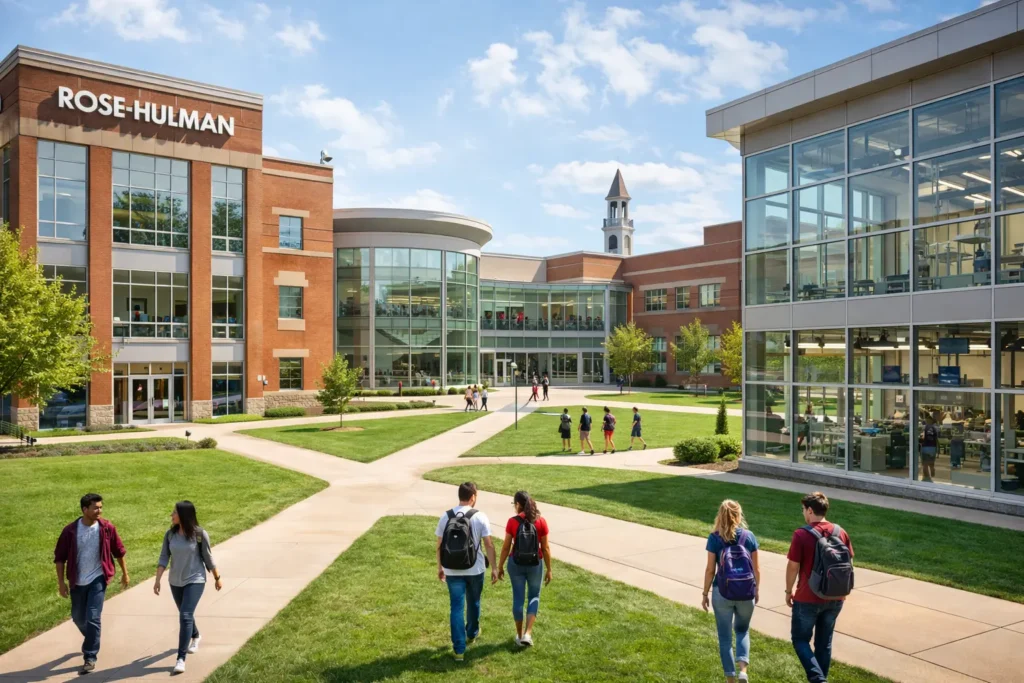
If you’re searching for the best undergraduate engineering college in the United States, one name consistently rises to the top: Rose-Hulman Institute of Technology (RHIT). Nestled on a sprawling 1,300-acre campus in Terre Haute, Indiana, Rose-Hulman has built a national reputation as a premier STEM school where future engineers, mathematicians, and scientists are shaped into world-class professionals.
For over two consecutive decades, U.S. News & World Report has ranked Rose-Hulman #1 among undergraduate engineering colleges that do not offer a doctorate. That’s not a fluke — it’s the result of a relentless commitment to hands-on learning, exceptional faculty, and career outcomes that rival schools many times its size.
This guide is your single, definitive resource for everything Rose-Hulman. Whether you’re a prospective student, a parent weighing costs, or simply curious about what makes RHIT special, you’ll find answers here — from admissions stats and tuition to campus culture and career outcomes.
Why Rose-Hulman Institute of Technology? A Legacy of Excellence
Consistent #1 Ranking by U.S. News & World Report
Rose-Hulman’s streak at the top of the U.S. News & World Report rankings for undergraduate engineering (non-doctoral programs) is unmatched in American higher education. But rankings alone don’t tell the full story. RHIT also earns top marks from:
- The Princeton Review, which consistently lists it among the best colleges for career preparation, internships, and return on investment.
- The Wall Street Journal, which recognizes RHIT for the strong salary outcomes of its graduates relative to their student debt.
- PayScale and similar ROI trackers, which place Rose-Hulman among the highest-value engineering degrees in the country.
What drives these rankings? A focused mission: Rose-Hulman exists exclusively for undergraduate STEM education. There are no large graduate research programs pulling faculty attention away from undergrads. Every professor, every lab, every dollar of investment is oriented toward the undergraduate experience.
What Students & Alumni Say: The Real RHIT Experience
Data and rankings are one thing. The actual student experience is another. Students and alumni consistently highlight a few recurring themes when they describe Rose-Hulman:
- “Professors who genuinely love to teach.” At RHIT, you won’t be sitting in a 300-person lecture hall being taught by a graduate student. Faculty are accessible, engaged, and deeply invested in student success. The 11:1 student-faculty ratio makes this possible.
- “A collaborative, not competitive, culture.” Unlike many engineering programs where students guard their notes and compete for curve-busting grades, RHIT students describe an environment where helping your classmates is the norm, not the exception.
- “Career services that actually work.” Students routinely land internships at top companies before their junior year. Recruiters come to campus in large numbers because they know RHIT graduates can hit the ground running on day one.
- “It’s hard — but you’re not alone.” Rose-Hulman is academically rigorous. Students are honest about the workload. But the support systems — from peer tutoring to faculty office hours — mean that struggling students rarely fall through the cracks.
Notable Alumni: Leaders in Industry
The strength of an institution often reveals itself in the people it produces. Rose-Hulman alumni occupy leadership roles across engineering, business, and technology:
- Jim Umpleby, CEO of Caterpillar Inc., one of the world’s largest construction and mining equipment manufacturers.
- Niles Noblitt, co-founder of Biomet (now Zimmer Biomet), a global leader in medical devices.
- Countless engineers at NASA, Apple, Intel, Lockheed Martin, General Electric, and hundreds of other leading organizations.
These outcomes are not coincidental. They reflect decades of rigorous academic preparation, a powerful alumni network, and a career services infrastructure that keeps RHIT graduates connected to opportunity long after graduation.
Inside the Classroom: Academics at RHIT
A Curriculum Built for Hands-On Learning
Rose-Hulman doesn’t believe in waiting until your senior year to give students real engineering experience. From your very first term on campus, you’ll be in labs, working on projects, and applying theory to real-world problems. This philosophy — that engineers learn best by doing — permeates every corner of the curriculum.
Key academic features include:
- Integrated labs and projects from day one. Even first-year students work in hands-on lab environments that connect classroom theory to practical application.
- The trimester system. Rose-Hulman operates on a unique three-term academic calendar (rather than semesters). This faster pace means students cover more material and gain more varied experience across their four years.
- Senior capstone design projects. Every student completes a rigorous, multi-term capstone project that mirrors real industry challenges — often in partnership with actual companies who sponsor and evaluate the work.
- Small class sizes. With a student-faculty ratio of 11:1, the average class at RHIT is intimate enough for meaningful professor-student interaction. You are not a number at Rose-Hulman.
Top-Ranked Majors and Programs
RHIT offers degrees across a broad range of STEM disciplines. Below is an overview of the primary departments and programs:
| Department | Popular Majors |
|---|---|
| Engineering | Mechanical, Chemical, Civil, Electrical, Biomedical, Aerospace |
| Computer Science & Software Engineering | Computer Science, Software Engineering |
| Mathematics | Applied Mathematics, Computational Mathematics |
| Science | Physics, Chemistry, Biology |
| Interdisciplinary | Optical Engineering, Engineering Management |
Every engineering program at Rose-Hulman is ABET accredited, the gold standard in engineering education recognized by employers and graduate schools worldwide. The institution itself holds regional accreditation from the Higher Learning Commission (HLC).
Rose-Hulman’s Reimagined Computer Science Curriculum
One of RHIT’s most exciting recent developments is the complete reimagining of its Computer Science program. Recognizing that the technology landscape is evolving faster than ever, Rose-Hulman redesigned its CS curriculum around the skills most in demand today, including dedicated specialization tracks in:
- Artificial Intelligence (AI): Machine learning, deep learning, and intelligent systems design.
- Cybersecurity: Network security, cryptography, ethical hacking, and secure systems architecture.
- Data Science: Statistical modeling, big data analytics, and data engineering.
This curriculum overhaul positions RHIT graduates to enter one of the most competitive job markets in the world with immediately applicable, cutting-edge skills — not just theoretical knowledge.
The Rose² (R²) Concurrent Degree Program
For students with graduate school ambitions, Rose-Hulman offers the Rose² Concurrent Degree Program, which allows motivated students to earn both a Bachelor’s degree and a Master of Engineering Management in just four years. This accelerated path gives students a significant competitive edge in the job market and eliminates the additional time and cost of a separate graduate program. It’s a rare opportunity at the undergraduate level — and another example of how RHIT consistently delivers outsized value.
Rose-Hulman Admissions: A Step-by-Step Guide
Understanding the Acceptance Rate and Admissions Requirements
Rose-Hulman’s acceptance rate of approximately 77% is notably higher than many peer institutions, which surprises some applicants. However, this figure comes with important context: the applicant pool is highly self-selecting. Students who apply to an engineering-focused school in Terre Haute, Indiana, are serious about STEM. They know what they’re signing up for.
That means admitted students are strong on paper and a genuine fit for RHIT’s academic culture. Admissions is holistic — the committee looks at:
- Academic record and course rigor (the most important factor)
- Class rank and GPA (average admitted GPA: 3.83)
- Test scores (if submitted)
- Letters of recommendation
- Personal essays and character
- Extracurricular involvement, especially in STEM-related activities
Standardized Tests: SAT, ACT, and the Test-Optional Policy
Rose-Hulman has adopted a test-optional admissions policy, meaning you are not required to submit SAT or ACT scores to be considered for admission. However, if you have strong scores, submitting them can strengthen your application.
For admitted students who do submit scores, the middle 50% ranges are:
- SAT: 1310–1410
- ACT: 28–33
These ranges reflect a competitive but accessible pool. If your scores fall within or above these ranges, they are likely to be a positive factor in your application.
Key Deadlines and Application Process
Rose-Hulman accepts applications through the Common Application, making the process straightforward for students applying to multiple schools. Key deadlines are:
| Decision Plan | Deadline |
|---|---|
| Early Action (EA) | November 1 |
| Regular Decision (RD) | February 1 |
Early Action is non-binding, meaning you’ll receive an admissions decision earlier without committing to enroll. Applying EA is generally advisable if RHIT is a top choice, as it can also give you earlier access to financial aid information.
Tips for International and Transfer Students
International students are welcome at Rose-Hulman and make up a meaningful portion of the student body. In addition to standard admissions materials, international applicants will typically need to demonstrate English language proficiency (TOEFL or IELTS) and have foreign credentials evaluated. The admissions office provides dedicated support and resources for navigating this process.
Transfer students are also considered on an individual basis. RHIT will evaluate your college transcripts, prior coursework, and alignment with your intended major. If you’ve completed strong STEM coursework at another institution, transferring into Rose-Hulman is a realistic goal.
Investing in Your Future: Cost, Financial Aid, and ROI
2024–2025 Tuition, Fees, and Room & Board
A Rose-Hulman education is a significant investment. Here is a transparent breakdown of the full cost of attendance:
| Cost Category | Annual Amount |
|---|---|
| Tuition & Fees | $58,200 |
| Room & Board | ~$17,427 |
| Estimated Total | ~$75,627 |
This places RHIT in the upper range of private university costs — comparable to many selective private schools. However, the sticker price is rarely what students actually pay, and the return on that investment is exceptional.
Financial Aid and Scholarships: Making It Affordable
Rose-Hulman is committed to making its education accessible, and it backs that up with a strong financial aid program:
- 51% of students receive need-based financial aid.
- The average need-based aid package is $43,002 per year.
- The resulting average net price is $38,280 — significantly lower than the sticker price.
- Merit-based scholarships are also available and are awarded based on academic achievement, regardless of financial need.
The key takeaway: don’t let the published tuition figure discourage you from applying. Many students pay far less than the listed cost of attendance. Completing the FAFSA early and applying for institutional scholarships is strongly recommended.
Unmatched Career Outcomes and Return on Investment
Here is where the Rose-Hulman value proposition becomes impossible to ignore. The numbers speak for themselves:
- Median starting salary: $85,935 for recent graduates
- Average student debt at graduation: $44,284
- Career placement rate: Consistently near 100% within six months of graduation
When you consider a median starting salary of nearly $86,000 against an average debt load of $44,284, Rose-Hulman delivers one of the strongest return-on-investment profiles of any college in the country. Many graduates pay off their student loans within just a few years of entering the workforce.
Top employers who actively recruit at RHIT include companies like Boeing, Cummins, Eli Lilly, Procter & Gamble, Intel, Microsoft, Amazon, and hundreds of regional and national engineering firms.
Rose-Hulman Ventures is the institution’s in-house internship and co-op program, connecting students with real paid engineering projects — sometimes while still on campus. This bridges classroom learning and career experience in a uniquely integrated way.
Life at Rose-Hulman: Campus, Culture, and Community
A Close-Knit Community of STEM Enthusiasts
Rose-Hulman’s undergraduate enrollment of approximately 2,300 students creates an intimate campus environment unlike large public universities. With 69% of students coming from out of state, the campus draws passionate STEM students from across the country who chose RHIT specifically and deliberately.
The culture that emerges is distinctive. Students here are intellectually curious, a little quirky, intensely driven — and remarkably supportive of each other. The collaborative ethos isn’t just marketing language; it’s a lived reality shaped by the nature of the student body. When everyone around you is passionate about engineering and mathematics, the conversation never gets boring.
Exploring Campus: From Mussallem Union to the Branam Innovation Center
Rose-Hulman’s 1,300-acre campus in Terre Haute is both functional and beautiful. Key spaces include:
- Moench Hall: The historic academic heart of campus, housing foundational engineering labs and classrooms.
- Branam Innovation Center (BIC): A state-of-the-art hub for interdisciplinary innovation, maker spaces, and entrepreneurship. Students come here to prototype, experiment, and build.
- Knovation Innovation Center (KIC): Focused on applied technology and industry collaboration.
- Mussallem Union: The social hub of campus — home to dining, student organization offices, recreation spaces, and gathering spots.
- Hatfield Hall: The campus’s premier performing arts venue, hosting concerts, speakers, and major campus events.
- Sports and Recreation Center: A comprehensive athletic facility featuring pools, courts, fitness equipment, and spaces for intramural and recreational sports.
Where You’ll Live: Housing and Residential Life
First-year students are required to live on campus, and 98% of freshmen do so. This creates an immediate community that accelerates the transition to college life and helps new students build friendships and support networks quickly.
Housing options include:
- Coed residence halls with a range of room styles from traditional doubles to suite-style configurations.
- Apartment-style housing for upperclassmen seeking more independence.
- Fraternity and sorority houses, which are a significant part of campus life for the students who join.
The residential experience at RHIT is designed to be more than just a place to sleep — it’s an extension of the academic community, with study groups, peer tutoring, and social events woven into daily dorm life.
Getting Involved: Clubs, Greek Life, and Athletics
Despite its academic intensity, Rose-Hulman has a surprisingly vibrant campus life outside the classroom.
Student Clubs and Organizations: With 90+ registered student organizations, there’s a club for nearly every interest — from robotics and coding competitions to theater, music, and outdoor adventure. The breadth of options ensures that even highly specialized interests find a home on campus.
Greek Life: Approximately 29% of students participate in fraternities or sororities, and Greek organizations play a meaningful social role on campus. RHIT has both traditional national fraternities and sororities, as well as co-ed engineering-focused honor societies.
Athletics: The Fightin’ Engineers compete in NCAA Division III athletics, fielding teams in sports including football, basketball, soccer, tennis, swimming, baseball, and more. Intramural and club sports are also extremely popular, allowing students who aren’t varsity athletes to stay active and compete recreationally.
Griffin Bike Park — an on-campus mountain biking trail system — is a unique and beloved feature of the RHIT campus, giving students a genuine outdoor recreation outlet without leaving school grounds.
Campus Safety and Wellness: Rose-Hulman takes student wellbeing seriously. The campus maintains comprehensive safety services in compliance with the Clery Act and offers robust mental health support, including access to Togetherall, an anonymous peer-to-peer mental wellness platform, alongside traditional counseling services.
faqs
Is Rose-Hulman an Ivy League school?
No — Rose-Hulman is not an Ivy League institution. The Ivy League is a specific athletic and academic conference consisting of eight northeastern universities. However, for undergraduate engineering specifically, RHIT’s #1 U.S. News ranking puts it in a conversation with the most prestigious engineering programs in the country.
What is the hardest major at Rose-Hulman?
Most students agree that all programs at RHIT are demanding — that’s part of the package. Chemical Engineering and Electrical Engineering are frequently cited as among the most challenging, given the depth of coursework and lab requirements. That said, “hardest” is subjective, and every major here requires serious commitment.
Is it hard to get into Rose-Hulman?
The acceptance rate of 77% is higher than many comparable schools, but the applicant pool is self-selecting and academically strong. A competitive application typically features a GPA near or above 3.83 and genuine passion for STEM. Students who are academically prepared and genuinely excited about engineering have a solid chance of admission.
What GPA do you need to get into Rose-Hulman?
The average GPA of admitted students is approximately 3.83. Strong performance in math and science courses is particularly important. Rigorous course selection (AP, IB, or honors classes) also carries weight in the holistic review.
Is Rose-Hulman worth the cost?
For most graduates, yes — emphatically. A median starting salary of $85,935 combined with an average debt load of $44,284 gives RHIT one of the strongest ROI profiles of any private university. Many graduates report paying off their loans within a few years of entering the workforce.
What is there to do at Rose-Hulman on weekends?
More than you might expect. Campus events, club activities, Greek life social functions, athletic events, intramural sports, and the Griffin Bike Park keep weekends active. Terre Haute itself offers dining, entertainment, and occasional concerts. Indianapolis — a major city with professional sports, arts, and nightlife — is about 75 miles away.
Does Rose-Hulman have parties?
Greek life hosts social events, and there is a social scene, though RHIT is primarily an academically focused environment. Students describe the social culture as active but balanced — you can find fun, but the academic workload ensures that socializing doesn’t dominate.
Can you have a car on campus at Rose-Hulman?
Yes. Students are permitted to have cars on campus, and parking is available. Having a car can be helpful for exploring Terre Haute and making trips to Indianapolis.
What is the gender ratio at Rose-Hulman?
Rose-Hulman’s student body is approximately 75% male and 25% female, reflecting broader trends in engineering education. The school is actively working to increase gender diversity through recruitment and support programs for women in STEM.
What companies recruit at Rose-Hulman?
A wide range of top-tier companies actively recruit on campus, including Boeing, Cummins, Eli Lilly, Procter & Gamble, Intel, Microsoft, Amazon, Caterpillar, General Electric, Lockheed Martin, and hundreds of regional engineering and technology firms. The career fair at RHIT is one of the most productive in the Midwest for engineering students.
Final Thoughts: Is Rose-Hulman Right for You?
Rose-Hulman Institute of Technology is not for everyone — and that’s precisely what makes it exceptional for those it is designed for. If you are a motivated, curious, and driven STEM student who wants a world-class engineering education in a close-knit, collaborative environment with outstanding career outcomes, RHIT should be near the top of your list.
The combination of its #1 national ranking, hands-on curriculum, 11:1 student-faculty ratio, near-100% career placement, and exceptional ROI make a compelling case that Rose-Hulman delivers more value per dollar than nearly any other undergraduate engineering institution in the United States.
The application is straightforward. The financial aid is meaningful. The outcomes are real. The only question left is: are you ready to become a Fightin’ Engineer?

Adrian Cole is a technology researcher and AI content specialist with more than seven years of experience studying automation, machine learning models, and digital innovation. He has worked with multiple tech startups as a consultant, helping them adopt smarter tools and build data-driven systems. Adrian writes simple, clear, and practical explanations of complex tech topics so readers can easily understand the future of AI.