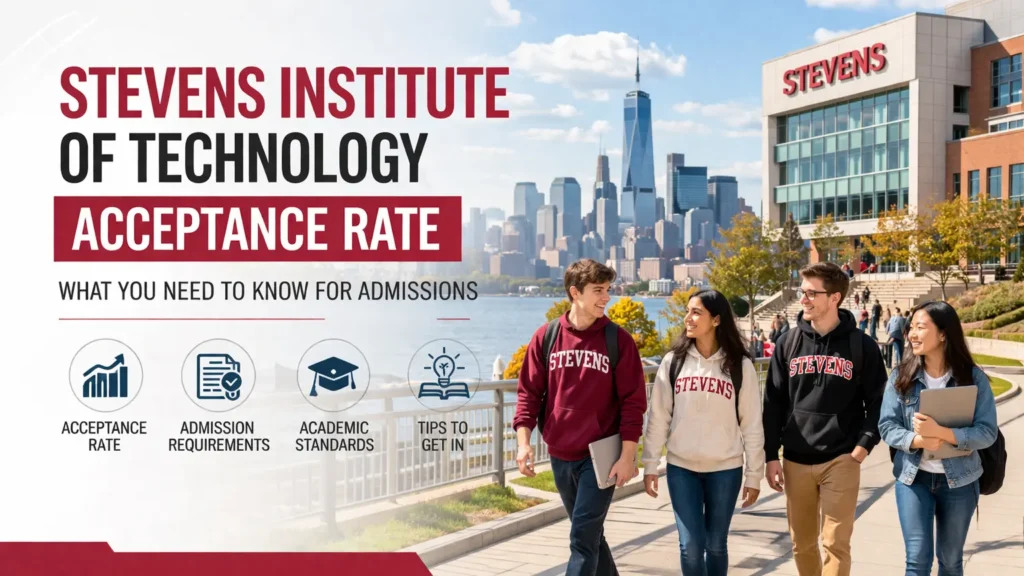
Stevens Institute of Technology, nestled along the Hudson River waterfront in Hoboken, New Jersey, has long been recognized as one of the nation’s premier technological universities. For prospective students and their families, understanding the admissions landscape is a critical first step. This comprehensive guide breaks down everything you need to know — from the current acceptance rate and required academic profile to application deadlines, financial aid, and actionable strategies for strengthening your candidacy.
What is the Stevens Institute of Technology Acceptance Rate?
Based on the most recent data for the Class of 2028 (Fall 2024 admissions cycle), Stevens Institute of Technology carries an acceptance rate of approximately 48%. This means that roughly one in two applicants receives an offer of admission, placing Stevens squarely in the “selective” category among American universities.
Key Takeaway: An acceptance rate of 48% makes Stevens moderately selective. While this is not as restrictive as elite Ivy League institutions, it means that a strong academic profile, compelling application essays, and well-rounded extracurricular involvement remain essential for admission.
It is also worth noting that admissions rates can fluctuate year to year based on the size of the applicant pool and institutional enrollment targets. Applicants should treat these figures as a guiding benchmark rather than a fixed guarantee.
A Detailed Look at Stevens Admissions Requirements
Gaining admission to Stevens requires meeting — and ideally exceeding — several key academic benchmarks. The admissions committee evaluates candidates on multiple dimensions, with GPA, standardized test scores, and course rigor forming the foundation of every competitive application.
The Academic Profile: GPA and Class Rank
The average weighted GPA for admitted students at Stevens is 3.86 on a 4.0 scale. This figure reflects a student body composed primarily of high academic achievers who have challenged themselves with rigorous coursework throughout high school.
Here is how to interpret your GPA relative to Stevens’s expectations:
- Above 3.86: Your GPA is at or above the average for admitted students. A strong academic record in this range, combined with excellent test scores and extracurricular involvement, makes you a competitive applicant.
- Between 3.5 and 3.85: You are within a reasonable range, but you will want to ensure your test scores, essays, and extracurriculars are particularly strong to compensate.
- Below 3.5: Admission becomes more challenging, but not impossible. Demonstrating a strong upward grade trend, exceptional talent in a specific area, or significant personal accomplishments can help offset a lower GPA.
Stevens places a high value on academic rigor. Admissions officers look favorably upon students who have enrolled in Advanced Placement (AP), International Baccalaureate (IB), Dual Enrollment, or other college-preparatory courses. A student earning a 3.7 in a rigorous AP-heavy curriculum is often viewed more favorably than one earning a 3.9 in standard-level courses.
While Stevens does not publish specific class rank requirements, graduating in the top 10–20% of your high school class is generally characteristic of admitted students.
Standardized Test Scores: SAT and ACT
Standardized test scores remain an important component of the Stevens application. The middle 50% SAT range for admitted students falls between 1380 and 1505, while the ACT range spans 31 to 34. Students scoring within or above these ranges are well-positioned from a test score perspective.
| Score Section | 25th Percentile | 75th Percentile | Midpoint |
| SAT Math | 710 | 770 | 740 |
| SAT Evidence-Based Reading & Writing | 670 | 735 | 702 |
| SAT Composite | 1380 | 1505 | 1442 |
| ACT Composite | 31 | 34 | 32.5 |
Note: Stevens has adopted test-flexible policies in recent years, particularly in the wake of the COVID-19 pandemic. Students should always check the official Stevens admissions website for the most current test requirements, as policies can change from cycle to cycle.
For context, the national average SAT score is approximately 1060. Stevens’s middle 50% range of 1380–1505 places admitted students well above this benchmark, reflecting the institution’s academically strong student body.
Beyond the Numbers: Holistic Review Factors
Stevens employs a holistic review process when evaluating applications. This means that no single metric — not even your GPA or SAT score — determines the outcome of your application in isolation. Admissions officers consider a comprehensive picture of who you are as a student and as a person.
Key holistic factors include:
- Extracurricular Activities and Leadership: Stevens is particularly interested in students who demonstrate initiative, leadership, and a passion for STEM-related pursuits. Robotics teams, science competitions, coding clubs, research projects, or entrepreneurial ventures all resonate well with the admissions committee.
- Letters of Recommendation: Strong letters from teachers in math, science, or engineering disciplines carry significant weight. Counselor letters that speak to your character, resilience, and academic contributions are equally valuable.
- Personal Statement and Supplemental Essays: Your essays are your opportunity to go beyond your transcript and test scores. Stevens looks for authentic voices that can articulate why engineering, technology, or science is not just a career interest, but a genuine passion.
- Demonstrated Interest: Attending virtual or in-person information sessions, visiting campus, engaging with Stevens on social media, and reaching out to admissions counselors can all signal genuine enthusiasm for the school.
- Character and Personal Qualities: Resilience, intellectual curiosity, collaborative spirit, and the ability to contribute to a diverse community are qualities that Stevens values deeply.
Decoding the Application Process: Deadlines and Plans
Choosing Your Application Plan: Early Decision vs. Early Action vs. Regular Decision
Stevens offers three application pathways, each with distinct strategic implications. Understanding these plans — and choosing the one that aligns with your academic readiness and financial circumstances — can meaningfully impact your admissions outcome.
| Plan | Deadline | Decision Date | Binding? |
| Early Decision (ED) | November 15 | December 15 | Yes |
| Early Action (EA) | December 1 | February 1 | No |
| Regular Decision (RD) | February 1 | March 31 | No |
Early Decision (ED): ED applicants benefit from a significantly higher acceptance rate — historically around 72% for Stevens ED applicants — compared to the overall 48% rate. However, the binding nature of ED means that if you are accepted, you are contractually obligated to enroll and withdraw all other applications. This plan is best suited for students who have identified Stevens as their clear first-choice school and whose families are financially prepared to commit without comparing financial aid packages from other institutions.
Early Action (EA): EA offers many of the psychological and strategic benefits of applying early — an earlier decision notification, a signal of strong interest — without the binding commitment. Students admitted through EA can continue to weigh their options and compare financial aid offers before making a final decision by May 1.
Regular Decision (RD): RD is the most flexible option and is appropriate for students who need more time to finalize their application, improve test scores, or are still exploring multiple schools. The February 1 deadline gives applicants the entire fall semester to strengthen their candidacy.
How to Submit Your Application
Stevens accepts applications through the Common Application (Common App), which is the standard platform used by over 1,000 colleges and universities nationwide. The required materials for a complete Stevens application include:
- Completed Common App form
- Official high school transcripts (all four years)
- Two teacher recommendation letters (preferably from STEM subjects)
- School counselor recommendation
- SAT or ACT scores (check current test policy)
- Personal statement / Common App essay
- Stevens supplemental essay(s)
- Application fee: $75 (fee waivers available for eligible students)
Be sure to request your letters of recommendation at least 4–6 weeks before your target deadline to give your recommenders adequate preparation time.
Who Gets In? Understanding the Stevens Student Profile
Class of 2028 Demographics: A Snapshot
Stevens’s student body is diverse, intellectually driven, and deeply engaged with technology and innovation. Understanding the composition of the current student body can help prospective students visualize where they might fit within the campus community.
- Total Undergraduate Students: 4,236
- Women: 34% of the undergraduate student body
- International Students: Approximately 9–11% of the undergraduate population
- Student-to-Faculty Ratio: 11:1
- Campus Location: Hoboken, New Jersey — directly across the Hudson River from Midtown Manhattan
The 11:1 student-to-faculty ratio is a meaningful figure. It suggests that Stevens maintains relatively small class sizes, enabling more direct interaction between students and professors — a significant advantage for undergraduates interested in research opportunities and mentorship.
Stevens’s location in Hoboken, NJ, places it within a short commute of New York City, giving students unparalleled access to internship and career opportunities with major corporations, financial institutions, and technology firms headquartered in one of the world’s great business centers.
What Happens After Graduation? Career Outcomes
One of Stevens’s most compelling selling points — and a key reason why competitive students choose it over other selective institutions — is its extraordinary record of post-graduation success.
- Average Starting Salary: $84,800 for recent Stevens graduates
- Post-Graduation Success Rate: 96.8% of graduates secure their desired outcomes — whether that means employment, graduate school enrollment, or other career pursuits — within six months of graduation
- Strong Industry Ties: Stevens maintains deep partnerships with employers in finance, technology, defense, and consulting, with companies such as Goldman Sachs, JPMorgan Chase, Deloitte, and Lockheed Martin regularly recruiting on campus
These outcomes underscore the return on investment (ROI) of a Stevens education. For families weighing the cost of a private university education, these career statistics demonstrate that Stevens graduates are exceptionally well-prepared for the professional world.
How to Strengthen Your Application to Stevens
Raw admissions statistics tell only part of the story. What distinguishes admitted students from those who are waitlisted or denied often comes down to the quality and authenticity of the application itself. Here are targeted strategies based on your current academic profile.
For Applicants with a GPA Below 3.86
If your GPA falls below Stevens’s average, do not be discouraged — but do be strategic. The following approaches can help bolster your candidacy:
- Highlight Grade Trajectory: If your GPA improved significantly from freshman to junior year, make sure this trend is visible in your application. An upward trajectory demonstrates academic maturity and resilience.
- Maximize Test Scores: A strong SAT or ACT score (above the 75th percentile, i.e., above 1505 SAT or 34 ACT) can help offset a lower GPA by demonstrating academic capability.
- Showcase STEM Achievements: National science competition placements, research publications, patents, or notable coding projects can demonstrate intellectual capacity that transcends GPA.
- Seek Compelling Recommendations: A teacher or mentor who can speak in concrete, specific terms about your intellectual gifts and contributions may be the factor that tips the scale in your favor.
For Applicants with SAT Scores Below the 25th Percentile
If your SAT score falls below 1380 (the 25th percentile for Stevens), consider the following:
- Retake the SAT or ACT: Most students improve their scores on subsequent attempts, especially with targeted preparation. A score increase of 50–100 points is attainable with focused study.
- Consider ACT as an Alternative: Some students perform significantly better on the ACT than the SAT. If you have not taken the ACT, it is worth exploring.
- Apply Test-Optional (if available): Verify whether Stevens is currently accepting test-optional applications and whether submitting a lower score might hurt your chances.
- Compensate with Coursework Rigor: A strong AP/IB transcript with high exam scores (4s and 5s) can signal college readiness even in the absence of a high standardized test score.
The Importance of the “Why Stevens?” Essay
Stevens typically requires one or more supplemental essays as part of the application. The most important of these is often a variation of the “Why Stevens?” prompt. This essay asks you to explain why you want to attend Stevens specifically — not just why you want to study engineering or technology in general.
A strong “Why Stevens?” essay will:
- Reference specific programs, professors, research centers, or initiatives at Stevens that align with your academic interests (e.g., the Hanlon Financial Systems Center, the Davidson Laboratory, the Babbio Center)
- Connect your personal story and goals to Stevens’s unique strengths in technology, entrepreneurship, and professional development
- Demonstrate that you have done your homework — vague, generic essays that could apply to any university are immediately recognizable and ineffective
- Articulate what you will contribute to the Stevens community, not just what Stevens can do for you
Avoid common pitfalls such as simply restating your resume in essay form, using overly formal or robotic language, or focusing exclusively on rankings and prestige. Admissions officers read thousands of essays — authenticity, specificity, and genuine passion are what make an application memorable.
faqs
How hard is it to get into Stevens Institute of Technology?
Stevens has an acceptance rate of approximately 48%, making it a selective but accessible institution compared to more restrictive elite universities. Competitive applicants typically have a weighted GPA around 3.86 and SAT scores between 1380 and 1505. Strong essays, extracurricular involvement, and demonstrated interest in STEM are equally important factors.
What SAT score do you need for Stevens Institute of Technology?
The middle 50% SAT range for admitted students is 1380–1505. Scoring above 1505 (75th percentile) places you in a strong position. Scoring below 1380 does not automatically disqualify you, but you will want to compensate with exceptional grades, essays, and activities.
What GPA is required for Stevens Institute of Technology?
The average weighted GPA for admitted students is 3.86. Students below this average should focus on demonstrating academic rigor through AP/IB courses, strong test scores, and a compelling overall application.
What is the early decision acceptance rate at Stevens?
Stevens’s Early Decision acceptance rate is historically significantly higher than the overall rate — approximately 72% for ED applicants, compared to the general 48% acceptance rate. Applying ED is one of the most effective strategies for increasing your odds of admission, provided Stevens is your clear first-choice school.
Does Stevens Institute of Technology have a supplemental essay?
Yes. Stevens typically requires supplemental essays as part of the Common App process. The “Why Stevens?” essay is particularly important. Applicants should carefully research Stevens’s specific programs and articulate a genuine connection between their goals and what Stevens offers.
What is the application deadline for Stevens?
Stevens operates on three main timelines: Early Decision (November 15), Early Action (December 1), and Regular Decision (February 1). All deadlines are firm, and late applications are generally not accepted.
Is Stevens Institute of Technology a good school for engineering?
Absolutely. Stevens is nationally recognized for its engineering and technology programs, consistently earning high rankings from U.S. News & World Report, The Princeton Review, and Niche. Its location near New York City provides exceptional internship and career placement opportunities for engineering students.
What is the student-to-faculty ratio at Stevens?
Stevens maintains an 11:1 student-to-faculty ratio, which supports smaller class sizes, more individualized academic attention, and robust undergraduate research opportunities.
Is Stevens Institute of Technology Ivy League?
No. Stevens Institute of Technology is not a member of the Ivy League, which consists of eight specific universities (Harvard, Yale, Princeton, Columbia, Penn, Brown, Dartmouth, and Cornell). However, Stevens is a highly regarded private research university that delivers outcomes — including starting salaries and career placement rates — competitive with many Ivy League institutions.
Does Stevens offer merit scholarships?
Yes. Stevens awards merit-based scholarships to high-achieving applicants as part of the admissions process. These scholarships range widely in value and do not require a separate application — admitted students are automatically considered based on their academic profile. Prospective students are encouraged to visit the Stevens Office of Financial Aid website for the most current scholarship information and award amounts.
What majors is Stevens known for?
Stevens is particularly well-known for programs in engineering (especially mechanical, electrical, computer, and civil engineering), computer science, data science, business and technology management, quantitative finance, and cybersecurity. The school operates through four colleges: the Schaefer School of Engineering & Science, the School of Business, the School of Systems & Enterprises, and the College of Arts & Letters.
Does Stevens require SAT scores?
Stevens has adjusted its standardized testing policies in recent years. Prospective students should visit the official Stevens Institute of Technology admissions page at stevens.edu for the most current and accurate test submission requirements, as test-optional policies can change between admissions cycles.
Final Thoughts: Is Stevens the Right Fit for You?
Stevens Institute of Technology offers a rare combination: a rigorous, STEM-focused education at a selective but accessible institution, situated in one of the most professionally dynamic locations in the world. With an acceptance rate of 48%, meaningful holistic review, and extraordinary post-graduation outcomes — including a 96.8% success rate and $84,800 average starting salary — Stevens represents a compelling choice for motivated students interested in engineering, technology, business, and the sciences.
The path to admission is competitive but navigable. Students who present strong academic records, challenge themselves with rigorous coursework, craft authentic and specific essays, and apply early stand the best chance of earning a spot in the Class of 2029. Whether you are a straight-A student with a perfect SAT score or a passionate builder with a slightly lower GPA, Stevens’s holistic review process means your full story has an opportunity to be heard.
Begin your preparation early, be intentional about how you present yourself, and remember: the goal is not simply to gain admission, but to find the institution where you will thrive, grow, and launch a career that matters.

Adrian Cole is a technology researcher and AI content specialist with more than seven years of experience studying automation, machine learning models, and digital innovation. He has worked with multiple tech startups as a consultant, helping them adopt smarter tools and build data-driven systems. Adrian writes simple, clear, and practical explanations of complex tech topics so readers can easily understand the future of AI.