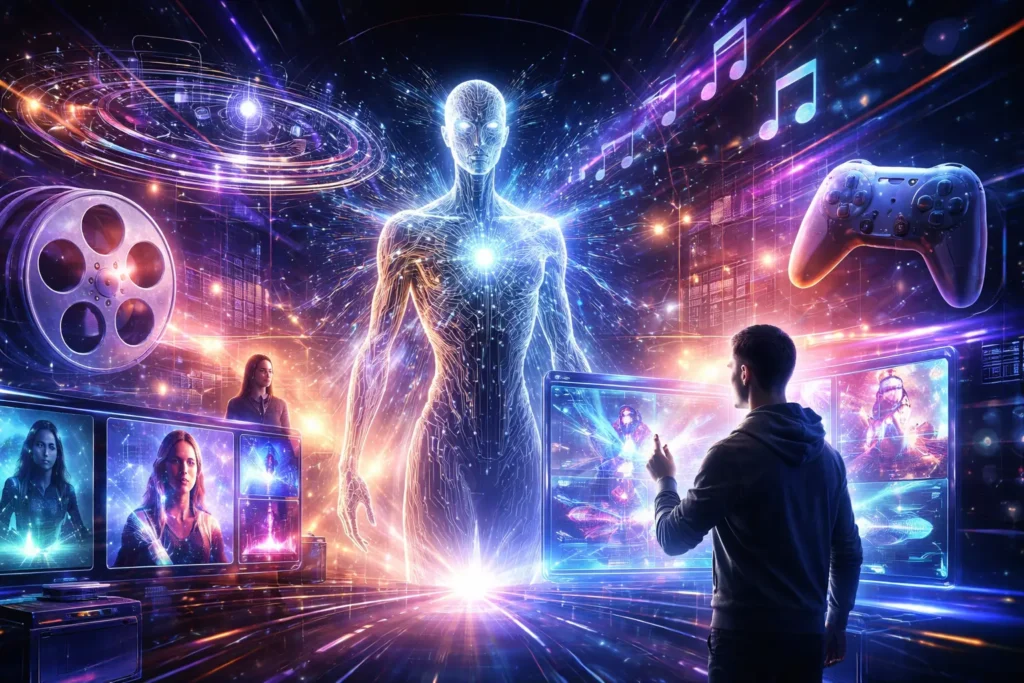
There’s a moment most people don’t notice at first. You open a streaming app and the “perfect” show appears. A song finds you before you knew you wanted it. A game character responds in a way that feels… uncannily personal. That moment—that subtle shift from passive consumption to adaptive experience—is where AI entertainment truly begins.
This isn’t science fiction anymore. It’s not a lab experiment or a Silicon Valley buzzword. AI entertainment is already shaping how we watch, listen, play, and interact with stories. And it’s doing so faster than most industries can fully grasp.
This article is for creators wondering whether AI is a threat or a superpower. It’s for business owners trying to understand where audience attention is heading. It’s for everyday users who sense something has changed but can’t quite name it. And it’s for anyone who wants a grounded, experience-backed understanding of what AI entertainment actually is, how it works, where it delivers real value, and where the risks quietly hide.
By the end, you’ll understand not just the technology, but the why—why AI entertainment is exploding now, what separates hype from substance, and how to use it intelligently rather than reactively.
AI Entertainment Explained: From Clever Algorithms to Creative Partners
At its core, AI entertainment refers to the use of artificial intelligence to create, personalize, enhance, or distribute entertainment experiences. That sounds broad because it is. But the easiest way to understand it is through a simple analogy.
Traditional entertainment is like a stage play: scripted, fixed, and performed the same way every night. AI entertainment is more like improv theater with a brilliant memory—constantly adapting based on who’s in the audience, what they respond to, and what’s happened before.
In practical terms, AI entertainment shows up in several interconnected ways. Recommendation systems decide what you see next. Generative models help create music, scripts, visuals, and even entire virtual personalities. Interactive systems allow games, stories, and characters to respond dynamically instead of following rigid paths.
What’s important—and often misunderstood—is that AI entertainment is not one tool or platform. It’s a layered ecosystem combining machine learning, data analysis, creative inputs, and human oversight. The AI doesn’t replace creativity; it reshapes the creative process.
In early forms, AI simply optimized distribution. Think of how platforms like Netflix learned your viewing habits or how Spotify refined its playlists. That was AI working quietly behind the scenes.
Today, the shift is deeper. AI now participates inside the creative loop—suggesting plot directions, generating concept art, composing music, animating characters, and even performing as digital entertainers themselves. Virtual influencers, AI-powered NPCs, and synthetic voices are no longer experimental curiosities. They are revenue-generating assets.
The evolution matters because it changes who can create, how fast ideas move, and what audiences expect from entertainment experiences.
Why AI Entertainment Is Exploding Right Now (And Not Five Years Ago)
Timing matters in technology adoption, and AI entertainment is a perfect example. The ideas have existed for decades. The sudden acceleration comes from a convergence of forces rather than a single breakthrough.
First, computing power finally caught up with creative ambition. Tasks like real-time voice synthesis, image generation, and adaptive storytelling were simply too resource-heavy until recently. Second, data availability exploded. Entertainment platforms now understand user behavior at a granular level—what people pause, skip, replay, or abandon.
Third, audience expectations shifted. Viewers and players no longer want static experiences. They want relevance. Personalization. Interactivity. The success of open-world games and binge-worthy series trained people to expect content that meets them where they are.
Finally, creative pressure increased. Studios, streamers, and independent creators face relentless demand for content. AI doesn’t eliminate that pressure, but it helps manage scale, speed, and experimentation.
You can see this convergence clearly in gaming. Studios use AI to generate environments, dialogue variations, and adaptive difficulty. In music, artists experiment with AI-assisted composition. In film, AI helps with pre-visualization, editing, and even casting decisions.
AI entertainment didn’t arrive because it was flashy. It arrived because it solved real bottlenecks.
The Real Benefits of AI Entertainment (Beyond the Hype)
The strongest case for AI entertainment isn’t novelty. It’s utility. When applied well, AI delivers tangible advantages across the entertainment ecosystem.
For creators, the most immediate benefit is leverage. Tasks that once required large teams—concept art, rough drafts, background assets—can now be prototyped quickly. That doesn’t eliminate creative roles; it reallocates effort toward higher-level decisions.
For audiences, personalization becomes meaningful rather than superficial. Instead of generic “recommended for you” lists, AI entertainment enables experiences that adapt in tone, pacing, and complexity. Games respond to how you play. Stories adjust based on your choices. Music shifts with your mood.
For businesses, AI entertainment reduces risk. Studios can test concepts, simulate audience reactions, and iterate before committing massive budgets. Marketing becomes more precise. Engagement metrics become more predictive.
A simple before-and-after illustrates the point. Before AI, a game NPC repeated the same dialogue endlessly. After AI, that character remembers past interactions, changes behavior, and feels alive. The entertainment value increases not because the graphics improved, but because the relationship did.
That relational layer is where AI entertainment quietly wins.
Real-World Use Cases Across Industries
AI entertainment isn’t confined to one medium. Its influence stretches across sectors, often blending into daily life so seamlessly people forget it’s there.
In film and television, AI assists with script analysis, pacing optimization, and visual effects planning. Tools help editors identify emotional peaks, predict audience drop-off, and refine cuts accordingly. AI-generated de-aging and voice recreation already appear in mainstream productions.
In music, AI supports composition, remixing, and discovery. Artists use AI to explore new styles or overcome creative blocks. Listeners benefit from smarter curation that surfaces music they might never find organically.
Gaming arguably showcases AI entertainment at its best. Dynamic storytelling, procedural world-building, and intelligent NPCs transform games into living systems rather than static products. Studios increasingly rely on AI to balance gameplay and personalize experiences at scale.
Social media and influencer culture also feel AI’s impact. Virtual influencers attract millions of followers. AI-generated content fills feeds faster than humans can scroll. Brands experiment with synthetic personalities that never age, sleep, or misbehave.
Even live entertainment adapts. AI-enhanced concerts use real-time audience feedback to adjust visuals and setlists. Sports broadcasts integrate AI-generated commentary, highlights, and predictive analysis.
The pattern is consistent: AI entertainment thrives where scale, personalization, and speed intersect.
A Practical, Step-by-Step Guide to Using AI in Entertainment Projects
Understanding AI entertainment conceptually is useful. Applying it intelligently is where real value emerges.
The first step is clarity of intent. Decide what problem you’re solving. Is it creative acceleration? Audience engagement? Cost reduction? AI works best when it augments a specific pain point rather than replacing an entire process.
Next, choose the right entry point. Beginners often start with AI-assisted tools—music generators, visual concept tools, or script analyzers. These offer immediate feedback without deep technical knowledge. Advanced users integrate AI into pipelines, automating repetitive tasks while retaining creative control.
Data quality matters more than most people realize. AI entertainment systems learn from inputs. If your training data is biased, shallow, or inconsistent, the output will reflect that. Curating inputs is as important as choosing tools.
Iteration is the final piece. AI excels at rapid experimentation. Use it to test ideas quickly, gather feedback, and refine. Treat outputs as drafts, not finished products. The best results come from human judgment layered on top of machine suggestions.
Throughout the process, transparency helps. Be clear with audiences about how AI is used, especially when it influences creative authorship. Trust compounds over time.
Tools, Platforms, and Expert Recommendations
The AI entertainment landscape is crowded, but not all tools serve the same purpose. Broadly, they fall into three categories.
Creative generation tools focus on producing music, visuals, text, or video. These are ideal for brainstorming, prototyping, and exploration. Their strength lies in speed, not polish.
Enhancement tools optimize existing content—editing video, cleaning audio, improving visuals, or analyzing engagement. Professionals often rely on these quietly, integrating them into workflows without fanfare.
Interactive AI platforms power dynamic experiences like adaptive games or conversational characters. These require more setup but deliver deeper audience engagement.
Free tools work well for experimentation. Paid platforms offer consistency, support, and customization. The choice depends on scale and stakes. For hobby projects, flexibility matters. For commercial entertainment, reliability and compliance become critical.
What experienced creators learn quickly is this: no single tool does everything well. Effective AI entertainment stacks combine multiple tools, each serving a clear role.
Common Mistakes in AI Entertainment (And How to Avoid Them)
The most common mistake is over-automation. When creators hand too much control to AI, outputs feel generic. Audiences sense it immediately. The fix is simple but difficult: keep humans in the loop, especially for final decisions.
Another pitfall is ignoring ethics and rights. Using AI-generated voices, faces, or styles without consent can trigger backlash or legal issues. Responsible use protects both reputation and revenue.
Many projects fail because expectations are unrealistic. AI is powerful, but it’s not magical. Treating it as a shortcut rather than a collaborator leads to disappointment. Understanding limitations is part of expertise.
Finally, some creators chase novelty instead of value. AI entertainment succeeds when it enhances the experience, not when it exists for its own sake. Audiences reward substance, not gimmicks.
The Cultural Impact of AI Entertainment
Beyond tools and workflows, AI entertainment reshapes culture itself. It blurs the line between creator and consumer. Fans become co-authors. Stories evolve dynamically. Entertainment becomes participatory.
This shift challenges traditional definitions of authorship and originality. Who owns an AI-generated song? Who gets credit for an evolving narrative? These questions don’t have simple answers, but they matter.
At the same time, AI lowers barriers. Voices previously excluded from entertainment—due to cost, access, or geography—gain new ways to create and share stories. That democratization carries enormous potential if guided responsibly.
AI entertainment isn’t just a technological trend. It’s a cultural negotiation between efficiency and expression, scale and intimacy, automation and artistry.
The Future of AI Entertainment: What Comes Next
Looking ahead, the most transformative developments won’t be louder or flashier. They’ll be subtler. Entertainment will feel more responsive, more personal, and more continuous across platforms.
Expect AI characters that persist across games, shows, and social spaces. Expect stories that evolve over months based on audience interaction. Expect entertainment ecosystems rather than isolated products.
The winners won’t be those who adopt AI fastest, but those who integrate it most thoughtfully.
Conclusion: Using AI Entertainment With Intention, Not Fear
AI entertainment is not here to replace creativity. It’s here to reshape how creativity flows. Used poorly, it produces noise. Used well, it amplifies imagination, deepens engagement, and expands what’s possible.
Whether you’re a creator, a business, or an engaged audience member, the question isn’t whether AI will influence entertainment. It already has. The real question is how intentionally you participate in that evolution.
Explore, experiment, but stay grounded. The future of entertainment belongs to those who understand both the technology and the human experience it serves.
FAQs
What is AI entertainment in simple terms?
AI entertainment uses artificial intelligence to create, personalize, or enhance entertainment experiences like music, movies, games, and interactive media.
Is AI entertainment replacing human creators?
No. In practice, AI acts as a creative assistant, accelerating workflows and expanding possibilities while humans retain creative direction.
Where is AI entertainment most commonly used today?
Gaming, streaming platforms, music production, and social media content creation currently lead adoption.
Are AI-generated movies and music legal?
Legality depends on data sources, rights, and jurisdiction. Responsible use and clear consent are essential.
Can small creators benefit from AI entertainment tools?
Absolutely. AI lowers barriers, enabling individuals and small teams to produce high-quality content more efficiently.

Adrian Cole is a technology researcher and AI content specialist with more than seven years of experience studying automation, machine learning models, and digital innovation. He has worked with multiple tech startups as a consultant, helping them adopt smarter tools and build data-driven systems. Adrian writes simple, clear, and practical explanations of complex tech topics so readers can easily understand the future of AI.