
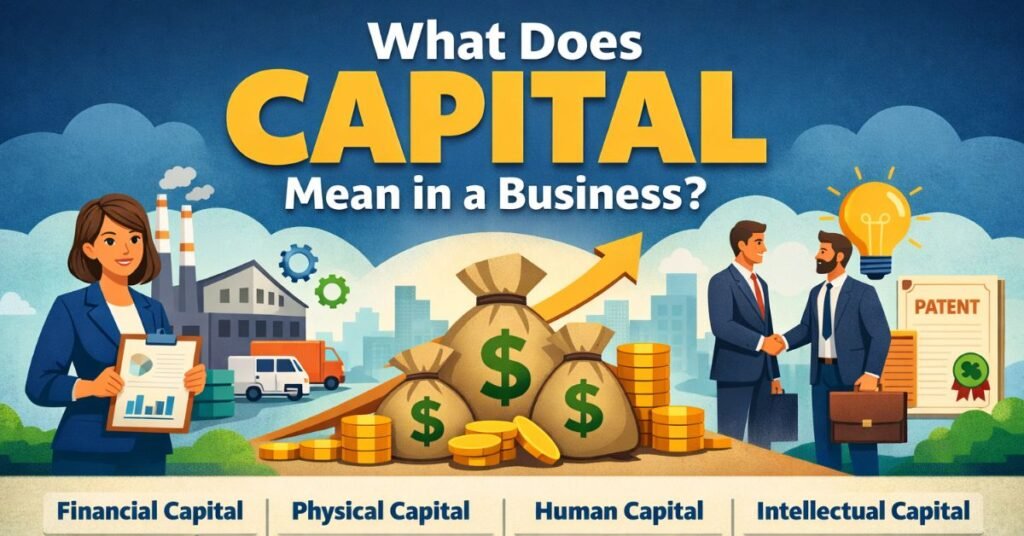
If you’ve ever sat in a meeting, watched an episode of Shark Tank, or skimmed through a startup pitch deck, you’ve probably heard someone say, “We’re raising capital,” or “We need more capital to scale.”
But what does capital mean in a business — really?
Is it just money in the bank? Investor funding? Equipment? Or something more strategic and layered?
Here’s the truth: capital is the lifeblood of a business. It’s not just cash. It’s the fuel that allows an idea to become a product, a product to become a company, and a company to become an empire.
In this guide, we’re going deep. By the time you finish reading, you’ll understand:
- The true meaning of capital in business (in plain English)
- The different types of capital and how they work
- How businesses raise, manage, and grow capital
- Common mistakes entrepreneurs make
- Real-world examples you can actually relate to
- Tools and strategies to handle capital wisely
Whether you’re starting your first business, managing a growing company, or just trying to understand financial terminology without the jargon, this guide will give you clarity — not confusion.
Let’s start with the basics.
What Does Capital Mean in a Business? (Simple Explanation First)
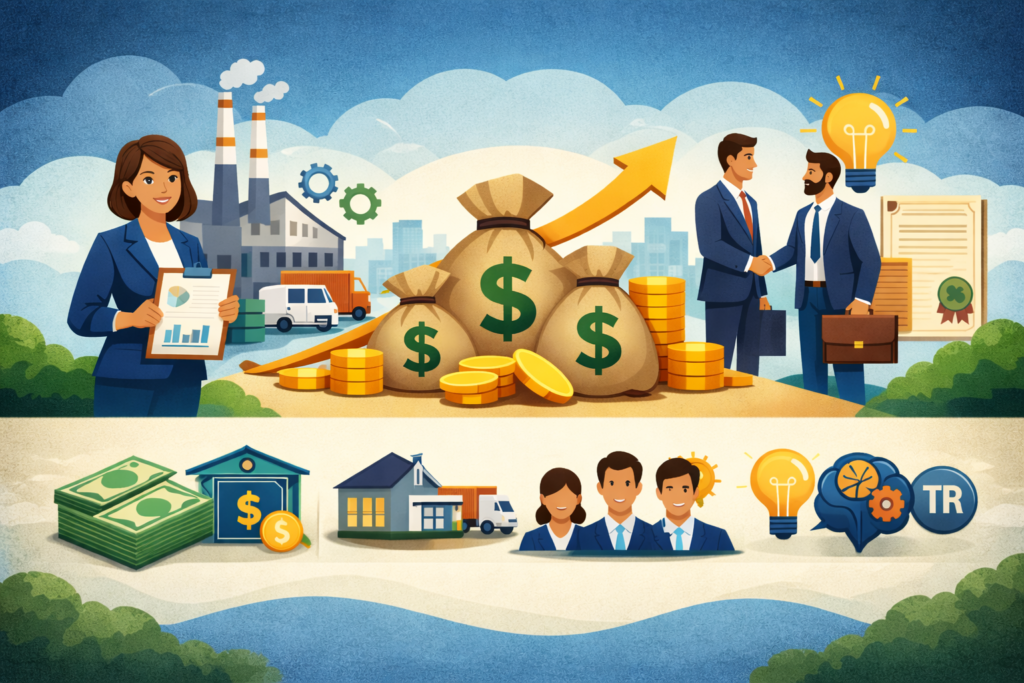
At its core, capital in business refers to the resources a company uses to operate and grow.
Most people immediately think of money — and yes, money is a major form of capital. But capital can also include:
- Cash
- Equipment and machinery
- Buildings and property
- Inventory
- Technology
- Even human expertise in some contexts
In practical terms, capital is anything that helps your business produce goods or services and generate profit.
Here’s a simple analogy.
Imagine your business is a car.
Your idea is the destination.
Your strategy is the GPS.
But capital? Capital is the fuel.
Without fuel, you’re not going anywhere — no matter how brilliant your idea is.
In accounting and finance, capital typically refers to the financial assets available for use. But in economic terms, it expands to include physical and productive resources.
So when someone asks, “What does capital mean in a business?” the accurate answer is:
Capital is the financial and productive resources a business uses to operate, invest, and grow.
Now let’s unpack that further.
The Different Types of Capital in Business
Not all capital is created equal. Understanding the types helps you make smarter financial decisions.
Financial Capital
This is what most people mean when they talk about business capital.
Financial capital includes:
- Cash in the bank
- Investments
- Loans
- Credit lines
- Funds from investors
There are two primary subcategories:
- Equity Capital – Money invested in exchange for ownership (shares).
- Debt Capital – Borrowed money that must be repaid with interest.
For example, if you raise $100,000 from an investor for 10% of your company, that’s equity capital.
If you take a $100,000 bank loan, that’s debt capital.
Both are capital — but they carry very different risks and responsibilities.
Working Capital
Working capital refers to the money available to cover day-to-day operations.
It’s calculated as:
Current Assets – Current Liabilities
If your business has:
- $50,000 in cash and receivables
- $30,000 in short-term bills
Your working capital is $20,000.
Positive working capital means you can meet your short-term obligations. Negative working capital means you might struggle to pay bills.
This is where many small businesses fail — not because they’re unprofitable, but because they run out of working capital.
Physical (or Fixed) Capital
This includes tangible assets such as:
- Machinery
- Equipment
- Buildings
- Vehicles
- Computers
If you own a bakery, your ovens are capital.
If you run a logistics company, your trucks are capital.
Physical capital allows you to produce goods and deliver services.
Human Capital
While not always listed on a balance sheet, human capital refers to the skills, experience, and expertise of your team.
A highly skilled engineer, marketer, or operations manager can be more valuable than a fancy office.
Businesses invest in human capital through:
- Training
- Education
- Hiring skilled professionals
- Leadership development
Smart companies understand that talent is a long-term capital investment.
Intellectual Capital
This includes:
- Patents
- Trademarks
- Brand reputation
- Proprietary processes
- Software code
For tech companies, intellectual capital is often their biggest asset.
Understanding these categories helps you see capital not as a single pile of money — but as a system of resources working together.
Why Capital Is So Important in Business
Let’s be blunt: without capital, businesses don’t survive.
Capital enables you to:
- Launch operations
- Purchase inventory
- Hire employees
- Market your products
- Invest in growth
- Survive slow periods
But here’s where it gets interesting.
Capital doesn’t just help you start. It determines your speed of growth.
Two businesses can have identical ideas — but the one with better access to capital will likely scale faster.
That’s why startups obsess over fundraising. That’s why established corporations issue bonds and shares. That’s why small businesses negotiate credit lines.
Capital equals optionality.
It gives you:
- Flexibility during downturns
- Power to seize opportunities
- Cushion against risk
- Room to experiment
In simple terms: capital buys time — and in business, time is leverage.
How Businesses Raise Capital
If capital is so essential, how do businesses actually get it?
There are several common methods.
Bootstrapping
Bootstrapping means funding your business with your own money.
This could include:
- Personal savings
- Credit cards
- Revenue reinvestment
Pros:
- Full ownership
- No debt obligations
- Total control
Cons:
- Slower growth
- Higher personal risk
- Limited expansion capacity
Many successful entrepreneurs start this way.
Bank Loans
Traditional debt financing involves borrowing from a bank.
You repay:
- Principal
- Interest
Pros:
- Maintain ownership
- Predictable repayment structure
Cons:
- Interest costs
- Qualification requirements
- Risk if revenue drops
Angel Investors and Venture Capital
Equity financing involves giving up ownership in exchange for funds.
Angel investors invest early.
Venture capital firms invest at scale.
Pros:
- Large funding amounts
- Strategic support
- Industry connections
Cons:
- Loss of ownership
- Pressure for high growth
- Reduced control
Crowdfunding
Platforms allow businesses to raise small amounts from many people.
It’s especially useful for:
- Consumer products
- Creative projects
- Innovative tech
Revenue-Based Financing
Instead of fixed payments, you repay investors as a percentage of revenue.
This reduces pressure during slow months.
Each funding path impacts your capital structure — which we’ll discuss next.
Capital Structure: How It All Fits Together
Capital structure refers to how a company finances its operations through debt and equity.
A company might be:
- 100% equity-funded
- 50% debt, 50% equity
- Mostly debt-funded
The right structure depends on:
- Risk tolerance
- Industry norms
- Cash flow stability
- Growth goals
Too much debt increases risk.
Too much equity dilutes ownership.
Smart financial management is about balance.
Step-by-Step: How to Manage Capital Effectively
Understanding what capital means in a business is one thing. Managing it well is another.
Here’s a practical framework.
Step 1: Calculate Your Current Capital Position
Start with:
- Cash flow statement
- Balance sheet
- Working capital calculation
Know:
- How much cash you have
- What you owe
- What assets you own
Clarity prevents panic.
Step 2: Forecast Your Needs
Project:
- Monthly expenses
- Revenue trends
- Growth plans
- Seasonal fluctuations
Always ask:
“How many months of runway do we have?”
Step 3: Optimize Working Capital
Improve cash flow by:
- Speeding up receivables
- Negotiating longer payment terms
- Managing inventory carefully
- Reducing unnecessary expenses
Small adjustments can free up large amounts of capital.
Step 4: Choose the Right Funding Mix
Ask:
- Do I need flexibility or ownership control?
- Can I handle debt payments?
- Is fast scaling essential?
Align funding with strategy.
Step 5: Monitor and Adjust
Capital management is ongoing.
Track:
- Burn rate
- Debt ratios
- Return on invested capital
- Profit margins
Financial discipline separates stable companies from fragile ones.
Tools and Software to Manage Business Capital
You don’t need spreadsheets alone anymore.
Here are practical tools:
Accounting Software
- QuickBooks
- Xero
- FreshBooks
These help track:
- Cash flow
- Expenses
- Profitability
Cash Flow Forecasting Tools
- Float
- Pulse
Great for runway planning.
Budgeting and Planning Tools
- LivePlan
- PlanGuru
These help align capital strategy with long-term goals.
Free options:
- Google Sheets templates
- Basic accounting software trials
Paid tools offer automation and deeper insights.
Choose based on complexity and growth stage.
Common Capital Mistakes (And How to Fix Them)
Even smart entrepreneurs make capital mistakes.
Mistake 1: Confusing Revenue with Capital
Revenue is income.
Capital is usable financial resources.
High revenue doesn’t mean strong cash flow.
Fix:
Monitor liquidity — not just sales.
Mistake 2: Overleveraging with Debt
Too much borrowing creates pressure.
Fix:
Maintain manageable debt-to-income ratios.
Mistake 3: Ignoring Working Capital
Profitable companies still collapse due to cash shortages.
Fix:
Keep emergency reserves.
Mistake 4: Raising Capital Too Late
Waiting until you’re desperate reduces negotiating power.
Fix:
Raise capital when you don’t urgently need it.
Mistake 5: Giving Away Too Much Equity Early
Early dilution hurts long-term control.
Fix:
Understand valuation before negotiating.
Real-World Example: Capital in Action
Imagine two ecommerce businesses.
Business A:
- $10,000 savings
- No external funding
Business B:
- $250,000 investor funding
Both sell similar products.
Business B can:
- Buy inventory in bulk
- Spend more on ads
- Hire specialists
- Expand internationally
Business A grows slower but keeps ownership.
Neither is “wrong.”
But their capital determines strategy.
That’s the power of capital in business.
Conclusion: Capital Is More Than Money — It’s Strategy
So what does capital mean in a business?
It means the financial and productive resources that allow a company to operate, grow, and compete.
It’s:
- Cash
- Assets
- Investment
- Equipment
- Talent
- Intellectual property
But more than that — it’s leverage.
Capital gives you options.
It buys you time.
It accelerates opportunity.
The smartest entrepreneurs don’t just chase revenue. They manage capital strategically.
If you’re building or running a business, start asking better questions:
- Do I have enough working capital?
- Is my capital structure healthy?
- Am I using resources efficiently?
Capital isn’t just accounting terminology. It’s the foundation of sustainable growth.
Now I’d love to hear from you:
Are you currently bootstrapping, raising funds, or optimizing working capital? Drop your thoughts and experiences.
FAQs
What does capital mean in a business in simple terms?
Capital refers to the money and resources a business uses to operate and grow, including cash, equipment, and investments.
Is capital the same as profit?
No. Profit is the money left after expenses. Capital is the resources available to run the business.
What are the main types of capital?
Financial capital, working capital, physical capital, human capital, and intellectual capital.
Why is working capital important?
It ensures a business can cover short-term expenses and avoid cash flow crises.
What is equity capital?
Money invested in exchange for ownership shares in the company.

Michael Grant is a business writer with professional experience in small-business consulting and online entrepreneurship. Over the past decade, he has helped brands improve their digital strategy, customer engagement, and revenue planning. Michael simplifies business concepts and gives readers practical insights they can use immediately.