
What Is an AI Detector? (And Why Does It Matter?)
The rise of large language models (LLMs) like ChatGPT, Gemini, and Claude has fundamentally transformed how text is produced. Millions of articles, essays, emails, and social media posts are now generated — in whole or in part — by artificial intelligence. While this opens tremendous opportunities for productivity, it also raises urgent questions about authenticity, academic integrity, and misinformation.
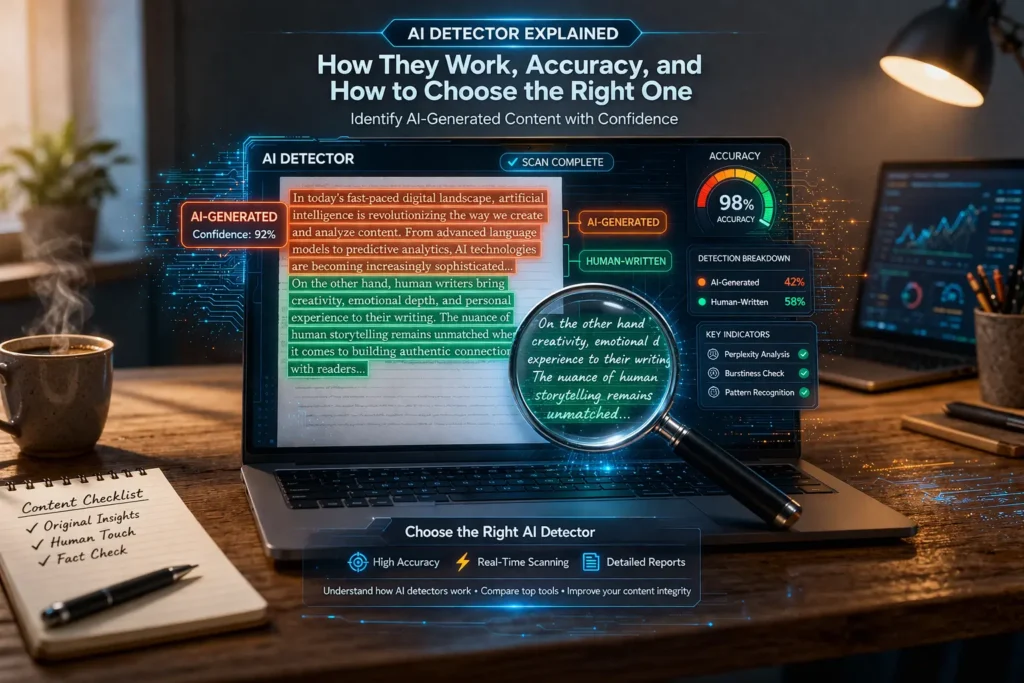
An AI detector (also called an AI content detector, AI writing detector, or AI text classifier) is a software tool designed to analyze a piece of text and estimate the probability that it was generated by an AI model rather than written by a human. These tools are rapidly becoming essential for educators combating academic dishonesty, publishers verifying content originality, and SEO professionals ensuring content quality.
But AI detectors are not a silver bullet. They are probabilistic tools — not lie detectors — and understanding how they work, where they fail, and how to use them responsibly is critical before relying on them to make consequential decisions.
| Key Takeaway AI detectors analyze linguistic patterns to estimate whether text was written by a human or a machine. They are useful tools for content verification but are not 100% accurate. Used responsibly, they complement human judgment — they do not replace it. |
The Science Behind the Scenes: How Do AI Detectors Work?
AI detectors rely on a combination of statistical analysis, machine learning, and natural language processing (NLP) to distinguish human writing from machine-generated text. At their core, these tools have learned that AI writing and human writing have measurably different characteristics — and they exploit those differences to make their determinations.
Perplexity and Burstiness: The Two Pillars of Detection
Two foundational concepts drive most AI detection systems: perplexity and burstiness.
Perplexity measures how predictable or ‘surprising’ a piece of text is. Language models are trained to predict the most likely next word in a sequence — so AI-generated text tends to be statistically predictable, choosing high-probability words and phrases. In detection terms, this means AI text has low perplexity. Human writing, by contrast, is more unpredictable: we choose unusual words, make surprising turns of phrase, and include idiomatic expressions that deviate from statistical norms.
Example of a low-perplexity (AI-typical) sentence: “Artificial intelligence has many applications in modern society, and it continues to evolve at a rapid pace.”
Example of a high-perplexity (human-typical) sentence: “The thing about AI is that it keeps slipping through your fingers just when you think you’ve got a grip on it.”
Burstiness refers to the variation in sentence length and structural complexity within a body of text. Human writers naturally shift between short punchy statements and long, nuanced sentences — creating an organic rhythm that feels dynamic and real. AI-generated text, on the other hand, tends toward uniformity: sentences are similarly structured, similarly sized, and flow with a machine-consistent cadence that trained detectors can identify.
From Machine Learning to Neural Networks: The Different Detection Methods
Modern AI detectors have evolved significantly beyond simple rule-based systems. Today’s tools employ a range of approaches:
- ML Classifiers: These are models trained on large, labeled datasets of human-written and AI-generated text. The classifier learns to associate certain textual features — word frequency distributions, syntactic patterns, phrase structures — with either a human or AI origin.
- Statistical Analysis: Early detection tools focused heavily on n-gram analysis (sequences of N words) and frequency distributions to spot statistical anomalies. If certain word combinations appear with machine-like regularity, this is flagged.
- Neural Networks & Deep Learning: More advanced detectors use transformer-based neural networks — similar in architecture to the very LLMs they are trying to detect. These models process entire passages, capturing long-range dependencies and subtle contextual cues that simpler models miss.
- Pattern Recognition: Detectors also look for linguistic habits common to AI outputs: overly consistent tone, absence of personal anecdotes, formulaic transitions (“Furthermore,” “Moreover,” “In conclusion”), shallow argumentation, and lack of genuine expertise or lived experience.
- LLM Fingerprinting: Some advanced systems attempt to identify the specific ‘fingerprint’ of a particular model (e.g., GPT-4 vs. Gemini) based on subtle differences in how each model weights vocabulary and structures output.
Watermarking: The Future of AI Detection?
One of the most promising — and most debated — emerging approaches to AI detection is watermarking. Rather than analyzing text after it has been generated, watermarking embeds invisible signals into the output during the generation process itself.
OpenAI, Google DeepMind, and academic researchers at institutions such as the University of Maryland have explored cryptographic watermarking schemes. The idea is to subtly bias the token-selection process in ways that are statistically imperceptible to a human reader but detectable by a corresponding verification algorithm.
While technically elegant, watermarking faces real-world challenges: text can be paraphrased to strip the signal, and the approach only works if all major LLM providers agree to adopt compatible standards — a coordination challenge that remains unsolved as of 2026.
| Emerging Concept: Provenance Tracking Beyond detecting AI text after the fact, next-generation tools like Grammarly’s Authorship feature aim to track the real-time writing process — logging keystrokes, edits, and pasting events to build a verifiable record of how a document was produced. This ‘provenance’ approach may ultimately prove more reliable than probabilistic detection alone. |
Can You Trust AI Detectors? A Deep Dive into Accuracy
The short answer is: yes, with caveats. AI detectors are powerful tools, but they are not infallible oracles. Understanding their performance metrics — and their failure modes — is essential for using them responsibly.
Measuring Success: Accuracy, False Positives, and False Negatives
AI detection performance is typically measured using several key metrics from machine learning:
- Accuracy: The overall percentage of correct classifications (AI vs. human). Top tools like Copyleaks claim accuracy rates above 99% under controlled conditions.
- False Positive Rate: The percentage of human-written text incorrectly flagged as AI-generated. This is arguably the most consequential error type — accusing a human writer of using AI when they did not.
- False Negative Rate: The percentage of AI-generated text that is missed by the detector — incorrectly classified as human-written.
- Precision & Recall: Precision measures how often a positive AI detection is actually correct; recall measures how many actual AI texts the detector successfully identifies.
- Confidence Score / Probability Score: Most detectors return not a binary yes/no verdict but a percentage probability — e.g., “78% likely AI-generated.” This score should be interpreted as an informed estimate, not a certainty.
It is important to understand that published accuracy figures from tool vendors should be treated with healthy skepticism. Performance in controlled lab conditions — using clean, unmixed, well-formatted text — often significantly exceeds real-world performance on messy, paraphrased, or mixed content.
The Major Limitations You Need to Know
AI detectors face a range of serious limitations that every user must understand:
1. Bias Against Non-Native English Writers
One of the most significant ethical concerns is the documented bias of AI detectors against non-native English speakers. Because these writers often use simpler vocabulary, shorter sentences, and more formulaic structures — features that superficially resemble AI output — they are disproportionately flagged as AI-generated. A widely cited 2023 study from Stanford University found that essays written by non-native English speakers were flagged as AI-generated at dramatically higher rates than those written by native speakers, even when all were genuinely human-authored.
2. Evolving AI Models
As AI models become more sophisticated — GPT-5, Gemini Ultra, and next-generation LLMs — they produce increasingly human-like text. The arms race between generators and detectors is ongoing, and detectors trained on older AI outputs may perform poorly against the latest models. Regular retraining is essential, but it creates a perpetual lag.
3. Adversarial Manipulation
Humanizing tools — including QuillBot, Undetectable.ai, and others — can rephrase AI text to lower its detectable perplexity and increase burstiness, often successfully evading detection. Adding deliberate typos, changing vocabulary, or simply editing heavily can also significantly reduce AI detection scores.
4. Short Text Challenges
Most AI detectors require a minimum of 250–350 characters (roughly 50–70 words) to make a meaningful assessment. Shorter texts simply do not provide enough statistical signal, leading to unreliable results. Attempting to scan individual sentences or very short paragraphs is unlikely to yield actionable data.
5. Mixed Content
Real-world content is often a blend: a human writer who uses AI to draft a paragraph, then edits it heavily, or a student who writes most of an essay themselves but uses ChatGPT for an introduction. Current detectors struggle to accurately identify and isolate AI-generated sections within predominantly human-written documents.
AI Detector vs. Plagiarism Checker: What’s the Difference?
A common source of confusion is the distinction between AI detectors and traditional plagiarism checkers. They serve fundamentally different purposes:
| Aspect | AI Detector | Plagiarism Checker |
| Purpose | Determine if text was written by AI | Find copied or unoriginal content |
| Method | Analyzes writing patterns, perplexity, burstiness | Compares against a database of existing texts |
| Output | Probability score (e.g., 83% AI-generated) | Similarity percentage with matched sources |
| Best For | Verifying authorship in AI era | Detecting copy-paste plagiarism |
| Limitations | False positives; cannot be 100% certain | Cannot detect original AI-written text |
In short: a plagiarism checker asks “Has this text appeared somewhere before?” An AI detector asks “Does this text show the statistical signatures of machine generation?” Many platforms (including Turnitin and Copyleaks) now combine both capabilities in a single tool, but it is important to understand that these are distinct analyses with distinct limitations.
How to Use an AI Detector (Step-by-Step)
Using an AI detector is straightforward. Most tools follow the same basic workflow:
- Prepare your text. Copy the text you wish to analyze. Ensure it meets the tool’s minimum length requirement — typically 250–500 characters for reliable results.
- Paste or upload. Most tools accept direct text paste; some (like Turnitin) process full documents (PDF, DOCX). Use the method appropriate for your tool.
- Run the scan. Click the scan/check/analyze button. Processing time varies from seconds to a minute depending on text length and tool complexity.
- Interpret the results. Review the overall AI probability score (e.g., “68% AI-generated”). Examine highlighted sentences or passages identified as most likely AI-written. Note any confidence indicators or risk levels.
- Apply human judgment. Do not treat the result as a final verdict. Consider context: Is the writer a non-native English speaker? Is this a technical document with naturally formal language? Use the score as one input, not the only input.
- Act accordingly. If the content needs revision, use the highlighted sections as a guide. If you are an educator, consider a conversation with the student before drawing conclusions.
How to Manually Spot AI-Generated Text (Without a Tool)
Even without a dedicated tool, experienced readers can often identify AI-generated content by recognizing its characteristic patterns. Here is a practical checklist of warning signs:
- Overly consistent tone: The writing maintains the same formal register throughout, with no variation in energy, humor, or emotional texture — unusual in human writing.
- Repetitive sentence structure: Many sentences begin similarly (“It is important to note that…”, “Furthermore…”, “In conclusion…”) and follow a subject-verb-object pattern with monotonous regularity.
- Shallow argumentation: AI text often lists points without genuine depth, personal insight, or original analysis. Claims are made but rarely backed with lived experience or nuanced reasoning.
- Lack of personal anecdotes: Human writing is peppered with specific examples, personal stories, and concrete details. AI text tends toward generality and abstraction.
- Unnatural transitions: Phrases like “Moving on,” “It is worth noting,” and “This highlights the importance of” are favored by LLMs to link paragraphs — sometimes appearing so frequently they become a giveaway.
- Factual vagueness or inaccuracies: AI models can ‘hallucinate’ — generating plausible-sounding but incorrect facts, especially about specific dates, statistics, or niche topics.
- Perfect grammar and spelling: Paradoxically, flawless grammar can be a red flag. Human writers make small, natural errors; perfectly polished text (especially in informal contexts) may indicate machine origin.
- Generic examples: When asked for examples, AI tends to produce generic, textbook-style illustrations rather than the specific, sometimes messy, real-world examples a knowledgeable human would provide.
Top AI Detectors Compared (2026 Update)
Not all AI detectors are created equal. Different tools are optimized for different use cases, audiences, and accuracy profiles. The table below provides an objective comparison of the leading tools available in 2026:
| Tool | Best For | Key Feature | Accuracy | Price | Ideal User |
| Turnitin | Academia | LLM fingerprint detection + plagiarism | ~98% | Institutional | Universities & Schools |
| Copyleaks | Low false positives | Multi-language, source-level scan | ~99.1% | Free + Paid plans | Educators & Publishers |
| Originality.ai | SEO & content teams | Readability + AI + plagiarism combo | ~96% | Pay-per-use | Content marketers |
| Grammarly | Writing authorship | Authorship tracking + inline writing context | ~85–90% | Free + Premium | Writers & Students |
| QuillBot | Quick checks | Simple AI probability score | ~82% | Free + Premium | Students & Bloggers |
| Paperpal | Academic writing | Journal-specific AI pattern detection | ~94% | Free + Premium | Researchers |
How to Choose the Right AI Detector for Your Needs
Selecting the right tool depends on your primary use case:
- Educators and institutions: Prioritize Turnitin or Copyleaks for their low false positive rates, institutional reporting features, and combined AI + plagiarism detection. Turnitin’s deep integration with LMS platforms (Canvas, Blackboard, Moodle) makes it the standard in higher education.
- Content marketers and SEO professionals: Originality.ai is purpose-built for content teams — offering AI detection, plagiarism checking, and readability scoring in a single workflow-friendly interface.
- Individual writers and bloggers: Grammarly’s built-in AI detection is convenient for writers already using the platform. QuillBot offers a free tier suitable for occasional checks.
- Academic researchers: Paperpal specializes in academic writing conventions and is particularly good at flagging AI patterns common in scholarly text.
- Publishers and legal professionals: Copyleaks’ enterprise-grade security (SOC2, GDPR compliance) and multi-language support make it well-suited for organizations with compliance requirements.
Best Practices for Using AI Detectors Responsibly
AI detectors are powerful tools, but they carry real risks when misused. False accusations of AI use can damage reputations, undermine trust, and — in academic settings — have serious consequences for students. Here are the key principles for responsible use:
- Treat scores as informed estimates, not verdicts. A 75% AI probability score means the text has statistical characteristics common in AI writing — it does not prove that AI was used. Always combine detector output with human judgment and contextual knowledge.
- Cross-check with multiple tools. No single detector is authoritative. Running text through two or three different tools and comparing results gives a much more reliable picture. Consistent flags across multiple platforms are more meaningful than a single high score.
- Consider the context. Formal academic writing, technical documentation, and legal text can legitimately trigger AI detectors because of their naturally uniform, precise language. Always factor in the genre and author background.
- Be transparent about AI use. Content creators and students who use AI as part of their workflow should disclose this clearly. Many institutions and publishers now have explicit AI use policies — follow them.
- Avoid punishing based on detector results alone. Especially in educational settings, a detector flag should trigger a conversation, not immediate disciplinary action. Ask the student to explain their writing process, show drafts, or demonstrate familiarity with the content.
- Stay current. The AI detection landscape evolves rapidly. Regularly review whether your chosen tool’s training data and models are up to date with the latest AI generators.
How to Ethically Revise AI-Generated Text to Sound Human
There is an important distinction between deceptive manipulation — using humanizing tools to deliberately evade detection for academic fraud — and the legitimate editing of AI drafts to produce higher-quality, more authentic content. The latter is a valid and increasingly common professional practice.
Here are ethical, practical techniques for transforming AI-generated drafts into genuinely better human-quality content:
1. Inject Personal Experience and Specific Examples
Replace AI’s generic examples with real, specific ones from your own knowledge or research. Mention a particular client, a specific date, a real case study. This not only reduces AI signals but fundamentally improves the content’s value.
2. Vary Your Sentence Structure Deliberately
Read your text aloud. Where it sounds monotonous, deliberately mix short sentences with longer, more complex ones. Break a compound sentence into two. Combine two short sentences into one flowing thought. This increases burstiness and, more importantly, improves readability.
3. Add a Genuine Point of View
AI rarely takes a strong, defensible opinion. Add your own perspective explicitly: “In my experience, this approach consistently outperforms…” or “I’d argue this is overstated because…”. Unique opinions are the hallmark of authoritative human writing.
4. Fact-Check and Enrich
AI models hallucinate. Always verify every statistic, date, citation, and claim. Replacing a vague AI statistic (“Studies show that AI adoption is increasing…”) with a specific, cited figure (“According to McKinsey’s 2025 Global AI Survey, 72% of organizations have adopted at least one AI function…”) dramatically improves both quality and authenticity.
5. Use Natural Language and Contractions
AI text tends toward formal, full-form language. Introducing natural contractions (“it’s,” “we’ve,” “you’ll”), informal transitions, and conversational asides makes text feel more human. Don’t overdo it — match the tone to your audience — but a few well-placed natural phrasings can shift the feel of an entire piece.
6. Cut the Filler Phrases
Remove AI’s signature transitional filler: “It is important to note that,” “In today’s rapidly evolving landscape,” “Furthermore,” “It goes without saying.” Replace these with either a direct statement or a more original transition that reflects your own voice.
The Future of AI Detection: Moving Beyond Simple Checking
The AI detection landscape of 2026 is already radically different from where it stood in 2022. And the pace of change is only accelerating. Understanding where this field is heading is important for anyone building policies, tools, or workflows around AI content.
The Arms Race Between Generators and Detectors
There is an inherent structural challenge in AI detection: the same techniques used to train detectors can be used to improve generators. As detection tools get better at identifying AI text, AI developers (and adversarial humanizing tools) adapt to produce outputs that better evade detection. This is a classic adversarial arms race, and history suggests that generative systems tend to stay ahead.
GPT-5, Gemini Ultra 2, and other next-generation models produce text that is measurably more naturalistic, varied, and contextually grounded than their predecessors. The gap between AI and human writing quality is narrowing — and with it, the reliability of statistical detection.
From Detection to Provenance: A Paradigm Shift
Recognizing the fundamental limits of post-hoc detection, a new paradigm is emerging: provenance tracking. Rather than asking “Is this text AI-generated?” after the fact, provenance tools track the creation process in real time.
Grammarly’s Authorship feature is a leading example. It records keystrokes, paste events, editing patterns, and writing velocity to build a verifiable fingerprint of the composition process. A document authored primarily by a human will have a very different creation pattern — with false starts, revisions, non-linear editing — than one where a block of AI text was pasted in and lightly edited.
Similar approaches are being explored in educational technology platforms, enterprise content management systems, and legal document tools. The C2PA (Coalition for Content Provenance and Authenticity) standard, supported by Adobe, Microsoft, and others, aims to embed verifiable metadata into content at creation — a kind of content provenance certificate.
The Long-Term Viability Question
Some researchers and ethicists argue that AI detection, as currently conceived, faces a long-term viability crisis. As AI writing becomes ubiquitous — used as a productivity tool, an editing aid, or a brainstorming partner by virtually every professional — the meaningful distinction between “AI-generated” and “human-written” may dissolve. In a world where everyone uses AI as a collaborative tool, the question may shift from “Did AI write this?” to “How much human judgment and expertise shaped this output?”
The future likely involves a combination of cryptographic watermarking standards, provenance tracking, disclosure norms, and ongoing detector improvement — rather than any single silver-bullet solution. For educators, publishers, and policymakers, building frameworks that acknowledge AI’s role while preserving standards of authentic human contribution will be the defining challenge of the coming decade.
| Looking Ahead Watermarking standards (C2PA, OpenAI’s watermarking research) are developing but not yet universally adopted. Provenance tools like Grammarly Authorship represent the next frontier beyond probabilistic detection. The policy and ethical frameworks around AI transparency may ultimately matter more than technical detection accuracy. |
faqs
Are AI detectors accurate?
Leading AI detectors report accuracy rates of 95–99% under controlled conditions. However, real-world performance is lower — particularly with paraphrased text, mixed content, or non-native English writing. Treat results as probabilistic estimates, not definitive verdicts.
Can AI detectors be fooled?
Yes. Humanizing tools like QuillBot or Undetectable.ai can rephrase AI text to reduce detection signals. Heavy manual editing, adding personal anecdotes, and varying sentence structure can also lower AI detection scores. This is why detectors should always be combined with human review.
Why was my human-written text flagged as AI?
This false positive can occur for several reasons: very formal or academic writing style, repetitive sentence structures, non-native English patterns, or simply bad luck with statistical thresholds. This is one of the most important limitations to communicate to stakeholders — a flag is not proof of AI use.
What’s the best AI detector for teachers?
Turnitin is the industry standard for educational institutions, offering deep LMS integration, low false positive rates, and combined AI and plagiarism detection. Copyleaks is an excellent alternative with strong multi-language support and granular source-level analysis.
What’s the difference between an AI detector and a plagiarism checker?
A plagiarism checker compares text against a database to find exact or near-exact matches with existing content. An AI detector analyzes the statistical and linguistic patterns of the text itself to determine whether it was likely generated by an AI model. They address different questions about the origin and authenticity of content.
Can AI detectors detect ChatGPT specifically?
Most major AI detectors are specifically trained on GPT-3, GPT-4, and ChatGPT outputs, making them relatively effective at detecting content from these models. However, newer models and paraphrasing can reduce detection rates. No tool can guarantee identification of a specific AI source.
How much text is needed for accurate detection?
Most tools recommend a minimum of 250–350 characters (approximately 50–70 words) for a meaningful result. For reliable, high-confidence analysis, 300+ words is preferable. Very short texts produce unreliable results because there is insufficient statistical signal.
How do I check if text is AI-generated?
The most reliable approach is to use a dedicated AI detector tool (Turnitin, Copyleaks, or Originality.ai for professional use; Grammarly or QuillBot for casual checks) and to supplement this with the manual checklist of AI writing signals described in this article: consistent tone, repetitive structure, shallow argumentation, and lack of personal specificity.
Final Thoughts
AI detectors represent a critical — and still-maturing — response to the rapid proliferation of AI-generated content. They are most valuable when understood not as infallible judgment tools but as one layer of a broader verification process. The best approach combines automated detection with human editorial judgment, contextual awareness, and clear transparency policies about AI use.
As AI models continue to advance and as provenance-tracking technologies mature, the conversation will inevitably shift from detection to disclosure — from “Did AI write this?” to “How was this content created, and by whom?” Getting ahead of that shift, both technically and ethically, is the challenge — and the opportunity — facing every stakeholder in the AI content ecosystem.

Adrian Cole is a technology researcher and AI content specialist with more than seven years of experience studying automation, machine learning models, and digital innovation. He has worked with multiple tech startups as a consultant, helping them adopt smarter tools and build data-driven systems. Adrian writes simple, clear, and practical explanations of complex tech topics so readers can easily understand the future of AI.