
How do self-driving cars navigate busy streets without a human behind the wheel? How do archaeologists uncover ancient cities buried beneath centuries of jungle growth? How does NASA plan safe landings on distant planets? The answer to all three questions is the same: LiDAR.
Light Detection and Ranging Technology is an active remote sensing technology that uses laser pulses to measure distances and create precise, three-dimensional representations of the Earth’s surface, objects, and environments. Unlike passive sensors that rely on sunlight, LiDAR generates its own energy, making it equally effective day and night. From mapping coastlines to enabling autonomous vehicles, LiDAR has become one of the most transformative technologies in modern science, engineering, and industry.
This guide covers everything you need to know — from core principles and key components to advanced data products, industry applications, and how to choose the right system for your project.
What Is Light Detection and Ranging Technology? The Core Principles
How Does LiDAR Work?
At its most fundamental level, LiDAR works by measuring how long it takes for a laser pulse to travel from a sensor to a surface and return. This principle is known as time of flight (ToF).
The calculation is straightforward:
Distance = (Speed of Light × Time of Flight) / 2
A LiDAR system emits a laser pulse at the speed of light (approximately 299,792,458 meters per second). When that pulse strikes a surface — a tree, a building, the ground — it reflects back toward the sensor. By recording the elapsed time with extreme precision, the system calculates the exact distance to that surface.
A useful analogy is echolocation. Just as bats emit sound waves and interpret the returning echoes to navigate in darkness, LiDAR emits light pulses and interprets the returning signals to map its surroundings. The key difference is that LiDAR uses light rather than sound, achieving far greater precision and range.
From Pulses to Point Clouds: The LiDAR Data Workflow
A single distance measurement tells you how far away one point is. But a LiDAR system fires thousands to millions of pulses per second, each returning a distance measurement. Combined with precise positioning data from GPS/GNSS and orientation data from an Inertial Measurement Unit (IMU), each measurement is georeferenced — assigned real-world X, Y, and Z coordinates.
The result is a point cloud: a dense, three-dimensional collection of data points that together form an accurate digital model of the scanned environment. Point clouds can represent everything from a single room to thousands of square kilometers of terrain.
The full workflow typically unfolds like this: the sensor emits laser pulses and records return signals; GPS/GNSS records the sensor’s absolute location while the IMU records pitch, roll, and yaw; position and orientation data are fused with range measurements to place each point in real-world space; and finally, raw data is filtered, classified, and transformed into usable products such as DEMs, 3D models, or classified point clouds.
Key Components of a LiDAR System
The Laser Scanner
The laser is the heart of any LiDAR system. It emits pulses of light at specific wavelengths, and the choice of wavelength has a direct impact on what the system can measure. Near-infrared at 1,064 nm is the most common wavelength for topographic LiDAR — highly reflective from vegetation and man-made surfaces, making it ideal for land mapping. Green light at 532 nm is used in bathymetric LiDAR because it can penetrate water, allowing seafloor and riverbed mapping. 1,550 nm is popular in automotive and some aerial systems due to its eye-safe properties at higher power levels, enabling more powerful pulses without risk of eye injury.
The laser unit also includes optics and a beam-steering mechanism — either a rotating mirror, MEMS (Micro-Electromechanical Systems) mirror, or optical phased array — that sweeps the laser across a wide field of view.
Because LiDAR sensors are almost always moving, knowing the exact position and orientation of the sensor at every moment is critical. GPS/GNSS provides the absolute geographic position (latitude, longitude, altitude) of the sensor, while the Inertial Measurement Unit (IMU) records the sensor’s orientation — pitch, roll, and yaw — multiple times per second, capturing even small vibrations and movements.
Together, GPS and IMU data allow each laser return to be precisely georeferenced. Without this combination, the resulting point cloud would be a distorted, unusable mess.
Photodetectors and the Processing Unit
When laser pulses return to the sensor, a photodetector captures the incoming light and converts it into an electrical signal. The processing unit records the timing of each return with nanosecond-level precision and stores the raw data for post-processing.
Modern LiDAR systems can record multiple returns from a single pulse — for example, the first return from a tree canopy, intermediate returns from branches, and a final return from the ground below. This multi-return capability is one of LiDAR’s most powerful features, particularly for vegetation analysis.
Types of Light Detection and Ranging Technology
By Platform
Airborne LiDAR (fixed-wing aircraft or helicopter) is used for large-area surveys covering hundreds to thousands of square kilometers. It is the workhorse of national mapping programs, forestry surveys, and corridor mapping for roads and pipelines.
UAV/Drone-Based LiDAR has rapidly grown in popularity, offering higher-resolution data over smaller areas at a fraction of the cost of manned aircraft. Drone LiDAR is now widely used in precision agriculture, construction site monitoring, mining, and archaeological surveys.
Terrestrial LiDAR (tripod-mounted) is used for close-range, high-precision scanning of structures, heritage sites, and industrial facilities. A single scan can capture sub-millimeter detail of a building facade or a complex mechanical installation.
Mobile LiDAR (vehicle, backpack, or handheld) combines LiDAR with SLAM (Simultaneous Localization and Mapping) algorithms to enable scanning while moving — ideal for road surveys, indoor mapping, and rapid site documentation.
Spaceborne LiDAR operates from satellites. NASA’s ICESat-2 mission uses a spaceborne LiDAR to measure ice sheet thickness, sea ice, and vegetation height globally, providing critical data for climate science.
By Data Recording Method
Discrete Return LiDAR records one or more specific returns per pulse — typically the first, last, and sometimes intermediate returns. It is the most widely used approach and well-suited for topographic mapping and vegetation analysis.
Full Waveform LiDAR records the complete distribution of returned energy for each pulse rather than discrete peaks. This provides significantly more information about the target’s structure, enabling more detailed analysis of vegetation layers, surface roughness, and target properties. Full waveform systems are more complex to process but are increasingly used in scientific research and advanced forestry applications.
By Application and Wavelength
Topographic LiDAR uses near-infrared wavelengths to map land surfaces, forming the foundation of most elevation mapping, urban modeling, and environmental monitoring.
Bathymetric LiDAR uses green light to penetrate water and map seafloors, riverbeds, and shallow coastal zones. Many systems combine both green and near-infrared channels, enabling seamless land-water boundary mapping.
Multispectral LiDAR (MSL) represents the cutting edge of the technology. By simultaneously using multiple wavelengths (for example, 532, 1,064, and 1,550 nm), MSL systems capture both the 3D geometry and spectral reflectance properties of targets. This additional spectral information enables far more accurate classification of land cover types — distinguishing different tree species, separating vegetation from soil, or identifying different roof materials — tasks that single-wavelength LiDAR struggles with.
Hyperspectral LiDAR (HSL) extends this concept further, capturing reflectance data across dozens or hundreds of wavelength bands simultaneously, merging the capabilities of LiDAR and hyperspectral imaging into a single sensor.
Understanding LiDAR Data
The Point Cloud
A LiDAR point cloud is a dataset comprising millions or billions of individual points, each defined by X, Y, Z coordinates (the three-dimensional position in a geographic coordinate system), intensity (the strength of the return signal, indicating surface reflectivity), return number (whether this is the first, second, or last return from a given pulse), and classification (a label assigned to each point — ground, low vegetation, building, water, etc.).
Point clouds are typically stored in the .las or .laz (compressed) file formats, the industry standards defined by the American Society for Photogrammetry and Remote Sensing (ASPRS).
Common Data Products Derived from LiDAR
A Digital Elevation Model (DEM) is a raster representation of the Earth’s surface. The Digital Terrain Model (DTM) represents the bare-earth surface, with all vegetation and man-made structures removed through point cloud filtering — essential for flood modeling, slope analysis, and hydrological mapping. The Digital Surface Model (DSM) represents the top surface of everything, including buildings and trees.
A Canopy Height Model (CHM) is derived by subtracting the DTM from the DSM, giving the height of vegetation above the ground — widely used in forestry for estimating biomass and tree height.
3D City Models can be generated by classifying and extruding building footprints from point cloud data, providing the foundation for urban planning, telecommunications planning, and disaster response.
Point Cloud Processing Software
Processing raw LiDAR data requires specialized tools. LAStools is an industry-standard suite for reading, writing, and processing .las/.laz files. CloudCompare is a free, open-source 3D point cloud editor. PDAL (Point Data Abstraction Library) enables programmatic, scripted processing workflows. Global Mapper provides comprehensive GIS and point cloud capabilities. Mainstream GIS platforms ArcGIS and QGIS both offer integrated LiDAR processing, making them accessible entry points for organizations already invested in those ecosystems.
Top Applications of LiDAR Technology Across Industries
Surveying, Mapping, and Urban Planning
LiDAR is the backbone of modern topographic mapping. National mapping agencies — including the USGS in the United States — have completed national LiDAR coverage programs, making high-resolution elevation data freely available. In urban environments, LiDAR enables detailed 3D city models used for line-of-sight analysis, telecommunications planning, shadow modeling, and urban heat island studies.
Forestry, Ecology, and Agriculture
LiDAR has transformed forest inventory. From a single airborne survey, analysts can estimate canopy height, basal area, biomass, and individual tree count across vast forested areas — tasks that previously required costly, time-intensive field sampling. In precision agriculture, drone-mounted LiDAR enables crop height monitoring, drainage mapping, and variable-rate application guidance, improving yields while reducing inputs.
Archaeology and Cultural Heritage
One of LiDAR’s most dramatic applications is in archaeology. Because near-infrared pulses penetrate gaps in forest canopy and return from the ground below, LiDAR reveals hidden structures invisible from the ground or from aerial photography. Surveys in Cambodia, Guatemala, Honduras, and Mexico have used airborne LiDAR to map previously unknown ancient cities beneath jungle canopy — rewriting pre-Columbian history. NOAA uses LiDAR extensively for coastal archaeology and submerged cultural resource mapping.
Autonomous Vehicles and Robotics
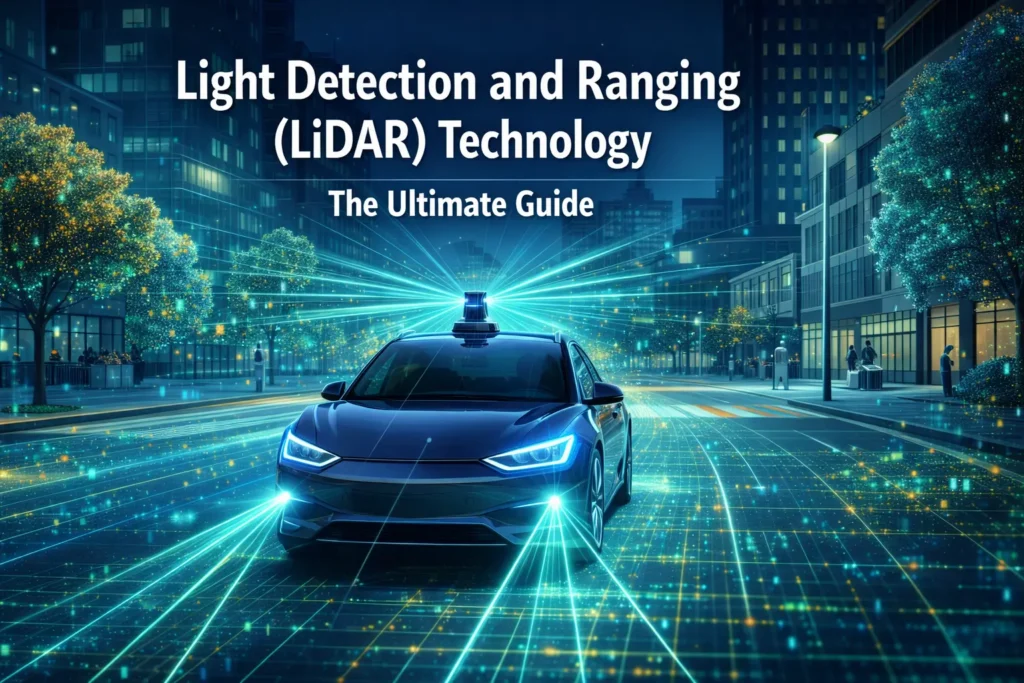
LiDAR is a core perception technology in autonomous vehicles. Mounted on the roof of a self-driving car, a rotating LiDAR unit produces real-time 3D maps of the surrounding environment at high speed, enabling the vehicle’s AI systems to detect other vehicles, pedestrians, cyclists, and obstacles — even in complete darkness. LiDAR is equally critical for robotic navigation in warehouses and industrial environments, and for spacecraft precision landing, where NASA has deployed LiDAR-based autonomous hazard detection systems for missions to the Moon and Mars.
Construction, Mining, and Engineering
In construction, mobile and drone LiDAR enables frequent progress monitoring — comparing as-built conditions against design models (BIM) with centimeter accuracy, tracking earthwork volumes, and managing site logistics. In mining, LiDAR calculates stockpile volumes, maps pit geometry, and monitors slope stability. Terrestrial and drone LiDAR have largely replaced traditional surveying methods at many mine sites, increasing both the frequency and safety of surveys.
Energy and Utilities
Powerline corridor mapping is one of the most commercially significant LiDAR applications. Airborne LiDAR surveys of transmission lines detect vegetation encroachment, wire sag, structure lean, and span violations — enabling utilities to prioritize maintenance and prevent outages or wildfires. LiDAR is also used for wind farm siting, solar farm design, and oil and gas pipeline inspection.
Coastal and Hydraulic Engineering
NOAA has used airborne LiDAR for coastal mapping since the 1990s. Surveys capture shoreline position, beach volume, dune morphology, and nearshore bathymetry — providing the data needed to monitor coastal erosion, model storm surge, and assess flood risk. High-resolution LiDAR-derived terrain models are the foundation of flood inundation modeling, helping planners identify at-risk properties and design flood defense infrastructure.
Atmospheric and Space Science
LiDAR is used extensively in atmospheric research — measuring cloud height and thickness, profiling aerosol distributions, and monitoring air quality. NASA’s ICESat-2 satellite uses a green-wavelength LiDAR to measure the height of ice sheets, sea ice, forests, and ocean surfaces globally, providing crucial data for sea level rise research and climate science.
Advantages and Limitations of LiDAR
LiDAR’s strengths are well established. As an active sensor, it generates its own light source and operates equally well day and night, in any season. It achieves sub-centimeter to centimeter-level accuracy under optimal conditions, collects data at speeds that allow modern aerial systems to survey hundreds of square kilometers per day, and — critically — its multi-return capability allows ground detection beneath forest canopy, a feat no passive sensor can match. It delivers true geometric 3D data rather than estimated 3D derived from image analysis, and it scales from handheld scanners to satellites.
Its limitations are equally real. Heavy rain, fog, and dust attenuate laser signals, reducing range and accuracy. LiDAR cannot see through solid rock, dense soil, or thick, unbroken ground cover. High-end systems are expensive — from tens of thousands to hundreds of thousands of dollars. Point clouds require specialized software and expertise to process. And standard LiDAR cannot penetrate water beyond a surface return, though bathymetric systems address clear, shallow water specifically.
LiDAR vs. Radar vs. Photogrammetry
| Feature | LiDAR | Radar | Photogrammetry |
|---|---|---|---|
| Data type | 3D point cloud | Range/velocity | 3D from images |
| Resolution | Very high | Low–medium | High |
| Works at night | Yes | Yes | No |
| Penetrates cloud/fog | No | Yes | No |
| Penetrates vegetation | Partially | Partially | No |
| Cost | Medium–High | High | Low–Medium |
| Texture/color data | No | No | Yes |
Radar excels where LiDAR fails — in heavy cloud cover, fog, and rain — and is widely used for large-area satellite mapping. Photogrammetry extracts 3D information from overlapping images at lower cost and provides texture and color data, but requires good lighting, cannot penetrate vegetation, and produces less precise elevation data. For high-accuracy 3D mapping requiring vegetation penetration and night operation, LiDAR remains the preferred choice.
How to Choose the Right LiDAR System for Your Project
Platform — For large-area surveys (greater than 50 km²), consider airborne or fixed-wing UAV LiDAR. For site-level work (under 1 km²), terrestrial or mobile LiDAR may be more cost-effective. For real-time navigation, automotive-grade solid-state sensors are standard.
Required accuracy and point density — Sub-centimeter accuracy requires a high-end terrestrial or close-range drone system with a precise IMU and ground control points. For national-scale topographic mapping, 10–20 cm vertical accuracy is often sufficient and far more economical to achieve.
Wavelength — Use green (532 nm) for bathymetric surveys. Use near-infrared (1,064 nm) for topographic and vegetation surveys. Consider multispectral systems if target classification — such as tree species identification or detailed land cover discrimination — is a priority.
Deliverable requirements — A simple DEM requires far less processing complexity than a fully classified point cloud or a BIM-ready 3D model. Define your end product before selecting a system.
Budget — LiDAR costs span an enormous range: the LiDAR sensor in an iPhone at one extreme; entry-level drone LiDAR systems ($10,000–$30,000); professional drone/UAV systems ($30,000–$100,000+); full airborne survey systems ($100,000–$500,000+). For one-time projects, hiring a LiDAR service provider is often the most cost-effective approach.
faqs
What does LiDAR stand for?
LiDAR stands for Light Detection and Ranging. It is sometimes written as “lidar” without capitals, as it has evolved from an acronym into a standard technical term.
Can LiDAR see through trees?
LiDAR cannot see through solid tree trunks, but because it fires millions of pulses, some pass through gaps in the canopy and return from the ground below. Multi-return processing allows analysts to extract the ground surface beneath vegetation — one of LiDAR’s most valuable capabilities.
Can LiDAR work in the dark?
Yes. LiDAR is an active sensor that generates its own light source, making it completely independent of ambient light. It operates equally well at night, making it ideal for autonomous vehicles and around-the-clock survey operations.
Can LiDAR penetrate water?
Standard near-infrared LiDAR cannot penetrate water. Bathymetric LiDAR uses green (532 nm) light, which can penetrate clear, shallow water to depths of approximately 40–70 meters depending on water clarity.
What is the difference between a DTM and a DSM?
A Digital Terrain Model (DTM) represents the bare-earth surface with all above-ground features removed. A Digital Surface Model (DSM) represents the top surface of everything, including buildings and vegetation. The difference between the two reveals the height of above-ground objects.
How accurate is LiDAR?
High-end terrestrial systems achieve sub-millimeter accuracy at close range. Professional aerial LiDAR typically achieves 5–15 cm vertical accuracy. UAV LiDAR systems generally achieve 3–10 cm vertical accuracy, depending on flight conditions and IMU quality.
What is multispectral LiDAR?
Multispectral LiDAR (MSL) uses multiple wavelengths simultaneously (e.g., 532, 1,064, and 1,550 nm) to capture both 3D structure and spectral reflectance, enabling significantly more accurate classification of vegetation types, land cover, and surface materials.
Does the iPhone have LiDAR?
Yes. Apple introduced a LiDAR scanner in the iPhone 12 Pro (2020) and iPad Pro, primarily for augmented reality and close-range 3D scanning up to approximately 5 meters. It is not comparable to professional-grade systems, but it has made LiDAR technology accessible to millions of consumers.
What is the .las file format?
The .las (and its compressed version .laz) is the standard binary file format for storing LiDAR point cloud data, defined by the American Society for Photogrammetry and Remote Sensing (ASPRS). It stores X, Y, Z coordinates, intensity, return number, classification, and other attributes for each point.
How much does a LiDAR system cost?
Entry-level drone LiDAR systems start around $10,000–$30,000. Professional UAV systems run $30,000–$100,000+. Full airborne survey systems cost $100,000–$500,000+. Engaging a LiDAR service provider for a specific project is often the most cost-effective option for one-time surveys.
The Future of LiDAR Technology
LiDAR is evolving rapidly, driven by demand from the autonomous vehicle industry, declining component costs, and advances in photonics and computing.
Solid-state LiDAR — including MEMS-based, flash, and optical phased array designs — is replacing mechanical spinning sensors in automotive and consumer applications. These systems have no moving parts, are smaller, cheaper, and more durable, though they currently trade some range and field of view for those advantages.
AI-powered classification is transforming point cloud processing. Machine learning models can now automatically classify ground, vegetation, buildings, and vehicles with high accuracy, dramatically reducing the time required for manual post-processing. Institutions such as Idaho National Laboratory (INL) are pioneering AI-LiDAR integration for complex environment interpretation.
Multispectral and hyperspectral LiDAR will enable far richer environmental characterization — distinguishing tree species, identifying invasive plants, assessing crop stress, and mapping land cover with unprecedented detail, moving LiDAR from geometry-only to geometry-plus-spectral sensing in a single pass.
Miniaturization and cost reduction continue to bring professional-grade LiDAR capabilities to smaller platforms and lower price points, democratizing access for smaller organizations and creating entirely new use cases in consumer electronics, healthcare, and retail.
Digital twin integration — where LiDAR feeds real-time, continuously updated 3D models of physical assets and environments — will make LiDAR a foundational data source for smart cities, autonomous infrastructure management, and industrial monitoring.
Conclusion
From the depths of the ocean to the surface of Mars, from ancient jungle cities to the streets of modern metropolises, LiDAR technology is reshaping how humanity perceives, maps, and understands the world. Its combination of accuracy, speed, versatility, and the ability to operate in conditions where other sensors fail has made it indispensable across science, engineering, and industry.
Whether you are a researcher studying forest carbon stocks, an engineer designing road infrastructure, an archaeologist searching for lost civilizations, or an entrepreneur building the next generation of autonomous vehicles, understanding LiDAR — how it works, what it produces, and how to choose the right system — is increasingly essential knowledge.
As costs fall and capabilities grow, LiDAR will only become more pervasive, powerful, and central to the data-driven technologies shaping our future.

Adrian Cole is a technology researcher and AI content specialist with more than seven years of experience studying automation, machine learning models, and digital innovation. He has worked with multiple tech startups as a consultant, helping them adopt smarter tools and build data-driven systems. Adrian writes simple, clear, and practical explanations of complex tech topics so readers can easily understand the future of AI.