
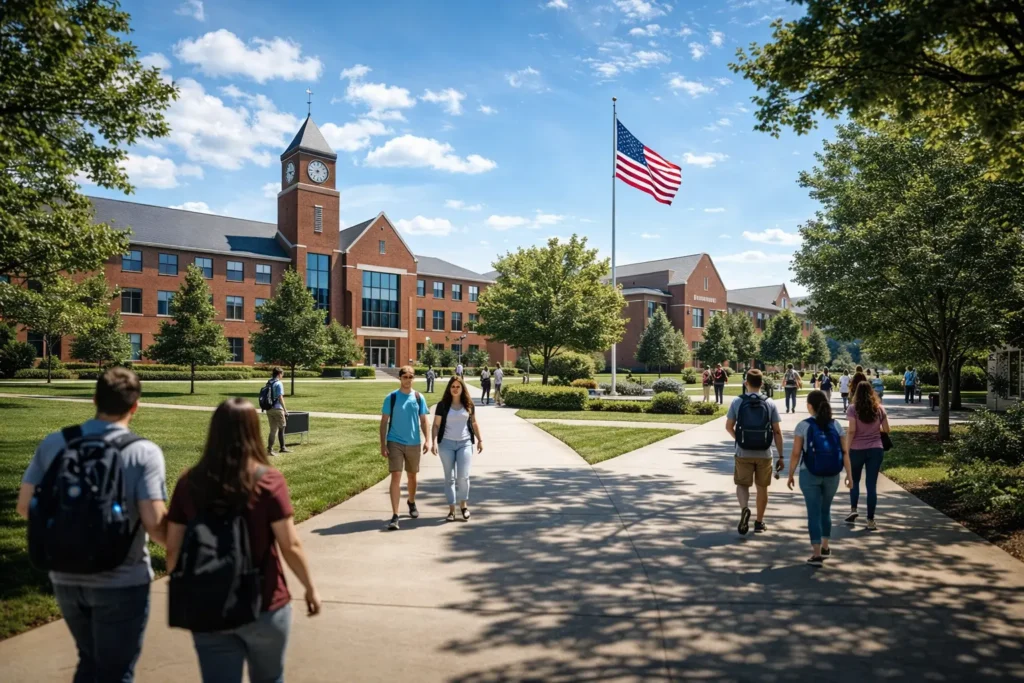
Pennsylvania College of Technology — known as Penn College or PCT — is one of Pennsylvania’s premier public applied technology colleges, located in Williamsport, PA. Founded in 1914 and a self-governing affiliate of Pennsylvania State University, Penn College has built a national reputation for turning hands-on learners into career-ready professionals. With more than 100 programs spanning engineering, nursing, business, and the skilled trades, it is the destination for students who want real skills for real careers.
This guide covers everything you need to know: academics and top majors, admissions requirements, tuition and financial aid, campus life, veteran resources, and outcomes data — all in one place.
Why Choose Pennsylvania College of Technology? An Overview
A “Future Made By Hand”: The College’s Mission and Identity
Pennsylvania College of Technology was built on a simple but powerful idea: learning by doing. While traditional universities tilt heavily toward lectures and theory, Penn College flips that ratio. Students spend three hours in labs and hands-on environments for every one hour in a traditional classroom — a 3:1 lab-to-lecture ratio that is at the heart of everything the college does.
This philosophy, captured in the college’s motto “Future Made By Hand,” reflects its belief that applied education produces the most capable graduates. Students graduate having already used industry-grade equipment, practiced real procedures, and solved genuine problems. That preparation is why Penn College’s graduate placement rate stands at 98%.
Penn College is not a community college, and it is not a research university — it is something distinct: a college of applied technology, purpose-built to produce graduates employers want to hire on day one.
Key Facts and Figures at a Glance
| Fact | Detail |
| Founded | 1914 |
| Type | Public, 4-year |
| Affiliation | Self-governing affiliate of Penn State |
| Location | One College Avenue, Williamsport, PA |
| Campus Size | 516 acres (city setting) |
| Undergraduate Enrollment | ~4,526 students |
| Student-Faculty Ratio | 12:1 |
| Athletic Nickname | Wildcats |
| Colors | Blue and Gray |
| Acceptance Rate | 76% |
| Graduation Rate | 42% (4-year) |
| Graduate Placement Rate | 98% |
| Median Graduate Salary | $47,995 (6 years post-graduation) |
Academics and Programs: Building Practical Skills
Exploring Academic Schools
Penn College organizes its 100+ programs across three main academic schools, each designed to deliver deep, applied expertise in its field.
The School of Engineering Technologies is Penn College’s flagship division. Programs here include welding engineering technology, electromechanical engineering technology, construction management, automotive technology, and aviation. Students work in some of the most advanced labs in the region, including the Lumley Aviation Center near Williamsport Regional Airport and the Advanced Automotive Technology Center.
The School of Nursing and Health Sciences is home to some of the college’s most competitive programs, including Registered Nursing, Dental Hygiene, Radiography, Physician Assistant Studies, and Emergency Medical Services. Clinical training is embedded throughout every program, ensuring students graduate with hundreds of hours of real patient-care experience.
The School of Business, Arts and Sciences rounds out the curriculum with programs in business administration, accounting, communication, and the general education disciplines that underpin every Penn College degree. It also houses the Le Jeune Chef Restaurant — a live-fire culinary training facility open to the public and run entirely by students enrolled in culinary arts programs.
Top Majors and Career Outcomes
Penn College is best known for a handful of programs that attract students from across the Mid-Atlantic and beyond. Here is a look at the most popular majors and their associated career paths.
| Major | Degree Level | Key Career Paths | Avg. Starting Salary* |
| Registered Nursing (RN) | Bachelor’s / Associate | Hospital RN, Critical Care, Surgical Nursing | $60,000+ |
| Welding Engineering Technology | Bachelor’s | Welding Engineer, Quality Inspector, R&D | $55,000–$70,000 |
| Dental Hygiene | Bachelor’s | Dental Hygienist, Practice Manager | $55,000–$65,000 |
| Business Administration | Bachelor’s / Associate | Management, Marketing, Finance | $45,000–$55,000 |
| Electromechanical Engineering Tech. | Bachelor’s | Industrial Maintenance, Automation | $55,000–$65,000 |
| Physician Assistant Studies | Master’s | PA in Primary or Specialty Care | $100,000+ |
*Salary estimates are based on national Bureau of Labor Statistics data and Penn College graduate outcomes. Individual results will vary by location, employer, and experience.
Degree Levels Offered
Penn College offers four distinct credential levels, giving students flexibility depending on their goals and timeline. Certificate programs typically take one year or less and are ideal for workers seeking to upgrade specific skills quickly. Associate degrees take about two years and provide a solid foundation for either immediate employment or transferring to a bachelor’s program. Bachelor’s degrees are the most common credential at Penn College and the gateway to most professional and engineering careers. The college also offers a master’s degree in Physician Assistant Studies for students pursuing advanced clinical practice.
Hands-On Learning: Labs and Facilities
Penn College operates more than 150 specialized labs across its campus and satellite locations. These are not demonstration rooms — students actively work on real equipment in environments that mirror actual workplaces. Nursing students practice in simulation labs stocked with high-fidelity patient mannequins. Aviation students gain flight and maintenance experience at the Lumley Aviation Center. Engineering students use the same CNC machines, welding stations, and diagnostic tools found in industry.
Satellite facilities extend the campus footprint significantly. The Lumley Aviation Center is located near Williamsport Regional Airport and supports aviation technology and flight training. The Earth Science Center provides field-based learning for environmental and geoscience programs. The Advanced Automotive Technology Center is equipped with modern vehicles and diagnostic systems for automotive students.
Admissions: Your Path to Penn College
Step-by-Step Application Guide
Penn College has a straightforward admissions process with a 76% acceptance rate — meaning the college is accessible to a wide range of students, though selectivity varies by program (Nursing and Physician Assistant Studies are more competitive). Here is how to apply.
Step 1: Complete the Common Application. Penn College uses the Common App, which you can access at commonapp.org. Create a free account and search for “Pennsylvania College of Technology.”
Step 2: Gather your supporting documents. You will need your official high school transcript (the average admitted student carries a 3.1 GPA), a completed application form, and any program-specific prerequisites. Note that Penn College is test-blind — SAT and ACT scores are not required and will not be used in the admissions decision.
Step 3: Submit by the deadline. The general application deadline is July 1 for fall enrollment. However, competitive programs like Nursing have earlier, limited-enrollment deadlines, so check your specific program’s requirements on pct.edu well in advance.
Step 4: Apply for financial aid. Submit your FAFSA as early as possible (the federal FAFSA opening is October 1 each year). Early submission significantly improves your chances of receiving need-based aid and institutional scholarships.
Step 5: Await your decision and confirm enrollment. Once accepted, you will need to submit an enrollment deposit to secure your spot. Veterans can have this deposit waived — see the Veterans section below for details.
Admissions Tips: What to Focus On
Because Penn College is test-blind, your high school GPA and transcript are the most important parts of your application. Students admitted typically have a 3.1 GPA, but the range varies by program. Competitive programs like Nursing often require higher GPAs and may have additional prerequisites such as biology or chemistry coursework.
Penn College values students who are genuinely interested in applied, career-focused education. If you have work experience, vocational training, or dual-enrollment credits, highlight these in your application. Transfer students from community colleges or other institutions are welcome and can often apply credits toward Penn College degrees.
Understanding the Cost: Tuition, Fees, and Financial Aid
2025-2026 Tuition and Fee Breakdown
| Cost Category | Amount (2025–2026) |
| In-State Tuition | $18,690 |
| Out-of-State Tuition | $26,640 |
| Room and Board (on-campus) | $12,872 |
| Total In-State (with housing) | ~$31,562 |
| Total Out-of-State (with housing) | ~$39,512 |
| Average Net Price (after aid) | $24,769 |
These figures represent the published “sticker price.” Most students pay significantly less after grants, scholarships, and financial aid are applied. The average net price — what a student actually pays after all aid — is approximately $24,769 per year.
Maximizing Financial Aid and Scholarships
About 65% of Penn College students receive some form of financial aid. The process begins with the FAFSA (Free Application for Federal Student Aid), which determines your eligibility for federal grants (including Pell Grants), federal loans, and work-study programs. Penn College also offers its own institutional scholarships based on need and merit.
To maximize your aid, submit the FAFSA as close to October 1 as possible — the date the application opens for the upcoming academic year. Many institutional grants are awarded on a first-come, first-served basis, and early filers consistently receive more aid than late filers.
Pennsylvania residents may also be eligible for PHEAA (Pennsylvania Higher Education Assistance Agency) grants, which can provide thousands of dollars in additional need-based assistance. Check pheaa.org for eligibility requirements and deadlines.
A Smart Investment: Graduate Salaries and ROI
Cost needs to be evaluated in context of outcomes. Penn College graduates earn a median salary of $47,995 six years after graduation, with many in-demand fields like Nursing, Physician Assistant Studies, and Engineering Technology commanding significantly higher salaries. The college’s 98% placement rate means virtually every graduate who wants a job in their field finds one.
For comparison, the average student loan debt for Penn College graduates is manageable relative to peers at private institutions, and the high placement rate means graduates enter the workforce — and start repaying loans — quickly. For students pursuing high-demand technical and healthcare careers, Penn College offers one of the strongest returns on investment in the Northeast.
Life at Penn College: Campus, Housing, and Community
A Tour of the Williamsport Campus and Beyond
Penn College’s main campus sits on 516 acres in Williamsport, Pennsylvania — a mid-sized city of about 28,000 people located in the scenic Susquehanna River valley, roughly 90 miles north of Harrisburg. The city offers a genuine mix of urban amenities and outdoor recreation: the Susquehanna Trail, state parks, and seasonal activities are all within reach.
The main campus along One College Avenue is home to the vast majority of academic buildings, student housing, dining, recreational facilities, and administrative offices. Campus life is anchored here, with easy walking distances between classes, residence halls, and student services.
Beyond the main campus, Penn College operates several specialized satellite facilities. The Lumley Aviation Center, located adjacent to Williamsport Regional Airport, supports aviation technology and flight training programs. The Earth Science Center provides an off-campus field learning environment for environmental programs. The Advanced Automotive Technology Center gives automotive students access to state-of-the-art diagnostic and service equipment.
Your Home Away From Home: Housing Options
Penn College offers several distinct housing options to match different preferences and lifestyles.
Rose Street Commons is the primary residence hall for first-year students. It is a traditional dormitory environment designed to help new students connect with classmates, adjust to college life, and take advantage of on-campus programming and support services.
Campus View Apartments offer more independent living with suite-style or apartment layouts, typically preferred by upper-division students who want more privacy while staying connected to campus.
The Village is a residential complex that offers apartment-style living with a community feel, popular among students who want a more home-like environment without moving off campus entirely.
Accessible housing options are available across residential facilities for students with disabilities. Students should contact the Housing Office directly to discuss specific accommodation needs.
Off-campus housing in Williamsport is also plentiful and generally affordable. Many upper-class students choose to live in the neighborhoods surrounding campus.
Student Life: Clubs, Sports, and Activities
Penn College offers more than 60 student organizations, spanning academic clubs, professional societies, community service groups, and hobby organizations. Whether you are interested in robotics, healthcare career preparation, entrepreneurship, or intramural sports, there is likely a community already formed around your interest.
Greek life at Penn College includes fraternities and sororities such as Sigma Pi and Phi Mu Delta, offering brotherhood and sisterhood communities, leadership development, and philanthropic engagement.
Athletics are a significant part of campus life. Penn College’s Wildcats compete in the United East Conference and the United States Collegiate Athletic Association (USCAA), which is separate from the larger NCAA Division III framework. Varsity sports include archery, baseball, basketball, cross country, golf, soccer, softball, tennis, track and field, volleyball, and wrestling.
Dining on campus is anchored by the main dining hall and the standout Le Jeune Chef Restaurant — a student-run fine dining establishment that serves the public and gives culinary arts students real-world restaurant experience. It is genuinely worth a visit, both for the food and the remarkable skill of the students running it.
Campus Safety and Security
Penn College maintains its own Penn College Police Department, a fully commissioned law enforcement agency that patrols the campus around the clock. Annual crime statistics are published in compliance with the Clery Act and are available on the college’s website. The department also offers safety escorts, emergency blue-light phones throughout campus, and regular community safety programming.
Penn College for Veterans and Military Students
Why Penn College Is Ranked #1 for Veterans
Penn College has earned the top ranking among regional colleges in the North for veteran-friendliness, and the recognition is backed by a genuinely robust support infrastructure — not just marketing.
Veterans and active-duty service members at Penn College benefit from a dedicated Veterans Resource Center staffed by advisors who understand the unique challenges of transitioning from military to college life. The center provides peer support, benefits navigation, academic advising, and connections to campus and community resources.
On the financial side, Penn College extends in-state tuition rates to all out-of-state veterans — a significant cost reduction for students from outside Pennsylvania. The college also accepts military tuition assistance (TA) for active-duty service members and is fully Yellow Ribbon Program eligible under the GI Bill. Additionally, Penn College waives the enrollment deposit for veterans, reducing upfront costs.
The college has earned the Military Friendly School designation, which reflects institutional commitments to veteran recruitment, retention support, and outcomes tracking. For veterans pursuing hands-on technical or healthcare careers, Penn College’s combination of strong programs, affordable tuition, and dedicated veteran support makes it one of the most compelling options in the country.
Penn College Rankings and Reputation
Penn College consistently earns recognition from U.S. News & World Report in its annual Best Colleges rankings. Key rankings include #4 among Regional Colleges in the North and #1 for Best Colleges for Veterans in the Regional Colleges North category. It also appears on the Most Innovative Schools list, reflecting its commitment to applied learning and industry partnerships.
These rankings matter, but context is important. Penn College is a specialized institution — its peer group is regional applied-technology colleges, not flagship research universities. Within its category, it is a top performer. For students who want hands-on training, strong job placement, and an affordable public school education, Penn College’s rankings translate to real-world advantages: strong employer recognition, a wide alumni network in the trades and healthcare, and a credential respected in the industries it serves.
faqs
What is the acceptance rate at Pennsylvania College of Technology?
Penn College’s overall acceptance rate is 76%, making it accessible to the majority of applicants. However, high-demand programs such as Nursing and Physician Assistant Studies have more competitive admission standards, so acceptance into specific programs may be more selective.
What GPA do you need to get into Penn College?
The average admitted student has a high school GPA of approximately 3.1 on a 4.0 scale. Competitive programs may require higher GPAs and specific prerequisite coursework, particularly in science and math.
Does Penn College require SAT or ACT scores?
No. Penn College has a test-blind admissions policy, which means SAT and ACT scores are not required and will not be considered in the admissions process. Your high school transcript and GPA are the primary academic factors reviewed.
How much is tuition at Pennsylvania College of Technology?
For the 2025-2026 academic year, in-state tuition is $18,690 and out-of-state tuition is $26,640. Adding room and board brings the in-state total to approximately $31,562 per year before financial aid. The average net price after all aid is approximately $24,769.
Is Penn College part of Penn State?
Penn College is a self-governing affiliate of Pennsylvania State University — it is not a Penn State campus. This means it operates independently with its own admissions, tuition, faculty, and policies, while maintaining an academic relationship with Penn State that benefits students through shared resources and credentialing pathways.
What majors is Penn College known for?
Penn College is best known for programs in Registered Nursing, Welding Engineering Technology, Dental Hygiene, Business Administration, Electromechanical Engineering Technology, and Physician Assistant Studies. It also has nationally recognized programs in aviation technology, culinary arts, and construction management.
What is the graduation rate at Penn College?
Penn College’s four-year graduation rate is 42%. This figure is lower than many traditional universities, in part because a significant portion of students pursue associate degrees (two-year programs) and certificate programs (under one year), which complete outside of the four-year window used for this metric.
Does Penn College have dorms?
Yes. Penn College offers multiple on-campus housing options including Rose Street Commons (designed for first-year students), Campus View Apartments, and The Village. Each offers a different housing experience, ranging from traditional dormitory to apartment-style living.
What division is Penn College athletics?
Penn College’s Wildcats compete primarily through the United States Collegiate Athletic Association (USCAA) and are members of the United East Conference. The college offers varsity sports including archery, baseball, basketball, soccer, wrestling, volleyball, and more.
What is the average starting salary for a Penn College graduate?
The median salary for Penn College graduates is approximately $47,995 six years after graduation. Salaries vary significantly by program — graduates in Nursing, Physician Assistant Studies, and Engineering Technology typically earn above this median, while some business and liberal arts graduates may start lower.
What is the student-faculty ratio at Penn College?
Penn College maintains a 12:1 student-to-faculty ratio, which enables relatively small class sizes and direct access to instructors — an important feature in an applied learning environment where individual feedback and mentorship are central to the educational model.
Conclusion: Is Penn College Right for You?
Pennsylvania College of Technology is built for a specific kind of student: someone who learns by doing, wants a clear career path, and is ready to put in the hands-on work that leads to real expertise. It is not a traditional liberal arts college, and it is not trying to be. PCT excels at what it sets out to do — training skilled, job-ready graduates in healthcare, engineering, technology, and business.
If you are drawn to applied, career-focused education; if you want a school that takes veterans seriously; if you want strong graduate placement without a private-school price tag — Penn College is worth serious consideration. The 98% placement rate and strong employer relationships in the industries it serves are not accidents. They are the product of decades of institutional focus on outcomes.
The best next step is to visit campus and explore programs directly at pct.edu, where you will find the most current program information, application deadlines, and financial aid resources. Prospective students are strongly encouraged to schedule a campus tour to see the labs, meet faculty, and get a feel for what life at Penn College looks like in person.

Adrian Cole is a technology researcher and AI content specialist with more than seven years of experience studying automation, machine learning models, and digital innovation. He has worked with multiple tech startups as a consultant, helping them adopt smarter tools and build data-driven systems. Adrian writes simple, clear, and practical explanations of complex tech topics so readers can easily understand the future of AI.