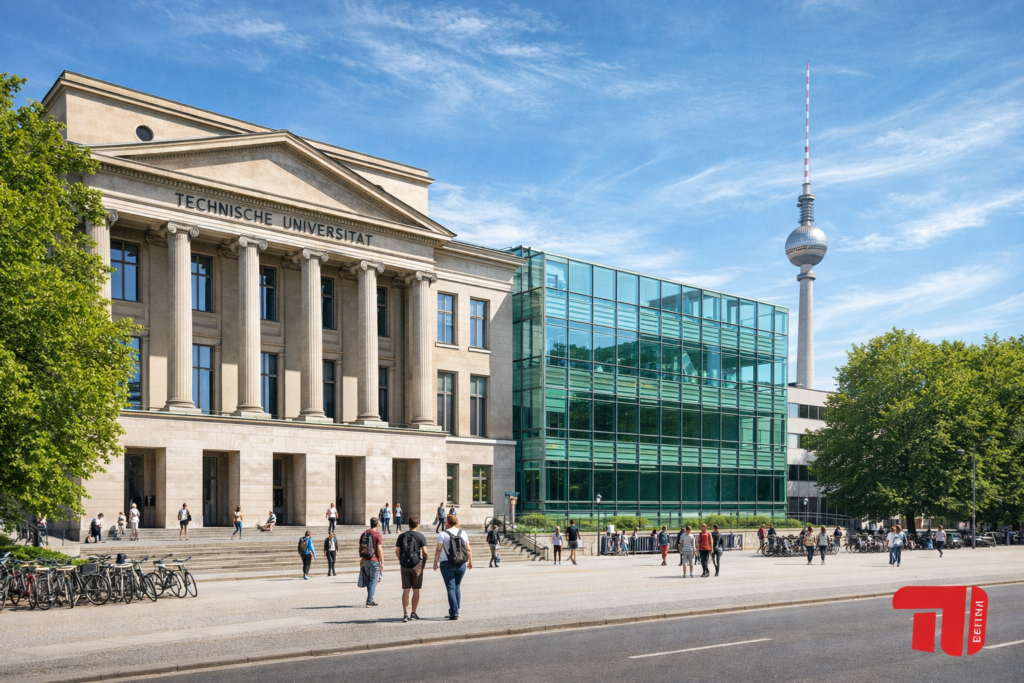
Technische Universität Berlin, commonly known as TU Berlin or the Berlin University of Technology, stands as one of Germany’s most prestigious public research universities and a flagship institution for technical education. Designated as a University of Excellence through Germany’s Excellence Initiative, TU Berlin has built its reputation on a foundation of groundbreaking research, innovative teaching, and a commitment embodied in its motto: “We’ve got the brains for the future.”
Located in the heart of Berlin, TU Berlin serves over 35,000 students from around the world, with international students comprising approximately 28% of the student body. This guide provides comprehensive information about the university’s academic programs, research strengths, admission requirements, costs, and student life to help you make an informed decision about studying at one of Germany’s leading technical universities.
Why Technische Universität Berlin? Prestige, History, and Excellence
A Legacy of Innovation Since 1879
Founded in 1879 as the first institution in Germany to bear the title “Technische Universität,” TU Berlin has roots extending back to 1770 through its predecessor institutions, the Bauakademie and Bergakademie. The university holds the distinction of being the first German institution to award doctoral degrees in engineering, establishing a precedent for technical education that continues today.
After World War II, the university reopened in 1946 in West Berlin and has since evolved into a comprehensive technical university known for bridging fundamental research with practical applications. This rich history has produced remarkable achievements, including the work of Konrad Zuse, who developed the world’s first programmable computer at TU Berlin.
Excellence and Elite Affiliations
TU Berlin’s academic standing is reinforced by its membership in several prestigious networks:
TU9: As a founding member of TU9, TU Berlin belongs to an alliance of Germany’s nine leading technical universities, representing the highest standards in engineering education and research.
Berlin University Alliance: TU Berlin collaborates with Freie Universität Berlin, Humboldt-Universität zu Berlin, and Charité – Universitätsmedizin Berlin in this strategic partnership, which was recognized as a University of Excellence cluster by the German government.
European and International Networks: The university maintains active memberships in the European University Association (EUA), TIME network, CESAER, SEFI, and PEGASUS, facilitating international research collaboration and student exchange.
EIT Knowledge and Innovation Communities: TU Berlin participates in several European Institute of Innovation and Technology initiatives, emphasizing its role as “The Entrepreneurial University” (Die Gründerhochschule).
Notable Alumni and Nobel Laureates
The university’s reputation is further enhanced by its association with multiple Nobel Prize winners, including Fritz Haber (Chemistry, 1918), Carl Bosch (Chemistry, 1931), and Gustav Hertz (Physics, 1925). The institution continues this tradition of excellence under the leadership of President Fatma Deniz, who assumed office in 2026.
Academic Profile: Faculties, Research, and Famous Programs
University Structure and Faculties
TU Berlin organizes its academic programs across seven faculties, each focusing on specific areas of technical and scientific education:
Faculty I: Humanities – Philosophy, History of Science and Technology, Educational Science
Faculty II: Mathematics and Natural Sciences – Mathematics, Physics, Chemistry
Faculty III: Process Sciences and Engineering – Chemical Engineering, Biotechnology, Food Technology, Environmental Technology
Faculty IV: Electrical Engineering and Computer Science – Electronics, Computer Engineering, Telecommunications
Faculty V: Mechanical Engineering and Transport Systems – Mechanical Engineering, Aeronautics and Astronautics, Transportation Systems
Faculty VI: Planning Building Environment – Architecture, Civil Engineering, Urban and Regional Planning, Landscape Architecture
Faculty VII: Economics and Management – Economics, Management, Industrial Engineering and Management
Pioneering Academic Programs
TU Berlin is particularly renowned for founding Industrial Engineering and Management as an academic discipline in Germany. This interdisciplinary field, combining engineering expertise with business acumen, has become one of the university’s signature programs and serves as a model for similar programs worldwide.
Other notable programs include Global Production Engineering, which prepares students for leadership roles in international manufacturing, and numerous Master’s programs taught entirely in English to accommodate the university’s increasingly international student body.
Leading Research Areas and Institutes
TU Berlin has established itself as a research powerhouse in several critical areas:
Energy Transition and Climate Research: The university operates dedicated institutes focusing on renewable energy systems, hydrogen production technologies, and sustainable energy solutions. These research efforts directly support Germany’s Energiewende (energy transition) and global climate protection initiatives.
Catalysis and Process Sciences: TU Berlin’s research in catalysis has led to breakthroughs in chemical processes that reduce environmental impact while improving efficiency, with applications in industrial chemistry and materials science.
Aerospace Engineering: The university maintains strong research programs in aeronautics and astronautics, often in collaboration with the German Aerospace Center (DLR) and industry partners.
Urban Planning and Environmental Technology: Given its Berlin location, TU Berlin conducts cutting-edge research on sustainable urban development, smart city technologies, and environmental engineering solutions.
Computer Science and Neuroscience: Interdisciplinary research combining information technology with cognitive sciences has positioned TU Berlin at the forefront of artificial intelligence and brain-computer interface development.
Materials Science and Biotechnology: The university’s process sciences faculty leads research in advanced materials, bioengineering, and biotechnological applications.
Practical Information: Admissions, Fees, and Deadlines
Application Process and Deadlines
Understanding TU Berlin’s application system is crucial for prospective students. The university operates on a semester system with two main intake periods:
Winter Semester (begins in October)
- Application deadline: July 15
- Primary intake period with most programs available
Summer Semester (begins in April)
- Application deadline: January 15
- Limited program availability
Important Distinction: TU Berlin programs fall into two categories:
- Zulassungsfreie Programs (Open Admission): If you meet the formal admission requirements (academic qualifications, language proficiency), you will be admitted. These programs have no capacity restrictions.
- Zulassungsbeschränkte Programs (Restricted Admission/NC): These programs have limited spaces and use a Numerus Clausus (NC) system based on grades and waiting time. Competition for these programs can be intense.
International Student Applications
International applicants (non-EU/EEA citizens) typically apply through uni-assist, a centralized service that evaluates international credentials. The process involves:
- Creating an account on uni-assist.de
- Uploading certified copies of academic transcripts and certificates
- Providing proof of German or English language proficiency
- Paying the processing fee (approximately €75 for the first application, €30 for each additional)
- Submitting by the deadline (applications are processed on a first-come, first-served basis)
Language Requirements:
- German-taught programs: TestDaF (level 4 in all sections) or DSH-2
- English-taught programs: TOEFL iBT (minimum 88-95) or IELTS (minimum 6.5)
Tuition Fees and Cost of Living in Berlin
One of TU Berlin’s most attractive features for international students is its affordability:
Tuition Fees: TU Berlin charges no tuition fees for most undergraduate (Bachelor) and consecutive Master’s programs, regardless of nationality. This policy applies to both EU and non-EU students, making it one of the most accessible world-class technical universities.
Semester Contribution: Students must pay a mandatory semester contribution (Semesterbeitrag) of approximately €315-€350 per semester. This fee includes:
- Semester ticket (unlimited public transportation in Berlin and surrounding areas)
- Student union services
- Sports facilities access
- Administrative costs
Monthly Living Costs in Berlin: While tuition is free, students should budget for living expenses:
- Accommodation: €350-€700 (shared apartment/student residence to private studio)
- Food and groceries: €200-€300
- Health insurance: €110-€120 (mandatory for all students)
- Internet and phone: €30-€50
- Personal expenses and entertainment: €100-€200
- Books and study materials: €30-€50
Total estimated monthly costs: €820-€1,420, depending on lifestyle and accommodation choices.
Scholarship Opportunities: International students can apply for funding through:
- DAAD (German Academic Exchange Service) scholarships
- Erasmus+ programs
- Deutschland Stipendium
- Faculty-specific scholarships
- External foundation scholarships
Student Life at TU Berlin: Campus, City, and Careers
Campus Location and Facilities
TU Berlin’s main campus is located in Charlottenburg-Wilmersdorf at Straße des 17. Juni 135, offering a central urban location with excellent connectivity. The iconic main building houses administrative offices, lecture halls, and the university library, located in the distinctive Volkswagen building.
The urban campus setting means students enjoy immediate access to Berlin’s cultural offerings, startup ecosystem, and vibrant neighborhoods while studying. Additional TU Berlin sites are distributed across the city, with specialized facilities for specific research areas.
International Presence: Beyond Berlin, TU Berlin operates the El Gouna campus in Egypt and collaborates with the Vietnamese-German University, demonstrating its global engagement.
The International Student Community
With approximately 28% of students coming from abroad, TU Berlin offers a truly international environment. The university provides comprehensive support for international students through:
- Welcome Week: Orientation programs helping new international students settle in Berlin
- Student Advisory Service (Studienberatung): Guidance on academic planning, program requirements, and university navigation
- Buddy Programs: Connecting international students with local mentors
- Language Courses: German language classes at various levels, often subsidized or free
- International Offices: Support with visa extensions, residence permits, and administrative matters
Student Organizations and Activities
Beyond academics, TU Berlin students can engage in:
- Hochschulsport: Comprehensive sports programs offering everything from fitness classes to competitive team sports
- Student Clubs and Initiatives: Over 100 student organizations covering interests from renewable energy to entrepreneurship
- Cultural Events: Regular lectures, film screenings, concerts, and exhibitions on campus
- Startup Incubators: TU Berlin actively supports student entrepreneurship through dedicated programs and spaces
Career Services and Industry Connections
TU Berlin’s location in one of Europe’s most dynamic tech and industrial hubs creates exceptional career opportunities:
Strong Industry Partnerships: The university maintains close relationships with major employers including:
- Siemens (electronics and engineering)
- BMW and Volkswagen (automotive)
- German Aerospace Center (DLR)
- Berlin’s thriving startup ecosystem
- Numerous consulting firms and tech companies
Career Support Services:
- Career fairs and company presentations held regularly on campus
- Internship placement assistance
- CV workshops and interview preparation
- Alumni network connections
- Research positions and student assistant jobs (HiWi positions)
Graduate Outcomes: TU Berlin graduates are highly sought after, with strong employment rates in engineering, technology, consulting, and research sectors. Many graduates find positions in Germany’s robust engineering industry or pursue doctoral studies at leading research institutions.
How TU Berlin Compares to Other German Universities
Choosing the right technical university in Germany can be challenging. Here’s how TU Berlin compares to other top institutions:
| Feature | TU Berlin | RWTH Aachen | TU Munich | HTW Berlin |
|---|---|---|---|---|
| Type | Research University | Research University | Research University | University of Applied Sciences |
| Focus | Broad technical/engineering with strong theory-practice balance | Traditional engineering with heavy industry focus | Broader range including natural sciences and medicine | Applied sciences, practical focus |
| Students | ~35,000 | ~47,000 | ~45,000 | ~14,000 |
| International % | ~28% | ~20% | ~30% | ~22% |
| Location | Berlin (capital, startup hub, cultural center) | Aachen (smaller city, near Belgium/Netherlands) | Munich (expensive, traditional, Alps proximity) | Berlin |
| Research Profile | Excellence Initiative winner, strong in energy, climate, IT | Engineering powerhouse, automotive, production | Top-ranked, comprehensive, medical school | Less research-intensive, industry-focused teaching |
| Best For | Students seeking urban experience, entrepreneurship, research-practice balance | Pure engineering focus, automotive industry connections | Prestige-focused, comprehensive programs, Bavaria lifestyle | Hands-on learning, faster entry to job market, smaller classes |
Key Distinction from HTW Berlin: While both are in Berlin, TU Berlin is a research university (Universität) offering theoretical depth and research opportunities, while HTW Berlin is a University of Applied Sciences (Fachhochschule/Hochschule) emphasizing practical skills and industry readiness. TU Berlin graduates typically pursue research, development, or specialized engineering roles, while HTW graduates often enter applied technical positions more quickly.
FAQs
Is Technische Universität Berlin the same as the Berlin University of Technology?
Yes, “Berlin University of Technology” is the official English translation of Technische Universität Berlin. However, the university officially prefers to use its German name “TU Berlin” even in international contexts, as this is how it’s known globally.
Does TU Berlin offer programs in English?
Yes, TU Berlin offers numerous programs in English, particularly at the Master’s and PhD levels. English-taught Master’s programs are available in engineering disciplines (mechanical, electrical, computer science), renewable energy systems, management, and several interdisciplinary fields. Bachelor’s programs are primarily taught in German, though some courses may be available in English. Check the university’s official program catalog for specific language requirements.
Is TU Berlin tuition-free?
For most undergraduate (Bachelor) and consecutive Master’s programs, TU Berlin charges no tuition fees for both EU and non-EU international students. Students only pay a semester contribution of approximately €315-€350, which includes unlimited public transportation in Berlin. Some specialized Master’s programs and continuing education courses may charge tuition, so verify the specific program details.
What is TU Berlin best known for?
TU Berlin is internationally renowned for engineering education and research, particularly in mechanical engineering, electrical engineering, computer science, and industrial engineering (which was founded here as an academic discipline). The university is also recognized for cutting-edge research in climate science, energy technologies, sustainable urban development, catalysis, and aerospace engineering. Its designation as a University of Excellence and membership in the TU9 alliance confirm its status among Germany’s elite technical institutions.
How competitive is admission to TU Berlin?
Admission competitiveness varies significantly by program. Programs with open admission (zulassungsfrei) accept all qualified applicants who meet the formal requirements, including language proficiency and appropriate academic background. Programs with restricted admission (zulassungsbeschränkt/NC) can be highly competitive, with selection based primarily on grades. Popular programs like computer science and industrial engineering typically have higher competition. International applicants should also note that having credentials evaluated early through uni-assist improves chances, as some programs fill on a first-come, first-served basis.
What are the housing options for students at TU Berlin?
TU Berlin doesn’t guarantee university housing, but students have several options: student residences managed by Studierendenwerk Berlin (€250-€400/month, apply early as waitlists exist), shared apartments (WGs/Wohngemeinschaften, €350-€600/month, most common and social), private studios (€600-€900/month), and temporary housing through the university’s accommodation service while searching for permanent housing. Starting your housing search 2-3 months before arrival is strongly recommended.
Can I work while studying at TU Berlin?
Yes, international students from non-EU countries can work up to 120 full days or 240 half days per year without requiring additional work permit approval. EU students have no work restrictions. Many students find part-time jobs as student assistants (HiWi positions) at the university, work in Berlin’s service industry, or secure internships related to their studies. These opportunities help cover living costs while gaining valuable experience.
Is Berlin expensive for students?
Compared to other major European capitals and German cities like Munich, Berlin is relatively affordable for students. While costs have risen in recent years, students can live comfortably on €850-€1,200 per month, including rent, food, insurance, and entertainment. The semester ticket (included in the semester contribution) provides unlimited public transportation, significantly reducing mobility costs. Strategic choices in accommodation and lifestyle can keep expenses at the lower end of this range.
Making Your Decision: Is TU Berlin Right for You?
Technische Universität Berlin offers a unique combination of academic excellence, affordability, urban location, and international atmosphere that makes it an outstanding choice for technical education. The university is ideal for students who:
- Seek a research-intensive environment with strong practical applications
- Want to study in one of Europe’s most dynamic and affordable capital cities
- Value international diversity and wish to build a global network
- Are interested in entrepreneurship and innovation ecosystems
- Aim to work in Germany’s robust engineering and technology sectors
With no tuition fees, world-class facilities, renowned faculty, and Berlin’s unmatched quality of life, TU Berlin provides exceptional value for ambitious students worldwide.
For more information and to begin your application, visit the official TU Berlin website or contact the student advisory service (studienberatung) for personalized guidance. The university also offers virtual campus tours and informational webinars for prospective international students.
Last updated: January 2026. Information subject to change. Always verify details through official TU Berlin channels before making final decisions.

Adrian Cole is a technology researcher and AI content specialist with more than seven years of experience studying automation, machine learning models, and digital innovation. He has worked with multiple tech startups as a consultant, helping them adopt smarter tools and build data-driven systems. Adrian writes simple, clear, and practical explanations of complex tech topics so readers can easily understand the future of AI.