
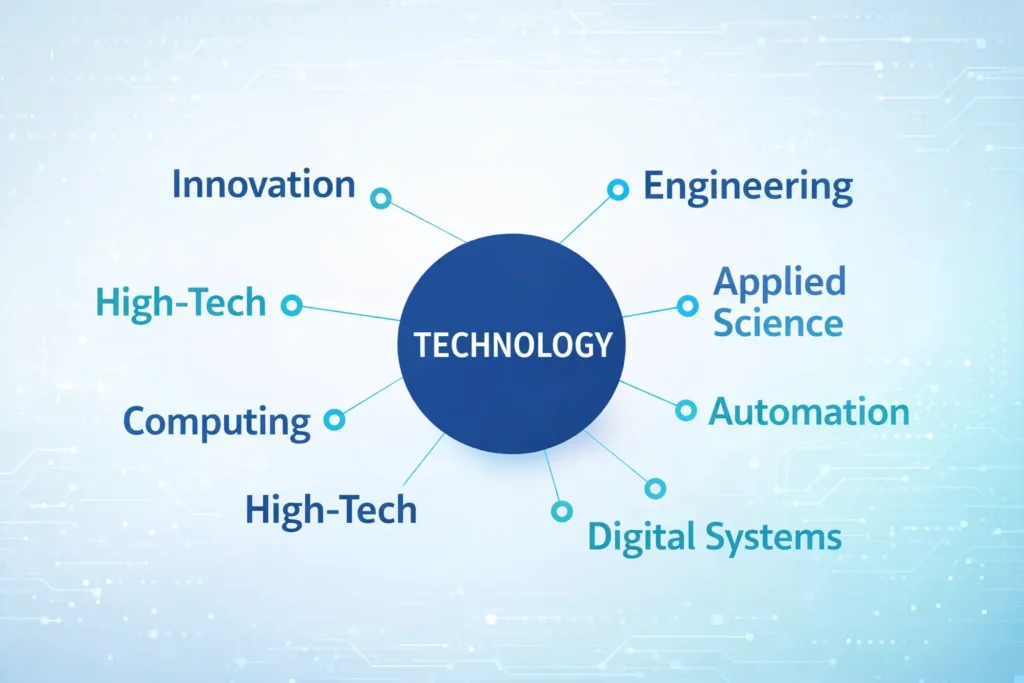
Finding the perfect word to describe technology can make the difference between vague communication and precise, impactful writing. Whether you’re crafting a business proposal, writing academic content, or creating marketing copy, understanding the nuances of technology synonyms helps you communicate with clarity and sophistication. This comprehensive guide provides not just a list of alternatives, but contextual guidance on when and how to use each term effectively.
Core Technology Synonyms: A Curated List
Here are the most common and widely accepted synonyms for “technology,” organized for easy reference:
Primary Synonyms:
- Applied science
- Engineering
- Innovation
- High tech / Hi-tech
- Automation
- Robotics
- Machinery
- Computing
- Electronics
- Telecommunications
- Cybernetics
Secondary Synonyms:
- Mechanics
- Technique
- Methodology
- System
- Apparatus
- Equipment
- Gear
- Hardware
- Infrastructure
- Tools
- Devices
- Invention
Broader Concepts:
- Science
- Knowledge
- Progress
- Advancement
- Modernity
- Digitization
- Information technology (IT)
- Tech (informal)
Understanding the Nuance: When to Use Which Synonym
Not all technology synonyms are interchangeable. The right choice depends on your specific context, audience, and the aspect of technology you’re emphasizing.
Applied Science & Engineering: The Foundation
Use applied science when you want to emphasize the systematic application of scientific knowledge to practical problems. This term works best in academic or formal contexts where you’re discussing the theoretical underpinnings of technological development.
Engineering specifically refers to the discipline and practice of designing and building complex systems. Choose this term when discussing the human expertise and methodical processes behind technological creation.
Example: “The bridge’s construction required advanced engineering principles” rather than simply “technology.”
Innovation & High-Tech: The Cutting Edge
Innovation emphasizes novelty, creativity, and advancement. Use this term when highlighting breakthrough developments, disruptive concepts, or when discussing technology’s role in driving change and progress.
High-tech (or hi-tech) specifically denotes modern, sophisticated, or state-of-the-art technology. This term is particularly effective when contrasting with older or simpler approaches, or when describing cutting-edge fields like artificial intelligence, quantum computing, or biotechnology.
Example: “The company’s innovation in renewable energy has transformed the sector” focuses on the breakthrough aspect, while “high-tech manufacturing facilities” emphasizes modern, advanced equipment.
Machinery, Apparatus & Equipment: The Physical Tools
These terms help you differentiate between various scales and types of physical technology:
Machinery typically refers to large-scale mechanical systems, often with moving parts, commonly used in industrial or manufacturing contexts.
Apparatus describes a specific setup or assembly of equipment designed for a particular purpose, frequently used in scientific or technical settings.
Equipment is the most general term for physical tools and devices, applicable across virtually any context from offices to laboratories to construction sites.
Example: “The laboratory apparatus requires careful calibration” sounds more precise than “laboratory technology,” while “manufacturing machinery” better conveys scale than “manufacturing equipment.”
Technology Synonyms by Category and Industry
Different sectors use specialized terminology. Here’s how to choose the most appropriate synonym based on your industry context:
Information Technology (IT) & Computing
In the digital realm, consider these sector-specific alternatives:
- Computing for processing and data-related technology
- Digital systems for integrated technological platforms
- Software and hardware for distinguishing between programs and physical devices
- Telecommunications for communication technology
- Cybernetics for systems involving feedback and control
- Networking for connectivity infrastructure
Example: “Our computing infrastructure supports millions of transactions daily” is more precise than “our technology infrastructure.”
Industrial & Manufacturing
For production and industrial contexts:
- Automation for self-operating systems and processes
- Robotics for programmable machines
- Machinery for mechanical equipment
- Production systems for integrated manufacturing processes
- Industrial equipment for factory tools and devices
Example: “The factory’s automation reduced production time by 40%” clearly indicates the technological advancement better than simply saying “technology.”
Modern & Emerging Fields (Biotech, Fintech, CleanTech)
Contemporary sectors have developed their own technology terminology:
- Biotech (biotechnology) for biological and medical applications
- Fintech (financial technology) for digital financial services
- CleanTech for environmental and sustainable technology
- Agri-tech for agricultural innovation
- EdTech for educational technology platforms
Example: “The fintech startup disrupted traditional banking” immediately signals the specific technology sector.
Related Words, Adjectives, and Concepts
Describing Technology: Key Adjectives
Enhance your writing by pairing “technology” or its synonyms with these descriptive terms:
For modernity: Advanced, cutting-edge, state-of-the-art, modern, contemporary, current, latest, next-generation
For sophistication: Sophisticated, complex, intricate, refined, developed, evolved
For innovation: Innovative, revolutionary, groundbreaking, disruptive, pioneering, novel
For digitization: Digital, electronic, computerized, automated, virtual, cyber
Example: Instead of “new technology,” try “cutting-edge innovation” or “state-of-the-art systems” for greater impact.
Broader Associated Concepts
Understanding related concepts helps you choose the most contextually appropriate term:
- Progress and advancement emphasize forward movement and improvement
- Modernity and futurism highlight contemporary relevance or forward-thinking approaches
- Knowledge and expertise focus on the intellectual foundation
- Infrastructure emphasizes underlying systems and frameworks
- Implementation and adoption describe technology in use
The Evolution of “Technology” Words
The language we use to describe technology has evolved dramatically alongside technological advancement itself. Understanding this evolution helps us appreciate the nuances of different terms.
In the early industrial era, terms like mechanics, craftsmanship, and mechanization dominated discussions of technology. These words emphasized physical labor-saving devices and machine-driven production.
The mid-20th century brought industrialization and automation, reflecting the rise of systematic manufacturing and self-regulating systems. The information age introduced computing and digitization, marking the shift from purely mechanical to electronic and digital systems.
Today’s technology vocabulary includes artificial intelligence, machine learning, blockchain, quantum computing, and the metaverse—terms that would have been incomprehensible just decades ago. This linguistic evolution mirrors technology’s transformation from simple tools to complex, interconnected digital ecosystems.
How to Choose the Right Technology Synonym: A Quick Guide
Follow this decision framework to select the most effective synonym:
Step 1: Consider your audience
- Academic or technical readers: Use precise terms like “applied science,” “engineering,” or “cybernetics”
- General business audience: Stick with accessible terms like “innovation,” “systems,” or “digital tools”
- Marketing copy: Choose engaging terms like “cutting-edge,” “high-tech,” or “state-of-the-art”
Step 2: Identify the specific field or context
- Are you discussing physical equipment? Use “machinery,” “apparatus,” or “hardware”
- Focusing on processes? Try “methodology,” “systems,” or “technique”
- Highlighting advancement? Choose “innovation,” “progress,” or “advancement”
Step 3: Determine the scale
- Small-scale: “devices,” “gadgets,” “tools,” “equipment”
- Medium-scale: “systems,” “apparatus,” “installations”
- Large-scale: “infrastructure,” “machinery,” “platforms”
Step 4: Check the connotation
- Neutral/formal: “applied science,” “engineering,” “methodology”
- Positive/promotional: “innovation,” “advancement,” “cutting-edge”
- Technical/specialized: “cybernetics,” “automation,” “telecommunications”
Example Sentences Using Technology Synonyms
See how different synonyms create distinct meanings and tones:
Applied Science: “The university’s applied science program focuses on translating research into practical solutions.”
Engineering: “Civil engineering has revolutionized urban infrastructure over the past century.”
Innovation: “The company invests heavily in innovation to maintain its competitive edge.”
High-tech: “High-tech manufacturing requires precisely controlled environments and advanced equipment.”
Automation: “Factory automation has increased productivity while reducing errors.”
Machinery: “The construction site deployed heavy machinery for excavation work.”
Computing: “Cloud computing enables businesses to scale their operations efficiently.”
Apparatus: “The medical apparatus requires careful handling and regular calibration.”
Digital systems: “Our digital systems integrate seamlessly with legacy infrastructure.”
Infrastructure: “Updating the telecommunications infrastructure is critical for economic growth.”
Technique: “The chef’s technique combines traditional methods with modern equipment.”
Devices: “Wearable devices have transformed how we monitor health metrics.”
Why Synonyms Matter: Beyond Repetition
Choosing the right technology synonym serves purposes beyond simply avoiding repetition:
Clarity and Precision: The word “apparatus” immediately suggests a specific scientific setup, while “innovation” emphasizes novelty. Precise language reduces ambiguity and strengthens your message.
Professional Credibility: Using industry-appropriate terminology demonstrates expertise. A fintech professional discussing “digital payment infrastructure” sounds more knowledgeable than one simply referencing “payment technology.”
Branding and Marketing: Technology company names and product descriptions benefit from evocative synonyms. Consider how “Innovation Labs” conveys a different brand identity than “Technology Labs,” or how “cutting-edge solutions” resonates differently than “technology solutions.”
SEO and Content Optimization: Search engines recognize semantic relationships between terms. Content that naturally incorporates related terminology like “computing,” “digital systems,” and “automation” alongside “technology” provides richer semantic signals, potentially improving search visibility.
Audience Engagement: Varied vocabulary maintains reader interest and accommodates different search intents. Some users search for “applied science,” others for “high-tech”—comprehensive synonym usage captures broader audiences.
FAQ
What is the closest synonym for technology?
The closest synonym depends on your context. For formal or academic writing, applied science is most appropriate as it emphasizes the systematic application of knowledge. For casual conversation or informal writing, tech works well. In business contexts, innovation or systems often serve as effective alternatives. The key is matching the synonym to your specific situation and audience.
What’s another word for high technology?
Several alternatives effectively convey the concept of advanced or sophisticated technology:
Cutting-edge technology
Advanced tech
State-of-the-art systems
Innovation
Next-generation technology
Sophisticated systems
Modern innovation
Choose based on whether you want to emphasize newness (cutting-edge), quality (state-of-the-art), or advancement (next-generation).
What is a word for the use of technology?
When describing how technology is employed, consider these action-oriented alternatives:
Implementation (putting technology into practice)
Application (applying technology to solve problems)
Adoption (beginning to use new technology)
Utilization (making practical use of technology)
Integration (incorporating technology into existing systems)
Deployment (distributing and installing technology)
Each term emphasizes a slightly different aspect of technology use.
What are synonyms for technology skills?
Professional competencies related to technology can be described as:
Technical skills
Digital literacy
IT competencies
Engineering expertise
Computing proficiency
Technological capabilities
Digital competencies
Technical knowledge
Tech savvy (informal)
Choose formal terms like “IT competencies” for resumes and professional documents, or accessible terms like “digital literacy” for general communication.
How is “engineering” different from “technology”?
While closely related, these terms have distinct meanings. Engineering refers to the discipline, profession, and systematic approach to designing and building complex systems. It’s the process and expertise. Technology is the output—the actual tools, systems, and applications that result from engineering work. Think of engineering as the how (the methodology and practice) and technology as the what (the tangible or intangible products). For example, software engineering is the discipline, while the resulting application is technology.
Conclusion
Mastering technology synonyms empowers you to communicate with precision, professionalism, and impact. Whether you’re writing for academic audiences who appreciate “applied science” and “cybernetics,” business readers who resonate with “innovation” and “digital systems,” or general audiences who connect with “high-tech” and “cutting-edge,” the right synonym elevates your message.
Remember that context determines the best choice: consider your audience, the specific technological aspect you’re highlighting, the scale and scope of what you’re describing, and the tone you want to achieve. By thoughtfully selecting from the rich vocabulary of technology-related terms, you’ll avoid repetitive writing while demonstrating expertise and engaging your readers more effectively.
As technology continues to evolve, so too will the language we use to describe it. Stay current with emerging terminology while maintaining clarity and precision in your communication.

Adrian Cole is a technology researcher and AI content specialist with more than seven years of experience studying automation, machine learning models, and digital innovation. He has worked with multiple tech startups as a consultant, helping them adopt smarter tools and build data-driven systems. Adrian writes simple, clear, and practical explanations of complex tech topics so readers can easily understand the future of AI.