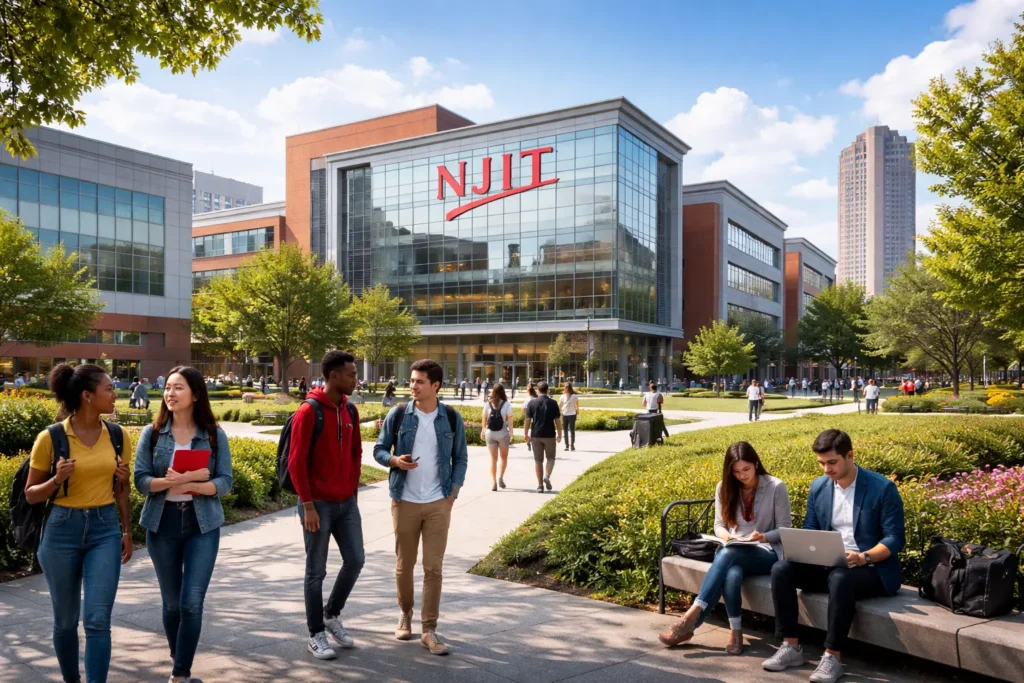
The New Jersey Institute of Technology — widely known as NJIT — is a top-ranked public research university located in Newark, New Jersey, in the heart of the vibrant University Heights district. Founded in 1881, NJIT has grown from a small technical school into one of the nation’s premier polytechnic universities, earning national recognition for its commitment to STEM education, innovation, and social mobility.
With more than 12,000 students across six academic colleges, NJIT offers bachelor’s, master’s, and doctoral programs in engineering, computer science, architecture, design, business, and science and liberal arts. The university’s strategic location — just minutes from New York City — gives students unparalleled access to internships, co-ops, cultural institutions, and career opportunities in one of the world’s most dynamic economic regions.
Whether you are a prospective undergraduate student, a working professional considering a master’s degree, or a researcher exploring cutting-edge labs, this comprehensive guide covers everything you need to know about NJIT: its rankings and reputation, academic programs, admissions requirements, cost and financial aid, campus life, and post-graduation outcomes.
| SECTION 1: Rankings & Reputation |
Why Choose NJIT? Rankings and Reputation
National and International Recognition
NJIT’s rise to national prominence is backed by hard data from the most respected university ranking organizations in the country. The Wall Street Journal named NJIT the #1 public university in the United States, citing its exceptional outcomes for graduates — particularly in career readiness, salary potential, and upward mobility. This is not a niche honor; it reflects a broad assessment of value, environment, and outcomes across the entire institution.
U.S. News & World Report places NJIT at #80 among all National Universities — a category that includes research-intensive schools across the country — and ranks it #34 in Top Performers on Social Mobility. This social mobility distinction is especially significant: it reflects NJIT’s ability to enroll students from lower-income backgrounds and propel them into high-earning careers, fulfilling the core promise of public higher education.
The Princeton Review consistently lists NJIT among the nation’s best value universities, currently ranking it #23 in Best Value Colleges. Forbes has recognized NJIT as #1 in upward mobility — a metric that evaluates how effectively a university elevates students from modest economic backgrounds. Washington Monthly has placed NJIT among the top universities in the nation, and Money magazine has awarded NJIT its coveted 5-star rating for college value.
| Ranking Source | Recognition |
| Wall Street Journal | #1 Public University in the United States |
| U.S. News & World Report | #80 National Universities; #34 Top Performers in Social Mobility |
| The Princeton Review | #23 Best Value Colleges |
| Forbes | #1 in Upward Mobility |
| Money Magazine | 5-Star Rating for College Value |
| Washington Monthly | Top National University for Public Service |
| PayScale | Top ROI for Engineering & CS Graduates |
| “NJIT is not just a great school — it is one of the best investments a student can make in their future.” — Multiple National Rankings, 2024–25 |
A Proven Return on Investment (ROI)
Beyond prestige, NJIT delivers measurable financial returns. The median salary for NJIT graduates is $69,591 — a figure that consistently outpaces the national average for college graduates. Even more remarkable is how students achieve this outcome: the average student debt at graduation is $32,459, which is significantly lower than many comparable research universities. When viewed through a return-on-investment lens, this combination of high earnings and manageable debt places NJIT among the top performers in the nation, as confirmed by PayScale’s College ROI rankings.
The ROI story becomes even more compelling when you factor in NJIT’s strong financial aid program. With an average net price of $17,955 per year and 69% of students receiving some form of financial aid, the actual cost for most families is far below the sticker price. For students from low-income households, grants and scholarships can make an NJIT education remarkably affordable — which is precisely why the university earns its social mobility distinctions year after year.
| Median Graduate Salary | $69,591 |
| Average Student Debt at Graduation | $32,459 |
| Average Net Price Per Year | $17,955 |
| Students Receiving Financial Aid | 69% |
| Top ROI Source | PayScale College ROI Rankings |
| SECTION 2: Academics & Programs |
Academics at NJIT: Programs, Colleges, and Schools
NJIT’s academic enterprise is organized into six distinct colleges and one honors program, each with its own identity, faculty, research culture, and career pathways. Together, they offer more than 125 undergraduate, graduate, and doctoral programs — giving students an extraordinary range of options within a focused, technology-forward environment. Here is a deep dive into each college and what sets it apart.
The Newark College of Engineering (NCE)
The Newark College of Engineering is NJIT’s flagship college and one of the oldest and most established engineering schools in the United States. NCE encompasses 11 distinct engineering departments, offering undergraduate degrees in disciplines ranging from mechanical and civil engineering to chemical, biomedical, electrical, and industrial engineering, among others.
NCE’s graduate programs are equally robust, featuring master’s degrees and doctoral programs in every engineering discipline. PhD candidates benefit from world-class research facilities and work alongside faculty who are leading researchers in their fields. The college is home to several federally funded research centers and has strong partnerships with major industrial partners in the New Jersey-New York metropolitan area.
One of the most distinctive features of NCE is its extensive co-op and internship ecosystem. NJIT has formal co-operative education partnerships with hundreds of top employers, allowing students to alternate between academic semesters and full-time professional work experiences. Engineering students who complete co-ops graduate with one to two years of professional experience — a significant competitive advantage in the job market.
NCE Undergraduate Programs Include:
- Mechanical Engineering
- Civil Engineering
- Electrical Engineering
- Chemical and Materials Engineering
- Biomedical Engineering
- Industrial and Systems Engineering
- Computer Engineering
- Environmental Engineering
- Aerospace Engineering
The College of Computing Sciences (CCS)
In today’s technology-driven economy, NJIT’s College of Computing Sciences stands as one of the most forward-thinking and in-demand academic units in the region. CCS prepares graduates for careers in software engineering, data science, cybersecurity, artificial intelligence, information technology, and bioinformatics — fields that consistently top lists of fastest-growing and highest-paying professions.
The Computer Science program at NJIT is one of the largest and most comprehensive in the state of New Jersey, attracting students from across the country and around the world. The curriculum blends theoretical foundations with hands-on project work, and students have access to specialized research labs focused on machine learning, network security, high-performance computing, and human-computer interaction.
CCS also offers a highly regarded Information Technology program, as well as graduate degrees and certificates in Data Science, Cybersecurity, and Computing. For working professionals, many CCS programs are available in online or hybrid formats, making it possible to earn a graduate credential without disrupting a career.
CCS Programs Include:
- Computer Science (BS, MS, PhD)
- Information Technology (BS, MS)
- Data Science (MS, Certificate)
- Cybersecurity (MS, Certificate)
- Bioinformatics (MS, PhD)
- Web and Information Systems (MS)
The College of Architecture and Design (CoAD)
The College of Architecture and Design is home to two distinct creative schools: the New Jersey School of Architecture and the School of Art + Design. Both schools sit at the intersection of creativity and technology — a fitting home within a polytechnic university environment.
The New Jersey School of Architecture is one of the most respected architecture programs in the Northeast. The five-year Bachelor of Architecture program (BARCH) is professionally accredited and prepares students for licensure and careers in architectural practice, urban planning, and sustainable design. The school’s design studios are state-of-the-art spaces where students work collaboratively under the mentorship of practicing architects and researchers. Graduate programs include the Master of Architecture and specialized tracks in urban systems and infrastructure design.
The School of Art + Design offers undergraduate degrees in Digital Design, Interior Architecture, Communication Design, and Fine Arts. With a strong emphasis on digital tools, fabrication technologies, and creative problem-solving, graduates of the School of Art + Design find careers in UX/UI design, branding, film, game design, and interior architecture. The school’s location in the New York metropolitan area provides invaluable connections to the design industry.
Other Distinguished Colleges at NJIT
Martin Tuchman School of Management
The Martin Tuchman School of Management (MTSM) prepares business leaders for the technology-driven economy of the 21st century. Unlike traditional business schools, MTSM uniquely integrates management education with NJIT’s core strengths in technology and innovation. Undergraduate programs include Management, Finance, and Marketing, while graduate offerings include an MBA with various specializations, as well as an MS in Finance and an MS in Management.
MTSM is AACSB-accredited — the gold standard in business education — and its programs emphasize entrepreneurship, data analytics, project management, and supply chain management. Many graduates enter roles in technology companies, consulting firms, and financial institutions throughout the tri-state area.
Jordan Hu College of Science and Liberal Arts (CSLA)
The Jordan Hu College of Science and Liberal Arts provides the foundational science, mathematics, and humanities education that underpins all of NJIT’s academic programs. CSLA houses bachelor’s programs in Applied Mathematics, Biology, Chemistry, Physics, and Professional and Technical Communication, as well as a robust slate of graduate programs.
CSLA faculty conduct research in fields ranging from applied mathematics and mathematical biology to environmental policy and science communication. The college also administers the core humanities and social science curriculum that ensures NJIT graduates are not only technically proficient but also effective communicators, critical thinkers, and globally aware citizens.
Albert Dorman Honors College
For NJIT’s most academically accomplished students, the Albert Dorman Honors College offers an enriched educational experience characterized by smaller classes, closer faculty mentoring, and exclusive research and scholarship opportunities. Honors students benefit from priority registration, dedicated advising, and access to the Dorman Honors Center — a hub for collaborative study, seminars, and social events.
The Honors College is not a separate degree program; rather, it is an overlay that enhances any major across all of NJIT’s colleges. Honors graduates receive special recognition on their diploma and transcript, and the network of Honors alumni is a valuable professional community.
Online and Graduate Programs
NJIT has invested heavily in online education infrastructure, offering more than 75 graduate programs in fully online or hybrid formats. This makes NJIT one of the most accessible research universities for working professionals seeking to advance their credentials. Online programs maintain the same rigorous standards as on-campus offerings, with instruction from the same world-class faculty.
| SECTION 3: Admissions |
NJIT Admissions: A Step-by-Step Guide
Applying to NJIT is a straightforward process, but understanding the requirements, deadlines, and financial aid options can make the difference between a smooth experience and a stressful one. Here is everything you need to know about getting admitted to New Jersey Institute of Technology.
Freshman Admissions Requirements
NJIT accepts applications from high school students and recent graduates through a holistic admissions process that considers academic achievement, course rigor, and personal qualities. The university has a test-optional policy, meaning students may choose whether or not to submit SAT or ACT scores — admissions officers will not penalize applicants who opt not to submit scores.
That said, students who do submit scores will find that the middle 50% range for admitted freshmen is 1240–1480 on the SAT and 29–35 on the ACT. The average high school GPA for admitted freshmen is 3.7 on a 4.0 scale, reflecting a strong preference for students who have challenged themselves with rigorous coursework in mathematics, science, and English throughout high school.
NJIT’s acceptance rate is 65%, making it a moderately selective institution — accessible to hardworking, motivated students without being the hypercompetitive gauntlet of a small number of elite schools. This is one of NJIT’s great strengths: it maintains high academic standards while remaining within reach for a broad population of qualified applicants.
| Acceptance Rate | 65% |
| Application Deadline (Freshman) | March 1 (Priority: December 15) |
| SAT Range (Middle 50%) | 1240–1480 |
| ACT Range (Middle 50%) | 29–35 |
| Average High School GPA | 3.7 (on a 4.0 scale) |
| Test-Optional Policy | Yes — SAT/ACT submission is optional |
| Application System | Common App and NJIT’s own application portal |
Understanding the Cost and Financial Aid
NJIT’s tuition is among the most competitive of any nationally ranked research university, and financial aid significantly reduces the cost for most students. Here is a clear breakdown of costs for the 2025–26 academic year:
| In-State Tuition & Fees | $21,162 per year |
| Out-of-State Tuition & Fees | $39,912 per year |
| Room & Board (On-Campus) | $17,580 per year |
| Estimated Total (In-State, On-Campus) | ~$38,742 per year |
| Estimated Total (Out-of-State, On-Campus) | ~$57,492 per year |
| Average Net Price (After Aid) | $17,955 per year |
| Students Receiving Financial Aid | 69% |
These figures tell an important story. While the out-of-state sticker price may appear high, NJIT’s average net price of $17,955 is remarkably low — significantly below even the in-state tuition rate. This is the result of NJIT’s generous institutional grant and scholarship programs, which are awarded based on both academic merit and financial need.
To access federal financial aid — including Pell Grants, subsidized loans, and work-study opportunities — students must complete the Free Application for Federal Student Aid (FAFSA) as early as possible. New Jersey residents may also be eligible for the New Jersey Tuition Aid Grant (TAG), which can provide thousands of dollars in additional aid.
NJIT also offers a variety of merit scholarships for entering freshmen, including full-tuition awards for the most academically distinguished applicants. Scholarship awards are typically included in the initial admissions offer, so students know their full financial picture early in the decision process.
| NJIT Tip: The average NJIT student pays just $17,955 per year after grants and scholarships — making a world-class STEM education more affordable than most people expect. |
Tips for Transfer and International Students
Transfer students are welcomed at NJIT and make up a significant portion of the undergraduate population. Transfer applicants are evaluated on their college GPA (a minimum 2.5 is required, with 3.0+ recommended for competitive programs), the courses completed, and the relevance of their prior study to their intended major at NJIT. Credits from regionally accredited institutions transfer according to NJIT’s course equivalency database, and advisors help students map their prior coursework to NJIT requirements.
International students are an important and valued part of the NJIT community, representing more than 85 countries. International undergraduate applicants must demonstrate English proficiency through TOEFL (minimum score: 79 iBT) or IELTS (minimum: 6.0), along with strong academic credentials. NJIT has a dedicated International Student Services office that assists with F-1 visa documentation, housing, cultural adjustment, and academic integration.
| SECTION 4: Campus Life |
Life on Campus: The NJIT Experience
Life at NJIT is defined by a unique combination of academic intensity, urban energy, and community connection. The campus sits at the center of University Heights, Newark’s dynamic educational hub, while also positioning students just 30 minutes from Midtown Manhattan by train. Understanding what daily life looks like at NJIT can help prospective students visualize themselves thriving in this environment.
A Vibrant Campus in University Heights, Newark
NJIT’s 48-acre campus is compact and walkable, creating an intimate community feel within a major urban environment. University Heights is a neighborhood shared by several major institutions, including Rutgers University-Newark, the New Jersey Medical School, and Essex County College, giving the area a rich academic energy and a strong sense of shared purpose.
Newark itself is a city undergoing remarkable transformation. In recent years, downtown Newark has seen significant investment in arts, dining, technology, and entrepreneurship. Students benefit from access to the Prudential Center (home of the New Jersey Devils), the Newark Museum of Art, the New Jersey Performing Arts Center (NJPAC), and a burgeoning restaurant and café scene — all within walking distance or a short ride.
For those who crave the energy of New York City, Penn Station Newark provides direct NJ Transit access to Manhattan in approximately 30 minutes, opening up the world’s largest job market, cultural institutions, and entertainment venues. This proximity to NYC is one of NJIT’s most underrated assets — it provides the social and cultural richness of a world-class city without the costs of living in it.
Housing and Residential Life
NJIT offers a range of on-campus housing options, accommodating approximately 2,500 students in a variety of living environments designed to support academic success and community building. Freshmen are not required to live on campus, but many choose to do so for the social connections and convenience that residential living provides.
On-campus residence options include traditional dormitory-style housing in Redwood Hall and Cypress Hall, suite-style living in Oak Hall and Laurel Hall, and apartment-style living in University Centre — a modern residential complex with private bedrooms, shared living areas, and full kitchens. Each residence hall has its own community programming, resident advisors, and study spaces.
Campus dining options include the Campus Center Food Court, offering a variety of cuisines throughout the day, as well as additional dining locations across campus. Meal plans are available in multiple configurations to suit different lifestyles and dietary needs, including options for vegetarian, vegan, halal, and kosher diets.
| Redwood Hall | Traditional double-occupancy rooms; co-ed by floor |
| Cypress Hall | Suite-style living; popular with upperclassmen |
| Oak Hall | Apartment-style with shared kitchenette areas |
| Laurel Hall | Suite-style; strong programming community |
| University Centre | Modern apartment complex; private bedrooms, full kitchens |
| Total On-Campus Capacity | Approximately 2,500 students |
Student Activities, Clubs, and the Wellness and Events Center (WEC)
With more than 150 student organizations, NJIT offers a rich extracurricular landscape for students with virtually any interest. From academic honor societies and professional development clubs to cultural organizations, media outlets, gaming groups, and outdoor adventure clubs, there is genuinely something for everyone. Student government plays an active role in campus life, and new organizations can be formed with administrative support.
The Wellness and Events Center (WEC) is the crown jewel of NJIT’s campus recreation facilities. This state-of-the-art complex includes an Olympic-sized swimming pool, a rock climbing wall, fitness studios, group exercise spaces, cardiovascular and strength training equipment, and multiple gymnasium courts. The WEC also hosts major campus events, performances, and speaker series — making it a true social and cultural hub.
The Campus Center serves as NJIT’s student union — the place where students gather between classes, attend club meetings, eat, relax, and engage with the broader campus community. It houses the student government offices, the bookstore, and a variety of food vendors, creating a constant energy at the heart of campus.
A Closer Look at NJIT’s Diverse Student Body
Diversity is not just a talking point at NJIT — it is a defining characteristic of the institution. NJIT has received formal designation as both a Hispanic-Serving Institution (HSI) and an Asian American Native American Pacific Islander-Serving Institution (AANAPISI). These designations reflect the significant percentages of Hispanic/Latino and Asian American students in NJIT’s enrollment and unlock additional federal funding for student support programs.
The student body at NJIT represents more than 85 countries, with international students comprising a significant portion of both the undergraduate and graduate populations. This global diversity enriches classroom discussions, fosters cross-cultural collaboration, and prepares all students for careers in multinational organizations.
| Total Student Population | Approximately 12,000+ students |
| Undergraduate Students | Approximately 8,400 |
| Graduate Students | Approximately 3,600 |
| Student-to-Faculty Ratio | 16:1 |
| Gender Distribution | 69% male, 31% female |
| International Student Presence | Students from 85+ countries |
| Designations | Hispanic-Serving Institution (HSI); AANAPISI |
NJIT Highlanders Athletics: NCAA Division I Pride
NJIT’s athletic teams — the Highlanders — compete at the NCAA Division I level, primarily in the America East Conference. The Highlanders field teams across a variety of sports, with particular strength in basketball and men’s volleyball. NJIT’s women’s basketball team has become one of the most competitive programs in the conference, consistently challenging for conference titles.
Men’s volleyball is another standout program at NJIT, with the team routinely ranked among the top programs in the Eastern Intercollegiate Volleyball Association. Additional Highlander sports include baseball, cross country, fencing, lacrosse, soccer, swimming, tennis, and track and field — providing opportunities for athletes at multiple levels to compete and represent their university.
For non-varsity athletes, NJIT’s intramural sports program and the Wellness and Events Center’s recreational athletics facilities provide ample opportunities to stay active and competitive. School spirit runs high during home games, and the Highlander community is known for being passionately supportive of its student-athletes. For schedules, rosters, and tickets, visit njithighlanders.com.
| SECTION 5: Research & Innovation |
Research and Innovation: NJIT at the Frontiers of Discovery
NJIT holds the Carnegie Classification of R1: Doctoral Universities — Highest Research Activity, placing it in the most elite tier of research universities in the United States. This designation reflects the scale, funding, and impact of research conducted at NJIT across dozens of disciplines.
Faculty at NJIT secure tens of millions of dollars in external research funding each year from sources including the National Science Foundation (NSF), the National Institutes of Health (NIH), the Department of Defense, the Department of Energy, and major private-sector partners. This funding supports research into topics as diverse as solar energy, advanced materials, cybersecurity, biomedical devices, urban infrastructure, and AI.
Among NJIT’s most distinctive research assets is the Big Bear Solar Observatory (BBSO) in California — one of the world’s premier solar observatories, operated by NJIT faculty and graduate students. The observatory produces landmark research on solar flares and sunspot activity, with implications for space weather forecasting and satellite communications. NJIT also operates telescope facilities at the Owens Valley Radio Observatory in partnership with other leading research institutions.
For undergraduate students, research opportunities abound through formal programs like the NJIT Summer Undergraduate Research Program (SURP), departmental research assistant positions, and senior capstone projects. Engaging in faculty-mentored research as an undergraduate is one of the most powerful career and academic development experiences NJIT offers — and the university actively encourages and supports student participation in the research enterprise.
| SECTION 6: History & Leadership |
History and Leadership: NJIT’s Story
NJIT traces its roots to 1881, when it was established as the Newark Technical School — one of the first institutions in New Jersey to offer technical education to working-class students. Over the following century, the school evolved through a series of name changes and expansions, becoming the Newark College of Engineering in 1930 and ultimately the New Jersey Institute of Technology in 1975.
Today, NJIT is led by President Teik C. Lim, an internationally recognized researcher and academic leader who has guided the university through a period of significant growth in rankings, research activity, and enrollment. Under his leadership and that of his senior administrative team, NJIT has strengthened its national profile, expanded online learning, deepened industry partnerships, and invested substantially in campus facilities.
The institution’s physical home — its Newark campus at University Heights — has also undergone considerable transformation in recent decades, with new academic buildings, residence halls, and the Wellness and Events Center all constructed to serve the needs of a growing, diverse student population.
| SECTION 7: Frequently Asked Questions |
faqs
The following questions represent the most common inquiries from prospective students and families researching New Jersey Institute of Technology.
Is NJIT a good school?
Yes, NJIT is a highly-ranked public research university with exceptional standing in national rankings. It has been named the #1 public university by the Wall Street Journal, ranked #80 among National Universities by U.S. News & World Report, and recognized by Forbes as #1 in upward mobility. Its strong return on investment and social mobility record make it one of the best values in American higher education.
What is NJIT known for?
NJIT is primarily known for its engineering, computer science, architecture, and technology programs. The Newark College of Engineering is one of the oldest and most respected in the nation, and the College of Computing Sciences prepares graduates for the most in-demand careers in the digital economy. NJIT is also known for its commitment to social mobility — giving students from all backgrounds a pathway to high-earning careers.
What is the acceptance rate at NJIT?
The acceptance rate at NJIT is 65%, making it a moderately selective institution. While NJIT maintains rigorous academic standards, it is more accessible than highly selective private universities, making it a strong option for hardworking students with solid academic records.
What GPA do you need to get into NJIT?
The average high school GPA for admitted freshmen is 3.7 on a 4.0 scale. However, NJIT uses a holistic admissions process that also considers course rigor, extracurricular activities, and personal qualities. Students with GPAs slightly below 3.7 who have taken challenging coursework may still be competitive candidates.
How much is tuition at NJIT?
For the 2025–26 academic year, in-state tuition and fees are $21,162, and out-of-state tuition and fees are $39,912. Room and board on campus is approximately $17,580. However, after grants and scholarships, the average net price paid by NJIT students is $17,955 per year — significantly lower than the sticker price, thanks to generous financial aid.
Does NJIT have dorms?
Yes, NJIT offers a variety of on-campus housing options, including Redwood Hall, Cypress Hall, Oak Hall, Laurel Hall, and the University Centre apartment complex. In total, approximately 2,500 students live on campus. Housing is available to all students but is not required.
What is the student-faculty ratio at NJIT?
The student-to-faculty ratio at NJIT is 16:1. This means students have meaningful access to faculty for office hours, research mentoring, and academic guidance, especially in upper-level courses and graduate programs where class sizes are often smaller.
What Division is NJIT in for athletics?
NJIT’s athletic teams, the Highlanders, compete at the NCAA Division I level, primarily as members of the America East Conference. The university fields teams in more than a dozen sports, with standout programs in basketball and men’s volleyball. Visit njithighlanders.com for schedules, news, and tickets.
Is NJIT a party school?
NJIT is not known as a party school. The university attracts students who are primarily focused on rigorous academic programs and career preparation. That said, student life is active and social, with 150+ clubs, intramural sports, cultural events, and easy access to the vibrant social scene of Newark and New York City.
What is the average class size at NJIT?
Class sizes vary by level and program. Introductory undergraduate courses may have 50–100+ students, while upper-division and graduate courses are significantly smaller — often 15–30 students. The 16:1 student-to-faculty ratio means students have frequent opportunities for direct interaction with their professors.
Does NJIT offer online programs?
Yes, NJIT offers more than 75 graduate programs in fully online or hybrid formats, making it one of the most accessible research universities for working professionals. Online programs are taught by the same faculty as on-campus programs and carry the same academic credentials.
Conclusion: Is NJIT Right for You?
New Jersey Institute of Technology is not a school for everyone — and that is precisely what makes it right for so many students. NJIT is built for people who want to solve real problems, build things that matter, and launch careers that combine intellectual rigor with practical impact. Whether your passion is designing sustainable buildings, developing the next generation of software, advancing biomedical research, or leading technology companies, NJIT provides the education, resources, and network to help you get there.
Its position as the #1 public university in the United States by the Wall Street Journal is not a coincidence — it reflects decades of intentional investment in academic excellence, student support, and outcome-focused education. Its designation as a Hispanic-Serving Institution and AANAPISI reflects a genuine commitment to opportunity and inclusion. And its location at the gateway between Newark and New York City means that opportunity is not just theoretical — it is walking distance away.
For prospective students weighing their options, NJIT represents one of the clearest value propositions in American higher education: a research-grade education at a public university price, with outcomes that rival institutions costing two to three times as much. The data speaks for itself: $69,591 median salary, $32,459 average debt, and an average net price of $17,955 per year for students who receive aid.
If you are ready to take the next step, visit njit.edu to explore programs, schedule a campus visit, and start your application. The application deadline for freshman applicants is March 1, with priority consideration given to those who apply by December 15. The future starts at University Heights.
| Explore programs, schedule a visit, and apply at njit.edu | Questions? Contact the NJIT Office of Admissions at admissions.njit.edu |
Sources & Additional Information
njit.edu | admissions.njit.edu | njithighlanders.com | usnews.com | wsj.com/rankings | forbes.com | princetonreview.com | money.com
Data reflects 2024–2025 academic year statistics. Verify current figures directly with NJIT’s official sources before making enrollment decisions.

Adrian Cole is a technology researcher and AI content specialist with more than seven years of experience studying automation, machine learning models, and digital innovation. He has worked with multiple tech startups as a consultant, helping them adopt smarter tools and build data-driven systems. Adrian writes simple, clear, and practical explanations of complex tech topics so readers can easily understand the future of AI.